Here you will see students as young as 4 and 5 years old doing algebra and "advanced" math, without ever knowing it's supposed to be hard.
You are invited to learn how to use this method...


Showing posts with label fun math activites. Show all posts

Tuesday, October 20, 2015

House For A Duck.


Playing math often means learning math without really knowing you are learning math....when you are four or five. In this case we learned a lot of math, addends specifically, without worksheets without pencil, pens or paper. We just built a house for a duck and as an added bonus got a few more repetitions for these addends added to the long term memory. It takes many repetitions starting at an early age to get math facts (or any facts) into "the long term memory" and available for instant recall, but as you will see it's easier when they are younger and here is WHY.

Where most of you err particularly with multiplication is you try to cram the number of repetitions into a short time frame usually well after the brain is out of the "download mode". This can be effective but it has been my experience that this can also cause a host of problems particularly when it comes to math anxiety and attitude toward math in general. Instead of a fun and exciting language that underlies ALL of science and explains the universe around them via the physics and chemistry and biology it becomes drudgery and something that requires a lot of mental effort to memorize a host of math facts that don't seem to go together.

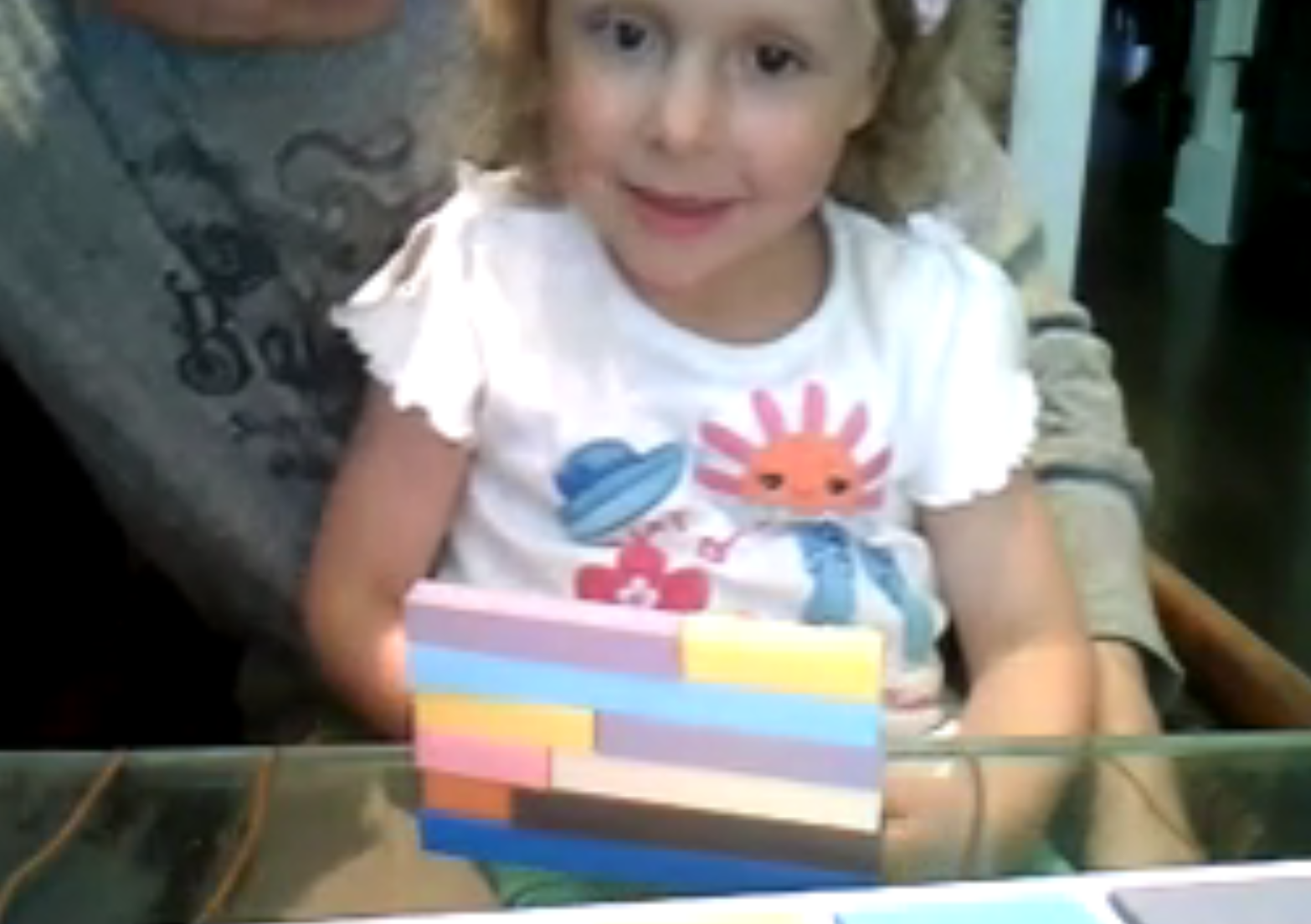
Using base Ten Blocks to Make A House For A Duck, You can also see a math bag in the background because we played what's under the cup too. We had fun while learning basic addends less than 10.


What you want to do is make positive associations with mathematics and avoid having to pound math facts into your children. This is what happens when you wait until they are past the age of 7 or 8 to teach them math. The very basics, 45 addends and 400 multiplication facts are learned easily before the age of 7; it is much harder after this age because the brain state has changed.

If you want to be an effective teacher you need to understand a little about how the brain works and how to put information in it. I will have more on this later but the basic is this:


When the child is naturally in "theta", they are basically in download mode. Learning anything is easier for ANYone while in theta, there is an entire industry dedicated to selling audio technology that puts the brain into these states for "super learning"...being happy and unstressed adds to this ability to learn easily. I cover this in Parent/Teacher training.

Removing "the NO" from the lesson is important because "NO" is a charged word that has all manner of negative associations attached to it even by the age of 5. Just hearing "no" is enough to make some children mad or sad or angry which activates the reptilian brain (cerebellum) which shuts down the prefrontal cortex which activates the fight or flight response where blood is pushed into the limbs NOT into the part of the brain that facilitates learning or higher order thinking.


By age six or seven "downloading" is no longer the default setting as it were and they begin spending more time in alpha and then by age 12 beta (and with training Gamma, a state not shown here and a state associated with "miracles" and the "paranormal" and other psychic abilities not easily explainable by modern science but which can be achieved with "practice.").  Logically the best time to teach a large amount of factual information is in the early years when it is easy down loaded or assimilated. The names of states and their capitols, Presidents, the ABC's and of course math facts like 7x8 and 17 squared are easily learned and stored in the subconscious for easy recall at earlier ages.  And if you make a game of it and make it fun, the learning is easier still.  Play math. Not worksheets.

At Crewton Ramone's House of Math as with Mortensen and Montessori, we emphasize whole brain activities...using both hands for example is VERY important, but can you also see that involving the other sensory cortexes would make learning easier? This is because we use more of the brain. This has been borne out by research at major universities.

This seems obvious to those of us that use manipulatives to teach math but quite a few others are only just now discovering that the more senses you involve the easier learning is.

WHEN you teach is also an important factor...as the child gets older more repetition is required to put information into the sub-conscious mind to be made available for instant recall.   In other words the older the child is the harder it will be to memorize multiplication tables...learn a new language or most any subject.  This does not; however, mean it can't be done. Obviously, it just means it will be harder,  take longer, and often involves a lot of tears and frustration.

Any student properly motivated and who is relaxed and happy can learn math at any age. I have proven this repeatedly for over 25 years with students of all ages including adults. But it is FAR easier if you get them young because by the time they are teens many factors are working against you, brainstate being primary among them but as you know, attitude and motivation may be lacking by the time they reach their teen age years, plus there is the added conditioning of past failures and the thought that math is hard instead of something easy and fun.

Here is theory in action. He sees the math facts. He hears the math facts. He experiences the math facts. He has fun. I should have put the camera on him when he told his parents he was done because you could see the satisfaction and pride in the smile on his face. Such a simple thing building a house for a duck, but terribly important for you to understand that through play we learn math, sans tears or fears and without "robbing them of their childhood", but instead making life far easier for him and others like him down the road.


Once (while) addends are mastered, multiplication which is just repetitive addition also becomes easy and we lessen the chance of losing them to multiplication tables and the stupidity that is the way we currently try to force feed students math at a late age.

Come join me on facebook. Share and like this post.


Tuesday, May 28, 2013

Crewton Ramone Using Base Ten Blocks In The Classroom.

Here is a second post about how easy it is to incorporate base ten blocks into your classroom situation. Here is the other post I did called Crewton Ramone In the Classroom.

base ten blocks in the classroom, fun math activities, 2nd grade math activities
This is also great for stoking their imaginations as they tell stories about the ruins of Egypt and Great MATH Pyramids.

I've gotten into contentious debates about whether little kids can do math like this. What is so hard about it? They use their ability to discover SAME on both sides to discover x and then they have to do some more thinking to discover what the number is that is disguised on either side. You start off easy and work your way up...in both of the cases I cover here some students got the answers instantly.


You can hear one little girl in the class throughout that vid. She has been given lots of labels, I wanted her to stay in the class even though she is disruptive because like all the other kids given the chance she proves to be pretty good at math and this is valuable at repairing her damaged self esteem. Anyhow, there is a myth that employing base ten blocks will cause mayhem in the classroom. This doesn't have to be the case as seen here:


I will be the first to admit that it CAN get loud and out of control if you let it. Here some of the class is gone because they have remedial reading, but groups of four per combo kit works well and there could easily have been all 24 of them. I never really got any of the lessons on Pythagorean theorem I did on vid but factoring, fractions and percents are all easy to do with manipulatives. Here is an additional page on how to teach addition. (Get it additional!! C'mon--that's funny right there.) You could spend quite a bit of time there if you follow all the links on that page.

At the same time you introduce those concepts you play and build addends learn about integers and subtraction and practice multiplication so they can see the whole picture not just tiny compartmentalized parts.

fun math activities, math manipulatives, base ten blocks.

This one shows them being creative, developing their fine motor skills and more. They not only built addends they had to work at getting the sevens fence to work using the posts...which are addends for 5...younger students would have a hard time making that fence work...these activities are great for preschool thru 3rd grade although older kids like to play too and some who never mastered their addends could also benefit.

Building and playing gives them a positive math experience.


They are in second grade. It shouldn't be work. It should be fun. These kids looked forward to Mondays with Crewton Ramone. They go home and tell their parents about what they did and the parents are amazed at their little second graders explaining factoring or Pythagorean theorem to them, I was at a birthday party and basically got mobbed by the parents there who were amazed that I was the math guy. They thanked me for teaching their kids math beyond adding and subtracting which is about the extent of the accepted 2nd grade curriculum... Adding subtracting a little measurement money and time telling.


This one can get out of hand because if they aren't careful the towers crash and there is a lot of excitement. Note that the point is to build addends NOT to build towers. I have seen teachers have them build using all the same blocks instead of the combinations...which defeats the purpose. Also you can count each level by the 4 or five blocks they used to get some skip counting in...in other words count the all the 7's on the 7 level...7, 14, 21, 28, 35...all the nines on the nines level etc just to get the patterns for the first few in.

addends, base ten blcoks, mortensen math, 2nd grade math activities,

For older kids (third or fourth graders) I make them build it and then tell me how many units they used...they have to do a lot of counting. That means count every block...including the hundreds...so lessee that's 100 plus 5 tens, plus another 100 plus 6 nines plus another hundred etc...some kids count all the hundreds then the pillars...no matter how they do t it's a great exercise in addition and multiplication.

Here is another fun exercise making a cube (it takes two top trays however) and I didn't make this vid in the classroom but at home with three home schoolers but there's nothing stopping you from doing in the classroom if you have the blocks. I did this with the first graders but never got it on vid. I made them line up and each kid built a combination and they went around and around their tables as fast as they could trying to build theirs faster than the other teams. A teacher could help keep the blocks straight and from falling down as it gets ten high. When you are done you can talk about cubes and notation if you want.


All in all it's EASY to use blocks in the classroom. You will find that just by playing they learn their addends and a lot more all on their own. Some direction from you can help but it's more fun and effective than worksheets and book work, the students learn more faster and you will earn a reputation as a good teacher and a fun teacher that students look forward to coming to rather than not.

Here is a page at the house of math that has a little more about using base ten blocks in the classroom and an instructional video with a million dollar idea in it...it basically links back to this blog post and the other one but it also contains a little more info and a couple of other vids to help you.


Monday, May 20, 2013

Never Too Young To Build Tens

People are always amazed that somehow children learn math through play. This is because when they remember math there probably wasn't much play or fun associated with it. In fact a lot of people would rather not remember their math experiences at all because they often were so bad.

How about you break this cycle with your kids and give them fun math experiences instead, and happy memories. Use math manipulatives and play and have some fun learning. The idea is to give them an algorithm to solve problems like 7 + 8, but before we do that we have to understand that numbers are made up of other numbers and in order to do that we need to build them starting usually with 10.

base ten blocks, addition, addends, math manipulatives
It's like stairs dad! And the two falling off was all kinds of funny.

This little girl is building tens we built other numbers and counted pairs of numbers too but we spent a lot of time on ten and nines. I'd say this qualifies as quality time with dad. We didn't attempt to write anything at all. Just built and talked about the numbers. Using base ten blocks makes it visually obvious to the child and later when they do see symbols the symbols make sense. She gets a full sensory experience using BOTH hands, hearing and seeing what we are learning as we go...whether she is a kinesthetic learner, a visual or auditory learner doesn't really matter...we cover all the bases. Further, even if she was dyslexic it wouldn't matter there are no symbols to confuse and the base ten blocks level that playing field too. She can see what she is doing and hear her father and I tell her that nine and one is the same as ten.


People often think that in order for them to learn math they have to write it down or they aren't really learning it. Really? Do you get little babies to write words down when you are teaching them English? Or do you just talk to them and they pick up the language that way and later maybe when they are 4 or 5 put a crayon in their hand and let them start learning to write letters...but just because they have a hard time writing their letters doesn't mean they can't speak English. Apply the same thinking and reasoning to the mathematics which is also a language.

base ten blocks, toddlers learn math, fun math activities,
I can do it...
You start with very basic concepts like numbers are made up of other numbers and they all want to be ten. You can build tens up and down or you can build them flat or you can make walls. It doesn't matter. If you build sky scrapers they get a good sense of ordination...that is 2 is 1 more than 1 and 3 is 2 + 1 and so on all the way to ten...here she started with 10 first and worked we our way down. There is no wrong way to play you don't have to start at one. She built NINES and TENS.

addends with base ten blocks
Building nines is fun and easy.

She looks pretty happy, doesn't she? She was being bribed with goji berries at the time but who cares? She had fun and she did her "work" with lots of smiles and discoveries that caused some exclamations. "6+4 is 10 and 4+6 is also 10!" Some methodologies say you shouldn't reward them and the learning itself should be the reward. Fine. I've seen kids move mountains of math for a piece of chocolate. make the associations with math pleasant from an early age. I give this dad credit because he understands it's extra important to give his daughter a good head start when it come to math (and other subjects) but especially math. Our culture still perpetuates the myth that math is a guy thing, the same way a few hundred years ago reading was a guy thing...

You don't have to go in order just play.
She was having fun building this ten wall on her own. No need to tell her to go in oder starting with nine and one. After a bit we asked her if she could use different combinations but at this point just building the wall that high without knocking it over was a big deal. Fine motor skills being developed...it's more than just math going here.

You can see these shots were taken on two different days about a week apart. In that amount of time at this age it's basically new again. But the repetition isn't lost and neither are the concepts. It's in there. The sub conscious mind stores everything. Later we can bring it out again. To educate. To draw fourth....not to cram in. AND when we draw it fourth it will come with pleasant associations making everything that much easier.

Basically we are working on addends here which will make addition much easier later on. I have pages on addends and addition and more games and activities you can play over at my website Crewton Ramone's House of Math.  Join us on FaceBook. And spend some time watching videos on youtube for more info on how to PLAY math.