Here you will see students as young as 4 and 5 years old doing algebra and "advanced" math, without ever knowing it's supposed to be hard. You are invited to learn how to use this method...
This is a pretty good lesson for beginners on integers. I believe in introducing integers EARLY. The one thing missing in this lesson is the time consuming task of drawing the problems. This step should not be left out especially for the younger students.
Again you don't want to draw every single problem (or build every single problem with the blocks) but you don't want to skip drawing them either. This vid is a lesson AFTER lessons where we drew quite a few of them. I did not get vid of the preivious sessions where she drew them. On the internet that means it didn't happen...lol..but I assure you it did. DRAWING IS A MUST. It's not optional. Why? Because it works. It bridges the gap between the symbols and the blocks. For some students this gap is wider than others, so more drawing may need to be done.
The drawing and symbols can go together and they can be very simple. In fact the better understood the concepts are, the less complex the drawings need to be, so some kids may start off with complex drawing of whatever it is, in this case integers and you will encourage them to move to simpler drawing and finally symbols only.
Drawings of integers usually involve holes in the ground, not a number line. Or up in Washinton and Idaho and a few other places a log standing on end can be put in holes and then figure out how much is sticking out...make up stories that the kids can relate to in their own situations. In the city that might be telephone poles or whatever. You can also combine drawings and blocks on a white board quite easily...draw a hole 3 deep, and then put a nine block in it. Show the various ways we can write this. -3+9, 9-3, 9+(-3), -3-(-9), etc...
Got to The House Of Math and find Sarah's page, the tab says Sarah SL for the complete vid P1 and P2 and also P3 which is another 6 minutes on algebra with negative factors. These vids might create greater understanding for students and teachers who are NOT autistic or working with SPED students too.
Here is an 11 year old who is just getting started at the house of math. His primary assignment is to work on multiplication.
While he is doing that, I expose him to various basic math concepts. He has played in algebra and fractions, and he is seeing that multiplication helps because it allows you count quickly. This gives some motivation to work on his multiplication. I specifically tell him (and his parents) not to just drill on multiplication tables but to play games, listen to music, and generally mix it up so it doesn't become tedious and boring.
We also work on addends...addition and multiplication are just ways of counting quickly. We need to be able to count quickly in order to math but math IS NOT computation in and of itself.
In just three lessons he has already come a long way.
The third lesson is a lesson on fractions if you'd like to see it you need a password and you can find it here (currently at the bottom of the page) called Fractions with Koa. My fractions page needs work, but there is a lot of stuff there and I have a few fractions worksheets for beginners up too. You can download the pdfs and see more vids with a password.
Find us on Facebook. And you can find me on twitter too...
Here we see a six year old knocking out factoring problems with ease. He doesn't know factoring polynomials is supposed to be hard and that I've had to work with kids 10 years his senior on these exact same problems...only they were frustrated and confused.
We just did a few problems for fun first thing in the morning. His brother chose not to play, opting for cars instead which I am told is equally fun not really MORE fun. Algebra doesn't have to be painful. The basic concepts can be mastered at an early age thus freeing up the teen age years for other things, more math if they want or whatever topic catches their interest. This child will have ALL the math currently taught in public schools through sophomore year MASTERED by the time his is about 9 or 10. Notice I use the word mastered. This is completely different from "memorized to be forgotten", which is what is currently the norm in classrooms through out the country, including our universities...
Here is a very short vid showing him developing his problem solving skills, along with a host of other math skills used for factoring polynomials.
Here you can see his progress. Algebra gets easier and easier as he gets better at counting and making symbols.
These two are bright and energetic...their math experience is limited so it's more fun and exciting for them than a lot of kids their age...each lesson is full of discoveries. Makes it fun for me two. Now the trick will be trying to capture some of the ah-ha moments on video.
Here is a snippet of my first meeting with them. They informed me that they don't do multiplication.
We played and had fun and the hour went quickly. Their mother and little sister stayed for the first one. A good time was had by all.
The next lesson was just the two of them and we covered a lot of ground...their homework was and will be "do multiplication."
Normally you need a password to see vids like this but just for fun and because it's basically a compilation of a bunch of other stuff with other students you can already get for free on Youtube or my Screencast channel, I put it here for you for FREE. Lets other parents see how to run a lesson for beginners too.
As you can see we cover lots of ground and lots of concepts just to expose them to the mathematics, not expecting them to retain it all for a test later. They are being exposed to math. We will focus on the basics of counting and then get to more complex counting as we move along but they are seeing first hand is that all math is, is counting. Multiplication allows you to count very quickly and therefore MUST be mastered.
There are many half hour and longer sample lessons on the password protected pages at Crewton Ramones's House of Math along with pdf's and detailed explanations of how to teach various topics of math using manipulatives...there are also tutorials for parents and teachers as well as links to an hour over-view of Mortensen Math.
Look at these problems. They would pose a challenge for most high school kids and even college students...but actually they are child's play:
Here you can see both the symbols and the drawings if you know what you are looking for...the skill required to solve these is quite simply the ability to count.
Playing with the boys. Filling in the holes as I go.
There they are suffering through another math lesson.
The older boy stumbled at 21 + 7 (we were counting by 7's) he wasn't sure what to do when he already had a one for the units but not enough to make a ten...adding seven more didn't automatically mean 28 for him. He is careful, thoughtful, literal and meticulous...
Once I was playing fractions and I said "this is one to two" and he heard one two two and asked where the other 2 was...
1/2
More than once over the years the young ones have taught me they take you at your word, literally.
Anyway, here is a quick 5 minute lesson showing place value is well understood and they are well on their way to mastery of number naming. Soon I will begin correcting to one hundred seventeen, no AND. Then adding thousands and ten thousands and hundred thousands...just saying 137,596 is fun for them. As we start naming numbers we also talk about what the words mean just like you would when introducing any new vocabulary. How many is 100,000? How many is a trillion? (We'll get there later, but we will get there.)
Turns out most Americans can't conceive of that number.
What I didn't catch in the video was showing having two tens and a one and a seven, or two tens and a five and a three etc...we talked about doing the addition without worrying about what the tens were doing...the sad thing is there are plenty of parents and educators that take these powerful blocks and teach addition and subtraction and place value and then stop there...look over this blog for algebra, fractions and more...
Again note that there are barely any symbols being used...but when we do use them they know what they mean. Later a fun math activity is to write the numbers and then get out the pieces...the fun part is writing with the markers. Other than that don't be slowed down with making symbols because the little kids don't have the fine motor skills to write quickly. Do that after they have played blocks and named lots of numbers.
I used manipulatives once they didn't really seem to work. I shot a gun once: missed the target, the gun didn't work. Same reasoning.
Here is a fun vid showing how scarily innumerate the average American is...only 21% get the answer right. We are now growing the deficit at 2 trillion a year. People say I need to keep the politics off the blog; however, those people miss the whole point of why it is I do mathematics.
This is a good place to start with the toddlers because the blocks are bigger and easier to get a hold of...also conceptually students can see the problem with more clarity.
The sample lessons are here. Look for the one called "Difference of 2 Squares." The vid is 34 minutes long. Scroll to the bottom for this one. As you may or may not know your password opens up a bunch of pages not just that one. Several people have told me that one page is worth a lot more than 3 bucks but so far only my friends in Namibia have been kind enough to actually put it writing.
Here we get into some very simple analysis of the blocks:
These very same questions have gone on in teacher trainings and it has at times taken me a lot longer to get a room full of adults to have the same light bulb go on as it did with the 6 year old after just a minute...literally. Watch. Sadly the camera was not pointed at his face when he had his ah-ha moment. YOU have to explain and show them and ask questions that they answer themselves NOT just tell them.
"Here: memorize this. Here is the formula. Now go do it." DOES NOT WORK. 20 years later and not much has changed except things have gotten worse...
Here is an opportunity to change. Start by going to the house of math and watching the vids or if you are more advanced break out three bucks and get a password...
x2 - 25 = (x + 5)(x - 5)
Is obvious to these kids: they can SEE it. No big deal. The concept of zero is being introduced and later when they see zero identities it won't be scary or confusing just really, really obvious.
x2 - 1 = (x + 1)(x - 1) and x2 - y2 = (x + y)(x - y) are also easy once the concept is understood. Several more impressions and it will START to be internalized. One of the main problems with high school and college courses is the fact that they don't go over concepts enough times (if at all) so the formula is stuffed into the short term memory recalled for a test and then forgotten. You also get to pay thousands per credit for the privilege.
Also added to their quiver will be adding zero to help with problem solving. Math concepts are never beyond a child if presented at the child's level. The next thing is negative expression and very shortly I was able and will be able to let them build and count problems that high school teachers will consider advanced. And we got there in baby steps...by the ripe old age of 4 in one case and 6 in the other...I have done this with HUNDREDS of students over the years. I know it works...we are past the testing stage. Soon there will be some pdf's with more evidence if somehow you can't believe your eyes here. Newspaper articles from 20 years ago and such.
We just keep getting bigger and learning more math facts...building the rectangles is easy by now counting them poses the challenge...
Other systems wait far to long to introduce algebra, here I use it to teach other math facts. People are starting to notice these boys can count...your kids can be math geniuses too, and YOU can be the one who makes them that way...just get started. Watch vids for free on Youtube, go to CRHOM there's lots of stuff there...when you've burned trough all the free stuff in a few months get a password and check out hours of lessons which are free but for three bucks they are practically free. One page alone has several hours of vid on it.
The idea is to quit procrastinating, months gone by are months lost that could have been used to make multiple impressions on your kids/students. They need LOTS of repetitions to internalize math concepts and math facts...then they have instant recall of simple things like 4x7 or 7+8 but more importantly understanding of math concepts and how to apply the computation to problem solving.
Here we are doing addends for nine AND 10, 7 and 2 is 9, 2x and 7x are 9x, and 1*9 is 9...and the x plus the 9x is 10x...you can find the video on the sample lessons page...the mind wants to work fast, and factoring x2 + 10x + 9 can teach a bunch of stuff at once...not just algebra and not just addends. Lastly they can see that (x+1)(x+9) = x2 + 10x + 9
Many parents and kindergarten teachers are afraid of math like this. So of course the kids never see it until it's way, WAY too late. Parents got an "F" in algebra, teachers memorized enough to pass the test but hated it and now the 5 year old is going to have a fair shot and learning to enjoy math or not...somewhere along the line we have to break the cycle. All I can do is fill the pond with water. Horsey thirsty: horsey come drink. Better yet dive in and go swimming, the water's fine...
I hear it from parents all the time: "...what if I do it wrong?" Just play...there is no wrong play unless you are actually hurting somebody with a stick or something...other than that: play math! You can't get it wrong...even if you get it wrong, that will be a stepping stone to getting it right. Watch the vids, the blocks make it visually obvious for the novice and professor alike. Many "math people" are amazed because they can finally see what it is they know how to do...others are like, "...doesn't everybody see it this way?" And are amazed the answer is "NO!" (Actually that should come with an expletive not just an exclamation.) You might want to share these posts with people you know who have kids or teachers...they'll thank you for it.
Math enrichment for the masses is what this is all about. Here is a guy having fun with his daughter: math fun.
Once they are comfortable factoring and playing with with these, it's time to move on to negative expressions. See next post.
Little boys doing math, you can see their progress, and how they enjoy being mischievous as they are doing their lessons. Several inside jokes regarding counting can be observed. I especially enjoy teaching the 4 year old because he tests MY abilities every time.
You don't help them by doing it for them. Let them do it for themselves. Remove the no from the lesson...let them discover for themselves, teach them that failing is part of learning, and they they aren't wrong just getting more information. Tell them what they have not what they don't have...the basic concepts, I constantly remind myself of these things as I go along.
As a parent or teacher of course you want to show them how or help them when they are struggling to get the answer, but if you love them, let them do it themselves. You couldn't possibly do their walking for them, you could catch them when they fall (or kiss and make it better afterwards) and show them how to walk but the child has to get up and walk. It's the same with the math or any learning you can't just give it to them and expect them to know it, they have to discover for themselves. And when the light bulb goes off the satisfaction brings a smile every single time. Learning is fun.
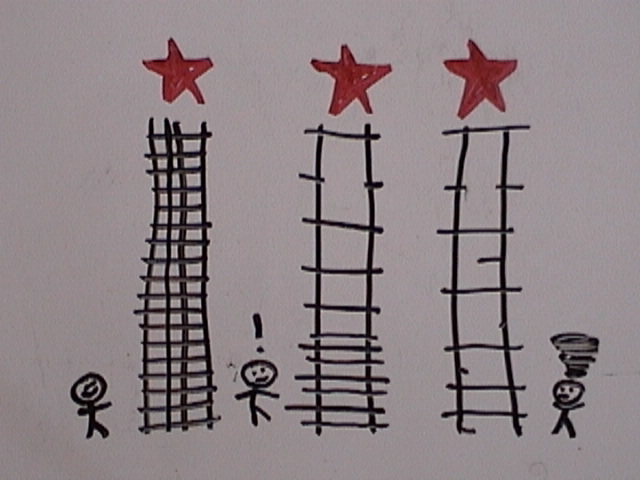
Balance this by putting them in a situation where they cannot fail. Nothing is more cruel than a trick question or a question where they don't have enough knowledge to answer...it is frustrating and exactly not fun. Some teachers confuse this with "a challenge." Keeping it challenging is important and those challenges should come AFTER the child/student has attained a level mastery, occasionally on the way to attaining mastery but remember this ladder and the concept of degree of difficulty.
Which ladder you you rather climb?
In the half hour video which is on the sample lesson page the 4 year old exhibits some of the exact same thinking that many adults across the country did during my travels. He counts more than just the sides, he counts by fours instead of ones he is unable to move the pieces easily to form rectangles at first...but all of these things will be easy for him within the year...he's only 4. What is obvious to adults is not always obvious to children, your job is to make it obvious and let them discover it. Unlike the adults he doesn't have any judgment of himself when he gets it wrong or when he isn't getting it right, and he learns quickly from his mistakes and uses the knowledge instantly to help him solve other problems.
On the other hand, his brother who has more experience can see the answers easily and watching his brother really cements the knowledge in for him as he is dying to tell him the answers when the 4 year old doesn't get them right away. It was also fun to see the younger brother insist on making his different from his brother, different but still correct.
There is a lot more going on with this factoring lesson for me than just teaching them addends and multiplication.
He is still having fun learning and playing. Imagine where he will be with his understanding by the time he is 7 THREE years from now, 158 weeks away...300 or 400 lessons away...of course multiplication will be mastered by then, and all 45 addends and fractions and algebra and more. And I will be an even better teacher then than I am now because he will have had a chance to teach me so much more too.
The half hour lesson is available now with a password at the House of math. Factoring polynomials really is child's play, it's a shame more children don't get to play math this way and are relegated to addition and counting at this age.
2x2 + 5x + 3, sure, but what about negative coefficients?
I am constantly asked how to show and factor or work with expressions like
x2 - 25
or
x2 - x - 6
and some people start with a presumption, "That's great but I bet you can't show negatives very well." Well enough to get this autistic kid to get it. Or "...that's great but what about trig?" What you have here is a uniform methodology for the visualization of mathematics...not just the positive part not just the rectangles. Eventually there will be the derivation of πr2 up on the sample lessons page, that 1/2 hour alone will be worth the price of admission. There are quite a few vids that I am told are worth the three bcks all by themselves. I am also told by marketers that the "problem" is the price is so low that people think there's no values there. I mean really, what can you get for 3 bucks?
Hours and hours of instruction that's what. Plus PDFs. Did I mention the PDFs?
I raised it from $1, apparently $19.95 is the going rate. MONTHLY. When I start getting some editing and some other paint and polish I will be raising the rates, meantime take advantage of the ridiculously low prices, NOW. It won't be long, this blog is already 3 years old, if you look at the first posts there were barely even pictures...lol...seems like yesterday.
Anyhow, here is Philip getting ready to go negative. Note how he is less than enthusiastic, because he has had bad experiences with integers due to that thing called the number line. I have lots of great stories about children who were taught about integers with this methodology compared to the way they did in school. One where the younger brother started solving problems faster than his older sister who "had learned all about negative numbers in school" but the method she had been taught was confusing and laborious...after seeing what her brother had been taught by me she said what most people say upon learning math this way: "I wish I'd had the blocks when I was learning this..."
For example:
Seems it would make sense to use blocks to teach about squares and the difference of two squares, or square roots or factoring...but they also come in handy for trig, pre-calc, and some basic concepts in calculus which I may never get around to here because there's hardly demand for it...well not nearly as much as algebra. But once you SEE an example of a derivative many light bulbs will start going off. Anyhow, once we are comfortable with factoring positive expressions THEN it's time to get NEGATIVE:
I see so many people who want to do too much too fast. "Okay, since they got that lets do this..." Remember degree of difficulty. Also the other thing to remember is you don't want to use the blocks for every single problem. The point is exactly the opposite...where you don't need the blocks once you understand the symbols anymore than you need pictures in your novels...but they were REQUIRED when you were first learning to read.
BTW: I'd appreciate if a couple of people who do have passwords would comment on their experience with the password protected pages. Is it worth the 3 bucks or 12 bucks or what? If not here than on the facebook page and I'll screenshot it an paste it here.
Via email:
Hi there
Just read your blog where you ask for feedback about the password protected pages.
I visited once or twice with the password below, and the pages are great! The videos/screencasts are especially helpful. My only problem is that here in Africa (Namibia), our bandwidth is not enough to watch the screencasts without constant buffering etc. Far better for me is to be able to download the videos to watch later (and I might add, watch again and again!)
I have downloaded all your You Tube videos which are so helpful. Is there not some way that you can make it possible for us to download those screencasts?
OR, if you had some kind of full blown E-book/video course with an entire curriculum (k-12) in it to download, I’d definitely buy it. (?)
Anyway, thanks again for all the stuff that you’ve posted in various places already. I really is great!