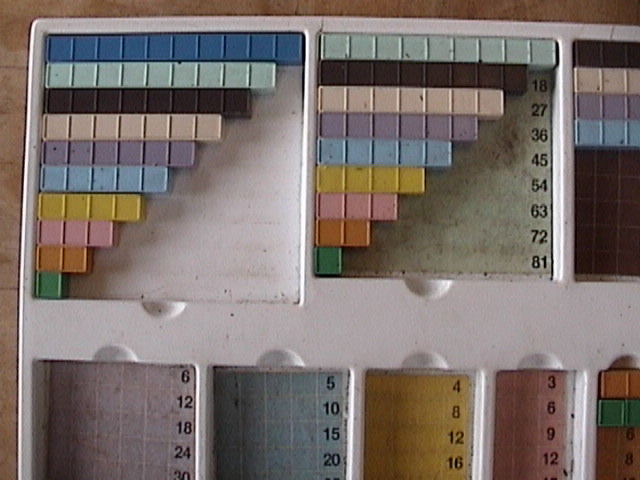
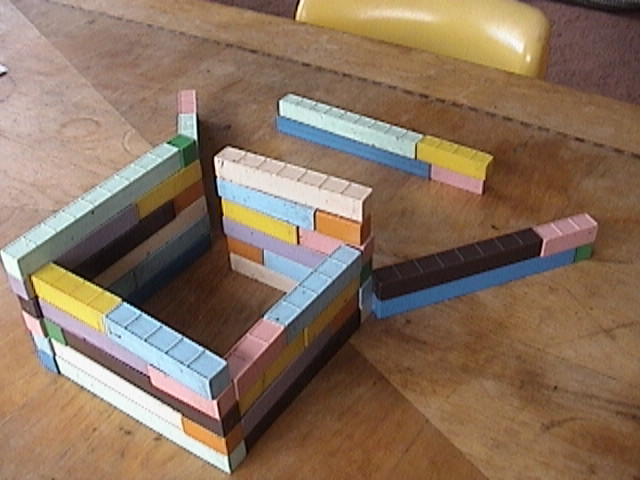
Here you will see students as young as 4 and 5 years old doing algebra and "advanced" math, without ever knowing it's supposed to be hard.
You are invited to learn how to use this method...


Monday, August 31, 2009

Algebra teaches addition and multiplication facts.

I now have a seven year old doing algebra...without fear or tears. At the end of this post you'll find a link to a page where children as young as 4 and 5 are taught math with algebra.


solving equations with base ten blocks, base ten manipulatives
We started with an easy one... x + 4x = ___

This often throws a lot of kids off.

x + 4x = 5x

Here it's obvious. The questions that come up for "regular" algebra teachers rarely come up at all because it's visually obvious that "x" means "one x" and you don't need to write 1x because it's redundant. This quick lesson saves a lot of pain later. Now what if each x is 2? Or 5? Easy. X can be anything.


By now, it's getting to the "no big deal" stage. Take a look at the problems below; he did them one by one...and approached them with supreme confidence that he could do it. In fact, it was basically a game of solving the puzzles I made.

We certainly didn't start here; but hour after hour--little by little--each concept compounds and we are now at the point where I just write the symbols and he does the rest. Note: I am teaching him much more than factoring. He is still learning addition facts and multiplication facts AT THE SAME TIME he is learning to factor polynomials. He took more than half an hour to do these four problems, and he had to do a lot of math to solve them.

Expect lots of trial and error; he learned several ways that didn't work for these problems but gained information that will come in handy later.

Take the third expression for example:

x2 + 9x + 20.

He discovered several ways to break up 9, before he got to 4 and 5.

4 + 5 = 9 and 4 x 5 = 20,

we also discussed the economy counting disguised as "fewest pieces possible" so we used four 5's instead of five 4's which is still a little amazing to a 7 year old. He figured out right away that two 10's wouldn't work.

At the end he was much more impressed that he could make 8's by drawing figure 8"s instead of by drawing two circles...


...than the fact that he had factored x2 + 11x + 28! I know 17 year olds who run away in fear when confronted with these kinds of problems, and college graduates who can't remember how to do this...but they paid for the credits anyway.

He also drew a picture of each problem. Drawing is crucial for understanding why we use symbols. It brings the point home that the symbols are faster and that the mathematics expresses reality numerically. He won't soon forget because he knows what the symbols mean and what they look like. The hardest part was counting out 28...what to use? 9's? 8's?...ah hah! 7's.

In the process he figured out some multiplication facts for 8's and 9's...on his way to discovering he needed four 7's...he also made comments like, "this number isn't square...if we had 12x we could make a square number..."

Here is a Polynomial PDF to practice all 45 addends and many multiplication facts too.

Most importantly, we had fun the whole time. Since he stayed on task the whole time and since we did a lot of math very quickly, he got some free time to draw. He was much more impressed with his ability to make 8's and 2's than his ability to factor the trinomial! And the pirate ship came out pretty cool too.

factoring using manipulatives, base ten blocks, algebra

Here is a post with lots of video showing ALGEBRA with toddlers.


Saturday, August 22, 2009

Experience the Division.


Here we see a very simple problem of 14/2. We put the blocks on the white board and counted the sides...they can see and feel/touch that there really are 2 sevens in 14.

What we are doing is counting how many 7's are contained in 14: there are 2 of them...we counted to 14 one at a time, two at a time and lastly seven at a time. I am quite pleased that the 4 year old can count by 2's and 3's...

A few days ago in the store I gave him a simple real life problem.

If it costs two dollars a week to put a business card on the bulletin board at the health food store, how much will it cost for 4 weeks.

First response, "I dunno that's hard!"
"Stop!" I said. "Let's think about it. Hold up 4 fingers. How many?"
Laugh. "Four...!"
"Okay now each one of your fingers has a two on it..."
He nods vigorously. "Two, four, six...eight! It's eight!"
"Excellent!"
"How old is that kid?"
"I'm four!!"

He didn't have the blocks he had had his imagination. People alwaysraise objections like what happens "when they don't have the blocks?"...or "they can't take the blocks to school..." Yes they most certainly can...in their minds.

People are thinking he's a little genius. Now, if everybody thinks he's smart, and they treat him like he's smart what are the chances that he will live up to their expectations? If he believes he's smart and can do math now, it will take a lot to shake that belief later.

The younger child simply emulates his brother. It will be even easier for him. He's counting right along with us. How great is his understanding now? Probably not 100%, but a year from now his understanding will be much greater than the average child because he has been exposed to and is comfortable in a math rich environment. A basic tenet: put the child in a language rich environment and they learn that language.

Hawaiian immersion schools prove that. The children learn Hawaiian because they are in a environment that is language rich--all they hear is Hawaiian, they see Hawaiian words, they see the words related the world around them. Math is "just another" language ...


Here we see 9. 3x3, 9/3...
How many three's in 9?
9 can be square...and math being the thinking game it is...fuel of carrots and peanut butter keeps the brain running healthily.

Wednesday, August 19, 2009

90 Min Flies By...


I know I'm doing it right when there isn't any time for me...

Last few sessions I have had, have flown by in an instant. Have a little seven year old doing problems like 12 x 13, 13 x 15 etc...and having fun doing it...because bigger is funner.

Had a couple young girls doing math and having some fun...we did algebra...than backed up to addends...how is it possible we have created a system where a 14 year old girl doesn't know for sure what 6 needs to be ten? It boggles my mind, and the worst part is the system will start blaming HER.

In the picture above we were doing a compound teaching lesson where I showed her 15 x 13 and (x+5)(x+3)...just introducing them to the patterns and later when we evaluate these expressions for various values of x it will be easy. Then we went from multiplication to division it took a second for them to realize we were doing the same problems...


In my defense I wrote those upside down. After this we backed up and built addends for 10 and 9...they had a little race and I could see they have some sisterly competitiveness...which I can gently exploit to get more done in less time. I started the lesson with the 5 concepts then a quick lesson on rounding for their little sister who was not present, they assured me she had it wired. Then we moved onto a quick lesson on where these symbols (greater than and less than) come from

< >

No more confusion or memory devices. They know what the symbols mean. One more time and it should be "in there" [minds] and easily re-callable.

Then came some two digit by two digit multiplication, mostly as a confidence builder and then the algebra and then addends...and then 90 minutes had gone by. To me it felt like 5 minutes max....so I was shocked when their mother said an hour had gone by and pleaded for more time.

Also if you go here you can see the testimonials are trickling in. There seems to be a common theme: FUN.

Sunday, August 16, 2009

Why just teach one thing at a time?


Upon seeing this picture the youngest boy said, "That's us doing our shapes and counting!!" For him that's exactly what it was. For the older boy we were building rectangles and counting the parts....one big red one, five blue ones, two pink ones which are threes so six units. We do addition multiplication and counting all at once. We also pattern for 13 x 12 = 156 and we learn a little place value (count the big ones first).

I was at a party recently, handed someone my card and he said, "Math?!! My kid's only 3 years old." To which I replied, "are you teaching him English?"
Those nearby laughed and nodded...
"Math the way I teach it is a language. Just check out my website. Take what you like leave the rest."


Before this we did more place value. Then we just named the blocks one through ten and of course the hundred even though they already know it...Then did multiplication.

Started with 12 x 13 = 156 and spent time counting all the parts and counting the sides. Look at all the math:


**added 2 tens and 3 tens to get 5 tens
**counted 3 two times to get six
**saw that six can be a rectangle made with 2 threes or 3 twos...
**counted the big one then the blue ones and the units and talked about what each number in 156 meant.

Counted the sides very carefully to get 12 and 13...from 1 to 12 and from 1 to 13. then we counted fast, one ten and three more or one ten and two more is so much faster than counting 1,2,3,4,5,6....

Again they have to be taught to start at 10 even though they supposedly "know" one side of the red square is ten or the blue bar is ten...

Then we flipped them over and did algebra..and we were done...might have spent 20 minutes tops...on the entire lesson.

This compound teaching where each students takes away something different but where more than one concept is introduced at a time. Again the sub-concious mind logs all this information. It can (and will) be drawn forth later.

Wednesday, August 12, 2009

Confidence is key.


Here we have a 14 year old student, bright, above average intellect, likes to read does well in every subject except math. After a very short set of test questions I find damaged self-esteem and self confidence due to math anxiety brought about by previous failures in math. If you look carefully you can see a little bit of this telegraphed in her posture.

Decimals and fractions brought up instant mental blocks even when the problems were seemingly simple. Student brought an example of her pre-algebra which for the moment she has little difficulty doing. This gives me time to work on basics and drill for skills. Here we are working on addends which will certainly help her solve problems like p + 7 = 15.

We covered the five basic concepts. Did a few examples from her homework worksheet. Did some more advanced story problems that required two steps to solve. We then backed up and built tens and nines and did some subtraction. And then moved on to more basics: addends past ten. (Pictured above.)

The idea was to build confidence and get a feel for the students strengths and weaknesses. Strength: exceptionally quick mind. Weakness. ZERO confidence. This will improve as she grows to trust that I am not going to trick her and that the answers will be completely obvious 99.9% of the time. The other .1 may involve some thinking.

Then we did the 11 times table starting at 11 x 11, on up to 11 x 20 she got the pattern instantly then a few 12's and then flipped over to Algebra where she amazed herself by doing problems like (x+2)(x+3) = x2+5x+6...well almost she didn't really think it was hard because she could see it...then oops an hour and a half went by...

will put in many links later...

Sunday, August 9, 2009

Multiplication by song.

So the morning began with a rousing rendition of intsy weentsy spider, which then morphed into Mortensen Math's four song.."You'll never catch a four out to lunch..." And then we moved to Multiplication Rock...and watched all of them. More importantly we sang some of them...everyday they learn more of the songs...which means by the time they are in kindergarten they will have most of their multiplication tables wired. Now that's a head start.

Eat Sleep Math.


Everyday.

Wednesday, August 5, 2009

Dyslexic doesn't matter.


Here are a bunch of block towers built into a city. Each block is counted, or skip counted and we practice our multiplication while we do it. If we are using three's we count 3, 6, 9, etc...as we (or they) build the tower.

Originally the plan for this blog was simple: I'd do math, take a few pics and then describe what I did before I went to bed or first thing in the morning...well it isn't quite working out that way. Fortunately I take good notes. I have done quite a few tutoring sessions since my last post here.

Here is what happened during a few of them.

This is a child aged 5 years. Severely dyslexic. Does not like to write or draw, however even in the last week that is beginning to change. He is very sweet and very bright. He also has slight challenges in speech and hearing. We work on saying the numbers as we go along.

Class starts with him putting away a mess of blocks from the student before him.

"How are you?" I ask.

"So good." He replies. And I knew we were going to have a great day.

First things first, put all the blocks away in the tray and count them as we do it. We count 1 thru 9, then on some blocks where he is unsure we just say the name of the block over and over again as he puts it away. We also count the bigger blocks and then put them away.

All blocks put away. Now we build. First we build 10's then 9, 8, and at last 7. He does ALL the building by himself which is progress because he used to have to have me put one block in and then he would find the block that made ten. For example I would get a 9 and he would complete it with a 1. And together we would say ten!!! with great enthusiasm as denoted by the three exclamation points.

Now we have them all built in the tray...time for some exercises. Use one finger to point to the ten now show me the seven and what goes with it?

"Three!!"

Do this for every combination in the tray.

Now it's time for TWO fingers.

Use one finger on each hand to point to the combinations. Get fancy, cross over with his hands in other words point to the six that's on the right with his left hand and the four that's on the left with his right hand.

Now lets build some robots. First we build the thing and then we replace the parts with it's addends. (i.e. if it has a nine in it we replace it with a two and a seven, or a three and a six etc.) This kid likes robots, other kids build other things like pirate ships or rockets or airplanes. Whatever is most fun. In the picture at right we see on robot that has yet to be new and improved and one that has.

Then we built some skyscrapers, which continues to refine his fine motor skills and then we built some towers with three's and we were done. There was a time when he could barely build any of these things and would get frustrated because he would knock the blocks over before he was finished. I have been working with this child for almost 18 months his progress continues to amaze those around him.

We put the blocks away and an hour was gone.

It didn't matter at all that the kid was dyslexic, he could still count and put numbers together and learn the concepts in this lesson; we never even got out a pen and white board, or paper and pencil. Other times we do and the child can barely make a "1" or a "C" much less a "8" or something complicated like "3". Of late he has gotten good at "0" and "1" and has learned to make "9" (a zero on a stick) a "10" and is beginning to make 8's...he often writes "10" as "01" which gives us a lovely opportunity to talk about making sure the numbers are in the right places and place value.

He knows he has a problem because it seems to depress him when it's time to try some drawing. He heaves a big sigh and says "okay" as glumly as possible. He is improving, however. The blocks make it so when the time comes all he has to do is concentrate on making the symbols; the concepts will already be easy. With this method the symbols don't get in the way. In fact we will see that the symbols do what they are supposed to do which is save time. Symbols are faster than drawing or getting out blocks. Dyslexic or not.

It is overwhelming when doing symbol based math to only see 4 + 5 = 9, for example. The symbols are difficult to copy and draw because they don't see what we see, and then they have to remember how many four is, and then they have to remember how many five is, and then they have to add it together and then they have to make the symbols...and then...it's too much. This method breaks it down for them and they learn what the symbols mean. It's easy because the blocks make it visually obvious. We progress in stages; bite sized pieces that are easy to swallow. By the way he can do algebra. We just didn't do any that day..

It really levels the playing field for these children and builds self esteem because they can do the math they just can't always make the symbols but that will be mastered too--just not as quickly as other children his age. Doesn't mean he's special, or more or less than other students just different. I treat him like any other kid and he appreciates that most of the time. (Of course everybody likes special treatment.)

Monday, August 3, 2009

SIX.

Well today's "lesson" for the wee ones was about 6. How many is six...? We counted six. We listen to "I Got Six" from Multiplication Rock. We measured 6 with 2 threes. We measured six with 2's and found out there 3 of them in there. We counted out six units...we made rectangles with the 2's and the 3's. They lost interest. We quit in favor of reading rainbow on PBS.

Wednesday, July 29, 2009

Math lesson 21July2009. Challenged.

This lesson was taught to a bright and vibrant child with some slight challenges in hearing and speech. 5 years old. Fine motor skills undeveloped. Cannot draw or write (YET). He had class after his brother and I made sure that we did not put the blocks away before the new lesson. Therefore his first task was put away blocks.

He sorts and counts blocks as he puts them away. Counting to nine several times as a warm up...then we built 10, 9 , 8, 7, at the lowest degree of difficulty where I put the blocks in first and he just has to put the block that matches in the tray, for example the nine is in the tray and he has to put a one in there to make 10...etc. See picture below. Then he built them himself with no help. But still at the lowest degree of difficulty where he put in one thu 9 or 1 thru 9 etc ad ten added the matching addend. Building them one at a time is the next degree of difficulty.

base 10 blocks

I then made him use alternating hands to put the blocks in the tray, he could not pick up a block with the same hand twice in a row, thus engaging more of his brain and making it more FUN. He showed me each hand before he grabbed the block he wanted and I nodded and smiled each time giving him positive reinforcement.

Then we made a house with walls that were 10, 9, 8, and seven and eight high (this is not the exact one but you get the idea, this picture shows one a little more advanced with addends past ten.):

pre-school activities

Then we counted on our fingers. Two fingers on this hand three on the other: how many?

He had a little trouble putting up his fingers and copying me, but it was fun ad we did lots of combinations less than 5, obviously. 2 + 2, 3 + 2, 4+5, 4+4 etc.

Example: 5 + 3 = 8
He always counted starting at one, even if he knew one hand was 5 and the other 3. He started 1, 2, 3, 4, 5 and then 6, 7, 8. They have to be taught to start at FIVE and then count 6, 7, 8. this takes patience and practice because they always want to start at one just to be sure. We are counting on our fingers now because one day soon we will NOT be counting on our fingers. Fingers are a crutch we will ween off of shortly. Like training wheels on your bike, we won't need them once we get going and it will actually hamper you once you want to go fast and do tricks. We will know these facts "by heart" and the child will know all 45 addends by heart too. He had fun making up his own problems for me to count, part of the fun was getting his fingers to do what he wanted them to do. We then counted to 20 by fives using all our hands...we did this several times.


Many students come to me with an F in algebra and can't add 7 + 8 without either counting on their fingers (as seripticiously as possible) or stopping to think about it. Multiplying 7 x 8 also gives them pause. Fractions poorly understood...gee how come they don't get algebra? But I digress.

Then just for fun we built 3's and 4's because it's super easy, fun and quit because an hour had gone by. Note we never once used paper and pencil or even a white board.

Math lesson 21July2009.

Been busy. Have done hours of tutoring since my last post.

Here is a description of what happened for one of of those hours.

Student 7 years old. Normal to above average intelligence. Slight hyperactivity. Expressed in hyperkenetic activity and extreme talkativeness. He's a regular kid.

First we built tens on down to two's.
Then we talked about subtraction, and with the blocks right there verbally drilled him on facts. 10 take away 4, 8 kids in the room, three leave how many left? Etc. Did 15 different facts and five that were the same. Did not relate subtraction and addition. In other words 10 - 4 = 6 Is exactly the same problem as 6 need what to be ten...when you have the blocks. He had the tray to look at the whole time. So it was easy. Soon he will only have symbols...but first he will be absolutely confortable with blocks and drawing.

Then we built rectangles and labeled the sides and hid the answers underneath. The over the shoulder shot show him labeling 5 eights...


Then we talked about division and multiplication. Here we see symbols only and we have adjusted the symbols to fit the blocks the way we wanted. You don't see that we changed the sevens to show five across 7 down and used 5's because 5 is contained in 35, seven times. We also talked about how to read that expression...4 IS CONTAINED IN 16 four times. He could see that, it was visually obvious.


We then added the arrows for the pattern across and down. and as you can see he got the blocks out to help him. All he had to do was count the down he already knew the one side and how many in the rectangle, I thought he would get out 5's but he got out 4's because he knew the answer. That problem says build 20 with fives. He was in a situation where he could not fail. So he was confident. The important part was he got it right and understood that he had to count the other side. He also understood 4 is contained in 20 five times. Multiplication and division all at once. They are inverse functions after all.

Then we moved on to his favorite topic: ALGEBRA! We moved on to cross teaching or compound teaching concepts. The first "problem" was make as many rectangles as you can with x2+ 7x...

So he built

x2+ 7x + 10
x2+ 7x + 12
x2+ 7x + 6

We talked briefly about the factors (ie the factors of x2+ 7x + 10 are (x + 2)(x + 5) ) but mostly we were concerned with the 10 being made up of 2 fives or 5 twos.


Then we added 3 more x. It was a tiny problem how many more x do we need? We had 7x so we needed 3x to make 10x. Algebra is easy! Now we made as many rectangles as we could with
x2+ 10x

He started out with x2+ 10x + 25
then did x2+ 10x + 21 then x2+ 10x +16 which you see pictured here. He has 2 on top and 8 on the side. (x + 8) across and (x + 2) up.

x2+ 10x + 16 = (x + 8) (x + 2).

We were more focused on the 2 x 8 part. The algebra is a bonus as it were. (!) It was much faster to make it with two 8's than with eight 2's. This is known as the economy of counting. We discussed this concept only briefly. But it's obvious it's faster to count 8, 16, than 2, 4, 6, 8, 10, 12, 14, 16...we did both of course.

Then x2+ 10x + 24 and lastly x2+ 10x + 9. Note how much math is going on here and why I call it compound teaching. He is learning all the addends for 10, the factors of the algebraic expressions and some the factors of the numbers 25, 21, 16, 24 and 9. We are working on all of this all at once and having fun doing it. Nothing scary or hard about it.

The we continued building the addends to 18...

Then the hour was up. 60 minutes flew by.