Here you will see students as young as 4 and 5 years old doing algebra and "advanced" math, without ever knowing it's supposed to be hard.
You are invited to learn how to use this method...


Showing posts with label Factoring Polynomials. Show all posts

Saturday, May 9, 2015

Graphing Polynomials With A 7 Year Old.


Start understanding what the symbols mean, and how they relate to a graph.


If you've played with blocks and done the lessons for YEARS this stuff is easy by the time you reach the ripe old age of 7. Ot you can wait ten years until your kids are 17 and watch the pain and frustration mount until the domestic tranquility leave your house hold they hate math, they hate school, and they hate they teachers and of course they hate you and let you know it sometimes at the top of their lungs. Make math fun and easy and now they don't hate going to school anymore in fact they might like going because people will think they are smart because people think people who can do math are smart whether they are or not...but anyway remove the pain and domestic tranquility returns. Maybe it isn't that bad for you, maybe you're just tired of your kid being sad at school because of math. Maybe you shouldn't wait till high school...

Or you could avoid the problems in the first place and let me teach you to teach your kids math. I could do it for you but it'd be better if you did it yourself...and yes I can teach YOU even if you think you are a failure at mathematics. Ever have a kid that has all "A's" EXCEPT for math? Might not be the kid's fault...maybe the method being used to teach the kid is an utter failure, not the kid.

Had to do a quick review of one of the building blocks. Squaring number that end in 5.
Graphing parabolas poses a problem for most kids because all they do is memorize rules and process (and then promptly forget them) or learn a formula and then learn to apply it long enough to take a test and then forget it. How about we understand what we are doing and what the numbers mean instead? Then suddenly this stuff is so easy it's ridiculous and you wonder why there were tears in the first place.

I have also had untold numbers of fathers and mother who DID understand the math but weren't able to get their kids to understand it come come me...after they figured out turning the volume up didn't help. If you have a good grasp of mathematics or love math...you will love my site. If you hate math you will end up loving my site. Check out the comment boxes on facebook and over on this SSS page...(I couldn't buy testimonials like that...well sorta: I bribed them with my book, but if the book sucked you wouldn't see testimonials and "thank you"'s like that now, would you?) you can also go to my website and watch video testimonials.  F to A is common. 100's are not rare at the house of math.

Algebra is Fun If You Do It Right.

You will need to spend some time with the blocks which you can HEAR in the video but you can't see them.  You can see them on my website though...lol...quite a bit. I have quite literally hundreds of videos where you can see the blocks in action for factoring these polynomials (and a whole lot more. You will see little five year olds factoring polynomials and having FUN doing it.  They ask for algebra...algebra is a reward near the end of class sometimes.

"Can we do algebra?!"
"Well...ok...but only if you are good and play nicely..."

Watch my videos you will hear this exchange and ones similar to it...


Follow The Links.

If you have some familiarity with the algebra or have struggled with it this should clear quite a few things up quickly. If this is all Greek to you, understand that if a 7 year old can do it, you probably can too it's just nobody ever taught you how in a way you can understand. If you had played with blocks for factoring and you had played with blocks for squaring numbers that in in 5 and you had used blocks to SEE polynomials in their various forms you how you can put a polynomial into these various forms and then use symbols to describe what you did, this stuff would be easy peasy but since all you've ever seen are the symbols confusion hath ensued and you think algebra is harder than water at the south pole in the winter time...or the prom queen's date on prom night.  Turns out completing the square is EASY here are some little kids doing completing the square...I start them out with this at 5 years old any kid can get the concept. Here we just put it all together as it were.

Get yourself some blocks and a password and start having fun or at leaste start taking the pain out of math for your children and maybe even yourself.  Follow the links on this page or just go to the house of math for more. There are hours and hours for FREE and many more hours behind paywalls where you need a ridiculously affordable password to get through to see little kids putting this method into practice and having FUN doing it.  Take the "advanced" algebra page for example....hours of Hours of video. Trig page hours more...of video you'll actually understand. More so if you have a set of blocks in front of you and you can follow along but even if not you can draw and play along that way....don't just watch.


If all you want to do is get by and pass a test this really isn't the place for you, but if you want to actually understand what you are doing and therefore be able to make others like your friends or kids understand it, you have come to the right place. I make math easy because math is easy, not because it's magic, it's not magic it's just math.

Graphing Polynomials? No Problem.
Just Watch Me.


We did this problem too but I didn't get it on video...you might try it at home it's easier than the last one you see in the video because of the even amount of x. In case you need the review here is another video with a lesson on squaring numbers that end in 5.


Don't tell me my passwords aren't worth the money...and this is just factoring polynomials. A lot of kids start having trouble with subtraction...so maybe we back up and you get my FREE subtraction manual, Supremely Simple Subtraction.

Find Crewton Ramone on Facebook.


Your mind is blown put your comments here and share this...intimidate your friends and impress your enemies.

Ready for more? Check out graphing polynomials with a 10 year old.


Sunday, November 30, 2014

More Compund Lessons With Base Ten Blocks

Part of what makes this method so effective is the idea of compound lessons. Why learn "one thing at a time"? One thing at a time is great when introducing concepts...but once concepts are understood it's more fun to practice more than one thing at a time, which is why I emphasize compound lessons.  And as you can see using base ten blocks to do it makes math fun.

algebra with base ten blocks, mortensen math, fun math activities
A six year old factors x² + 11x + 30 all by himself and celebrates with his magical math microphone.
People ask me what they should get. Get a combo kit. A set of Multi-Tens and a password or both passwords...and you are good to go. Seriously.  That's it.

In this hour we practiced mostly addition and multiplication but we did activities that were fun to practice them rather than doing worksheets over and over again. Using worksheets to memorize multiplication facts becomes counter productive at some point.
Just building addends over and over again would make math anything but fun. So even with this activity which by itself many kids find fun, we spice it up by racing your brother or mom or who ever happens to be around.  Then we build some pyramids. All kids can benefit from building pyramids, the benefits are manifold. You get fine motor skills, addends which naturally include addition and subtraction skills, and the all important repetition which puts the facts in the memory for instant recall later... 
Here the older boy is feeding his mother and brother combinations for their pyramids. and supervises the construction. They are building 11's, later we could build and find patterns with 11's.
Pretty soon he gets in on the base ten block building action. And his little brother hands over some combinations...sometimes we build all 45 addends at one sitting but today we just did all the ones from 8 to 10 and then 11's and 12's. How many math facts is that?
Children are always quite pleased when they complete one of these...or several of these. Sometimes we build towns or cities or temple complexes or moon bases (or whatever is in their imagination), made entirely out of pyramids built using base ten blocks, but today we played algebra which will give us addends and multiplication too. Started out with problems like x² + 7x +12 and worked our way up. We started there because he already has some experience factoring polynomials and I wanted to start easy...then we went on to x² + 8x + 12, and x² + 8x + 15,  x² + 8x +16...Went thru several with 9x then on to 10x,  those polynomials have lots of combinations.

x² + 9x + 8  you get addends for 9, 1 and 8, and 1 x 8 = 8.
x² + 9x + 14 you get addends for 9, 2 and 7, and 2 x 7 = 14.
x² + 9x + 18 you get addends for 9, 3 and 6, and 3 x 6 = 18.
x² + 9x + 20 you get addends for 9,  4 and 5, and 4 x 5 = 20. 
 
You don't have to do every single one in order...mix it up and have fun.  I did a couple with 10x like x² + 10x + 16 and then x² + 10x + 24...didn't do x² + 10x + 25...which is a good place to start if you want to go down the square numbers and square roots path which are made plain and EASY with base ten blocks.  I had a mom tell me they completed the square with 24 once. I said go back and take a look at that...24 will complete a rectangle but certainly doesn't complete a square. 25 would complete a square...and completing the square is quite a useful skill to have later on when you are graphing polynomials and want to easily convert to vertex form.

Playing with squares and radicals are also fun math activities where you can compound the lessons and learn algebra, addends, multiplication, square roots and more. You decide the emphasis depending on the student. For some older students who are supposedly past addition and multiplication because of their age you can use these techniques for remedial math without them even knowing it.

Instead I gave him x² + 10x + 24 which he got pretty easily but then I gave him x² + 11x + 24, which is a challenge at this age when they are still learning their times tables.  You can see he figured out he needed 8 and 3 to make it work.
Then I gave him a challenge.  x² + 11x + 30...the dilemma after he figured out it was going to be (x+5)(x+6) was finding enough fives or sixes....they were being used in the pyramid...and he found that he could count by 5's but not by sixes as easily...remember this boy is 6 years old, he hasn't mastered his 6 times tables yet but he will....and there won't be tears or frustration. It will be part of fun memories spent playing with his mom instead of being angry at his teacher because of yet another worksheet.
After a little fooling around he decided to make 30 with 6's...which meant he was going to have to bust up his pyramid.
Completing the corner was important to him, later you will find students especially older students who know their times tables skip putting the units in because they already know 5x6...and that 5x6 is the same as 6x5...when they are younger this is still a fun discovery.
Challenge completed! It's time for some celebration which is where we came in. Also some high fives with mom never hurt nothin'.
This lesson took place way back in the beginning of October. Just got around to finishing it here.  In this hour we basically practiced math facts in a very disorderly fashion...we didn't just do a bunch of addition or subtraction for an hour. We did both AND we did multiplication and some division AND we factored polynomials but the algebra was just along for the ride...as you can see it wasn't scary or hard and I used it to teach concepts and facts...most teen-agers I know FAIL algebra right at this point because they don't understand the distributive theory and never saw a polynomial until they were 12 or 13 years old...
Positive memories and positive associations with math are so important i don't have words. Wouldn't you rather have your child's or student's early childhood math experience be like this instead of rife with tears and frustration? They won't all be diamonds but more often than not you will find YOU the parent or teacher can make math fun and teach a whole lot of math all at once in compound lessons like this.

Want to get the materials you see in this blog post? GO HERE.

Want a FREE PDF of the polynomials that cover the 45 addends and the multiplication facts that go with them?  Click here: POLYNOMIAL PDF


Tuesday, January 21, 2014

Teaching Second Graders With Manipulatives.


fun math activities, crewton ramone in the classroomCrewton Ramone in the classroom! Here are a few videos and shots where second graders use manipulatives and do math that is supposedly beyond their years. These videos should give you a good idea how to incorporate the blocks into the classroom. Manipulatives make math fun and easy. They make math concepts visually obvious and you can get a lot more math done in a shorter amount of time once the students become familiar with the base ten blocks. Look how many addends get made when they build a tower. It's much better than writing them down over and over again--and more effective. Be careful with worksheets.

But don't be fooled into thinking all these kids can do with manipulatives is add and subtract and do some place value...they can learn all kinds of math concepts. The basic operations (addition subtraction, multiplication, division) and much, much more. Use your search engine I have tons of vids and posts up about math from counting thru high school math.

I often forget to turn my camera on during the lessons. You can look at the board and tell we covered a lot of math concepts, from square numbers to square roots to multiplying by nine. Here is a post lesson short:


Here they are doing second grade math, just learning their addends. I can't stress enough how important it is to learn and master all 45 addends.  We have broken into teams and they are racing to build pyramids of  10's and 13's...or you could use worksheets and get less done in more time. Note how we go from addends to factoring polynomials without skipping a beat. I expect you can see how it's all one lesson. Even when we are doing algebra, the algebra is just along for the ride what we are focused on at the second grade level is multiplication and addends and having fun.


You can hear the fun.  Building towers is a favorite fun second grade math activity. I use it as a reward. They practice addends and have fun doing it.  But they can do much more than just addends, they can do algebra, understand problem solving fool around with Pythagoras' math concepts regarding triangles and much more. As you can see addends in algebra go together all in one breath as it were, factoring cements the addends and gives them some multiplication and factoring of numbers and algebraic expressions.

Second Graders Factoring x² + 9x +18 with EASE!


This video is unlisted and won't come up in searches. It is on the sample lessons page along with a whole lot more. Gives you a little taste of the stuff you can get with a password. The password protected pages have hours and hours of vids. Here is a sample addends lesson with very young students.

Second Graders Tell ME Pythagorean Theorem


Breaking them into teams makes the whole thing much more manageable, creates a little competition but also lets kids know as they are working on the problems and other teams jump up and yell "done!" that they aren't impossible and that if their peers can do it, they can do it. It also adds a little excitement.

This little group of girls is working together trying to figure out what fits in the corner...not only do they get math skills but they learn team work and cooperation. I can't tell you how many times the kids who are supposedly the top of the class in math end up "losing" to other kids who are not as good at math as they are (my own son included) because they couldn't get their group to work as a team. And by "losing" I mean finishing after the other "winning" group, sometimes by mere seconds.

Keep it fun and keep it moving. Just play. Play is very important...it makes learning easier and faster.


I have several posts showing the use of base ten blocks in classroom situations plug Crewton Ramone In the Classroom into your favorite search engine and see what comes back...besides these:

http://crewtonramoneshouseofmath.blogspot.com/2013/04/crewton-ramone-in-classroom.html

http://crewtonramoneshouseofmath.blogspot.com/2013/05/crewton-ramone-using-base-ten-blocks-in.html

And now you know why in the world of Mortensen math this is no big deal, astonishing to some but not me or other who have spent the time to learn to use this effective method for teaching.

)

Don't forget to find me on FB.

Saturday, June 29, 2013

Factoring Forms Using Base Ten Blocks

Here is a quick video showing various ways of factoring a quadratic. Using the the blocks to show what we are talking about with each factored expression of

3x² + 17x + 24

Can be factored several ways. The most common way is a great example of economy of symbol.

factoring quadratics, polynomials, algebra
Note how we are still all positive...keeping in mind degree of difficulty. Lets understand some basic concepts before we start adding negatives coefficients to the mix.  Most text books just dive right in instead of taking it one step at a time.

The blocks take the fear out and make the symbols relate to something tangible in reality. They can actually see it.


Then when you show your students the other forms it's obvious. Then when it's time to start graphing these bad boys finding zeros and more points and the vertex and y-intercepts and such is easy because they already have this much under their belts instead of being inundated with it all at once.


The student in this video is shy and as soon as the camera goes on he chokes up...had the camera not been on he would have had an easier time answering my questions. Anyhow the action figures or lego men or whatever you have are handy to help get the point across.

factoring polynomials with base ten blocks, algebra

Got the Star Wars effect going on here...a long time ago in a galaxy not far enough away they were still teaching math like idiots. Then suddenly math was cool...and the kids could see it and the symbols made sense because they could decode them and everybody was laid back and groovy.

For more get a password and head over to the house of math.


Learn to use your base ten blocks.


Tuesday, February 26, 2013

Addition & Multiplication With Base Ten Blocks (Using Algebra)


Here is another video showing how you use base ten blocks to bring home the basic concepts of addition and multiplication. A very simple concept for very young students to grasp is numbers are made out of other numbers. You need to talk about addends...they get it when you tell them you can make a 5 out of a 3 and a 2. There are 45 addends but rather than doing the same thing over and over again for a whole year, addition in first grade for example, using worksheets and flashcards and drills...why not play and have fun and do many different activities that teach the same thing. Building towers, pyramids, walls and math towns are all activities that teach addends. (Search crewton ramone pyramids or crewton ramone addition) Variety is the spice of life.

multi-tens, base ten blocks, addends, addition, multiplication, algebra
 You teach addends, multiplication and the algebra is just along for the ride.

Here is another slightly more advanced way to teach three things at once using base ten blocks. You teach addends, multiplication and "the algebra is just along for the ride." Before you do this you get very comfortable with ONE x² before you add two or three. And you might check out this page that shows you how to present the basic concepts of addition and subtraction using manipulatives too. While you are using two of them you can really bring home the addends if you have a set of multiple tens. If you only have single blue (or whatever color you have) bars, not so much; BUT you can still get addends done if all you have is single bars just name the groups of x and add those.

As an added bonus you are factoring polynomials. I have discovered that a lot of older students have trouble with algebra because they haven't ever mastered their addends and they don't have their multiplication tables mastered either...yet they passed math several years in a row and find themselves in high school.

I left a few things out of the graphic because it was getting too busy. You should also see 9 + 9 and of course 1 + 1 (the x-squareds)  But when counting it up they may do 9 + 1 and 8 + 5 to get 23...at any rate LOTS of math goes on with each problem and the subconscious doesn't miss any of it...

Older students can take the time to draw the problems and write down the symbols. Younger students need speed and repetition so they don't get bored...and taking the time to write it all down slows things down too much...so we just talk about it...this also will come in handy later when you find they can do a lot of math in their heads. No Blocks. No pencil and paper either.


Other comments about this are regarding "mindset". Using algebra to teach basic math works well on all manner of students from various age groups because it changes their minds about math being hard. It's easy and even fun. Once they think it's easy: IT IS. If they think it's hard, math is much more difficult.

The next idea is working with older students who need to master multiplication and all 45 addends using traditional methods can make them feel stupid or inferior because they know they are doing work that is "beneath their level" or that younger kids do...this can be damaging to their self esteem and further turn them off to math. Recently a parent asked me what I thought of the math tutoring a public school had after school..."more math the same way they didn't get the first time. SO lets do it over again and perhaps they will get it this time." Even if they do they will have less than positive associations with math.

If you use algebra and it's fun and easy to start and stays easy, they have fun feel smart because they are doing algebra which they know in kid culture is supposed to be hard AND they get the practice they need to enhance their skill sets in addition and multiplication. Plus playing with base ten blocks is fun--they look like toys. They are toys. Powerful toys that teach math. Toys that make math child's play. In your hands they are powerful tools when used correctly.

base ten blocks
They MUST get their hands on the blocks. This way you reach all learning styles and oddly enough several universities have recently made the discovery that the more senses you use the better and easier learning is...and the more learning takes place.

Also note BOTH hands make for a whole brain activity. This is why I have success with so many different students.

 The only way to learn math is to do math, have fun while you're at it.


I found early on as a salesman for this method that sales sky rocketed when we had enough kits for everybody in the room and everybody got their hands on the blocks...they understood it, they saw it made it easy they got a kit. Otherwise it was just more math.

Also athletes and other learners that are more kinesthetic excel using this method, and this is also why we do so well with special need learners.

I have made many posts about using algebra to teach basic operations. See the links below. You can also use fractions to teach addends and multiplication but that's another post and another video.

The previous post Algebra With Base Ten Blocks For Addends And Multiplication this could be considered part 1 and the one you are reading now part 2.

More on using algebra to teach other operations:
Using Algebra To Teach Multiplication.

Algebra its many uses.

Here is an older post, contains no video just words and pictures:

Using Algebra To Teach Basic Operations.

And here is a pile of screencasts on various topics:

Crewton Ramone on Screencast-O-Matic.


Use base ten blocks to explain the distributive property.

Shortly there will be another post with Commander Colby showing how to use algebra for remedial math without damaging the child's self esteem or making them feel stupid or like they are behind.

Tuesday, January 29, 2013

3rd Power In His Head


Here is a gem. Don't tell me they have to have base 10 blocks or they will become block dependent using this method. Watch the older boy picture this problem

x³ + 9x² + 23x + 16 =

in his head...counting out the parts as he goes and then give it to me to solve.

This is a lesson on factoring and counting and multiplication...and how to be cool and have fun when you do math. The reason they don't need base 10 blocks is because they have been using base ten blocks...and we are learning by drawing and visualizing. Here is a post on 3rd power algebra where you can get an idea of what it is he is "looking at" in his head. We baby stepped our way here but now you begin to see the POWERFUL results of using this method.


More algebra at CRHOM. If you want to see more "advanced" algebra click on the "advanced algebra" tab.

We watched this together. The youngest boy pointed out that he drew 6x² + 10x + 4 and didn't get very much attention for it. He also told me the factors (you can see the drawing in black in front of him) (3x + 2)(2x + 2). "Come on, that was pretty cool dad." So we are going to make a new vid where he gets as much attention as his brother...

Find us on FACEBOOK.

And yes, I'm on Twitter.


Friday, May 4, 2012

Crewton Ramone Strikes Again! Jesse.

Here is a quick testimonial. 


Going from F to A...in an hour a week.

Started in the 30's and worked our way up yo "C" the only way to do that is with a lot of "A's."   This story is quite common at the house of math because once you understand the concepts all they can do is change the numbers. This student is studying algebra, specifically quadratics. Turns out it's not hard.

I  always enjoy working with students who show marked improvement. Gives me a good reputation for math tutoring. I have to stress the student has to put in the time and effort, all I do it point the way. No one can do your push ups for you as they say. Especially in math.

I also enjoy the math enrichment students...the ones who come who already have good grades but just want to learn more or as the case may be they have an A but they are just going through the motions--they don't actually understand what the are doing.  You'd be surprised how much this goes on. Lots of students sport an A but have no idea what they are doing or how it applies and memorize whatever it is just long enough to pass the test and then forget it again.

Here are some more testimonials if you are interested. The point is this system works. Mortensen Math is effective. If you are a teacher it will make you a better teacher because you get better tools to get the job done.  If you are a home schooler you can learn math right along side your kids, the question often comes up how do I teach algebra if I never "got" algebra. Well, now you can.

Between my blog and website the excuses have been removed. Used to be people would by a kit and then not know what to do because they needed training and we didn't have enough on video. This caused me to do 3 years of traveling...while there is nothing like face time and personal training in groups with all the stuff I have for free on the net and all the stuff you can get for 5 bucks with a password the days of inaction and excuses about not knowing what to do or where to start are over.

Get yourself a kit and get going...or dust off your old one and get crackin'.


Tuesday, March 6, 2012

Cram Course On Quadratics. P1

Here is a set of videos that covers Quadratics, Triangles and Squares with Pythagoras and a little bit more. Caution advised this is not a normal lesson nor is it the way you should present mathematics to younger students or even students this age, but because we have deadlines to meet I stuffed a lot more into the hour than usual. This might be good for some teachers/parents and students to see where we are going with all this...we seem to lose track of the destination sometimes when we get caught up in computation. This post should answer some WHY questions that may have been lurking out there.

Here is one of the graphs we made while we played around with factoring polynomials...the idea behind it all is problem solving, rational and critical thinking NOT memorizing rules. Note we don't even begin to cover application which means I am still being tricked into teaching backwards.


This is the crash course where we cover many concepts all in one hour. When you are teaching little kids you only cover one concept at a time and add more understanding in layers over time. For example you can spend quite a bit of time just playing and building squares. When they are used to factoring, then we can set it equal to zero and find "roots." What do we mean by roots?


So we start off with a simple one as a refresher and to make it non-threatening...and then we can start graphing and get more information.


Note how the symbols bring up some memories of linear functions for him...and you can see the blending of symbols, blocks, pictures and graphing.


We add more information and math terms like "axis of symmetry." Once we understand that we can add the "vertex", and now with those concepts and the concepts of "roots" we can start adding the "y-intercept" and the other points that make up a five point sketch of functions. YOU may want to take a break and make your own sketch...before watching the next one:


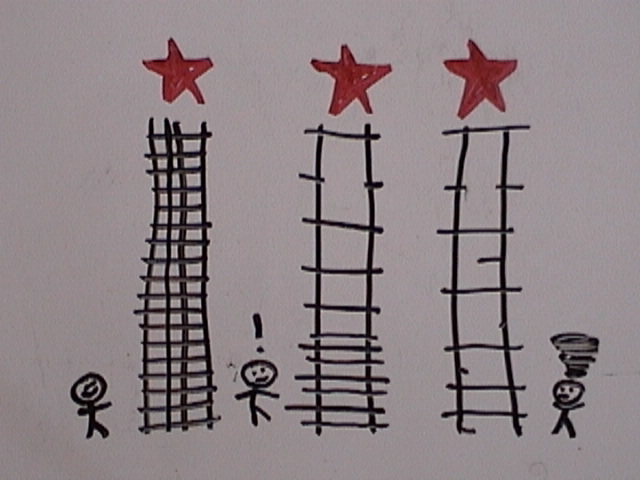
We stayed positive in this lesson and this is more than enough info to absorb for one lesson. Note a crash course with me still contains each rung in the ladder...

Then we change gears and play with triangles, radicals and Pythagoras:


And we also played a bit with fractions and covered the 5 concepts and how they related to everything we just did. You can hear him yawning which tells me we are stressing his attention threshold...good time to quit. No need for drugs or labels like ADD. The lesson went for a solid hour and we covered a lot of ground, MUCH more than you normally would. Stay tuned for more lessons.


http://www.facebook.com/Crewton.Ramone


Monday, December 19, 2011

Crewton Ramone Doing Distribution With A Nine Year Old.

This positive factoring of polynomials is easy and fun for all ages. At the house of math we also do negatives, higher powers and more. If you would like to see problems like this factored then you need a password and there is an abundance of material on the advanced algebra page.

negative polynomials

We did problems like to to help work on integers, this nine year ld has little problem with basic operations, and is having fun with fractions already, we will be covering more on this because right now he understands fractions from the point of view of the rules instead of the concepts. In other words he knows how to invert and multiply but he doesn't know why, he knows how to add fractions but he doesn't understand that he is making them "same" so he can add them...and the concept of multiplying by one is lost. But that's another post, this one is about factoring polynomials and it's many and varied uses for teaching math concepts beyond "just" distributive theory.

With young students you use if for cross teaching addends, addition, and multiplication as well as or in addition to factoring and how the distributive theory works. Once we get into negative factors we can use it to teach integers while we are learning about the distributive theory of multiplication.


This was just the warm up, we got into factoring the problems above and more. You can find them on the advanced algebra page, scroll down near the bottom. You will also find hours of other fun algebra there...but as you will see you need a password.

Find us on FaceBook.


Tuesday, December 6, 2011

Fun Kindergarten Math Activities: Dboyz Play With Bigger Polynomials


Here are some fun problems:

We cover all of these in the longer 20 minute video. Here is the short version, but you can get to the longer vid from here if you like:


In order to get here we played with basic concepts for months. With a password you can have access to hours and hours of video, sample lessons, PDF's and more and you can see step by step how a 6 year old got here. People are quite amazed at just how much you can get for 3 bucks or 12 bucks for an annual pass. Those who buy annual passes before the end of the year are in for some pleasant surprises next year, along with those of you who have already bought a annual pass to show your support...prices will be going up and there are more products being worked on as we speak that will be available at good discounts for those who have already gotten an annual pass. Also there are going to be separate passwords for various topics but right now one password does it all. For those who just want to take a peak 3 bucks gets you a good 60 days worth...but don't expect any special treatment.

[Update: prices have indeed gone up. Look at the side bar for details.]

For a more complete blog post on with these very same videos go to Math Genius Making.

Of course be sure to find us on FaceBook, and go to the House Of Math for much more on the best use of base ten blocks and manipulatives for math enrichment so your child or students can be doing math like this with no problem.

Stay tuned like I say on my website, "I'm just getting started."

Wednesday, June 29, 2011

3rd Power Algebra? It's Just Complex Counting.

Here is an excerpt from a lesson where we played around with some third degree algebra made rectangles and counted the sides.

You can see from the vid we are in the drawing stage, but we still get out manipulatives so we can get a solid handle on what we are doing which is counting. We start off with all positive expressions and basically factor them. Then we move on to expressions with negative coefficients and do division too. When you are first starting out just doing one problem can take up 15 minutes or more...but then as the understanding increases it will go faster and faster.

The way to increase understanding is not to do the same thing over and over again just using symbols and changing the problems, the way to get them to "get it" is to start in the concrete move to drawings and increase the degree of difficulty gradually as concepts are understood and mastered. This also shows how important neat writing is...lol...sloppy symbols can make the difference between an A and a B, or worse a C and an F. Also, for those with a password you will see on the follow up vids on the Advanced Algebra Page. Password costs all of 3 bucks or $12 for a year pass. Buck a month is hard to beat.

You will note sometimes I say one thing and mean another in these vids when I read the problems and say "x-squared" instead of "x to the third" and so on. I watched one vid where I did it over and over again...but eventually I say it right. Painful for me to watch.

Problems like x3-4x2+x+6/x-2 take a long time just to say but they are quite instructive. They are also intimidating to some students who find them confusing and scary just because of all the symbols, but once we get into it and it becomes familiar, they see that actually it's pretty easy...just have to count and keep track. Here we are going over the positive ones:


As usual I forget to turn the camera on until we've done a lot of them. Remember always start in the concrete, use three period lessons and make sure drawing is part of the lesson too, don't just use symbols.

Here we see that base x also has place value and answer the question "why do they go where they go?"...you'll see this on the next video look for "P2 Crewton Ramone and Syd Play with the 3rd Powers" on the Advanced Algebra page. Scroll down to the part that covers 3rd and 4th power.

My friends in Africa have shown that the passwords are valuable enough to steal, and enjoy putting jibberish in the email list box to let me know they have gotten into the password pages without paying. So far the ISP's trace back to Ghana and Nigeria. It's good to know they have enough value to some that they are worth stealing. Passwords will change soon so put your name in when you get in, that way you can be kept up to date on the new password and the new stuff that's being added so you can get the most out of your password while it works. Also Next year prices will go up a little again as more and more people find out about how cool this is. Those who have passwords or have bought passwords will get special discounts on renewals. If you buy kits or products from me or take tutoring you automatically get a password gratis.

Be sure to find me on Facebook or follow along on Twitter. There's only one Crewton Ramone so searching out vids and pages should be pretty easy.

Saturday, June 18, 2011

Algebra Is Child's Play

Here we see a six year old knocking out factoring problems with ease. He doesn't know factoring polynomials is supposed to be hard and that I've had to work with kids 10 years his senior on these exact same problems...only they were frustrated and confused.

We just did a few problems for fun first thing in the morning. His brother chose not to play, opting for cars instead which I am told is equally fun not really MORE fun. Algebra doesn't have to be painful. The basic concepts can be mastered at an early age thus freeing up the teen age years for other things, more math if they want or whatever topic catches their interest. This child will have ALL the math currently taught in public schools through sophomore year MASTERED by the time his is about 9 or 10. Notice I use the word mastered. This is completely different from "memorized to be forgotten", which is what is currently the norm in classrooms through out the country, including our universities...


Here is a very short vid showing him developing his problem solving skills, along with a host of other math skills used for factoring polynomials.


Here you can see his progress. Algebra gets easier and easier as he gets better at counting and making symbols.


Learn more at The House Of Math.


Tuesday, May 24, 2011

Factoring Fun With The Wee Ones

Little boys doing math, you can see their progress, and how they enjoy being mischievous as they are doing their lessons. Several inside jokes regarding counting can be observed. I especially enjoy teaching the 4 year old because he tests MY abilities every time.


You don't help them by doing it for them. Let them do it for themselves. Remove the no from the lesson...let them discover for themselves, teach them that failing is part of learning, and they they aren't wrong just getting more information. Tell them what they have not what they don't have...the basic concepts, I constantly remind myself of these things as I go along.

As a parent or teacher of course you want to show them how or help them when they are struggling to get the answer, but if you love them, let them do it themselves. You couldn't possibly do their walking for them, you could catch them when they fall (or kiss and make it better afterwards) and show them how to walk but the child has to get up and walk. It's the same with the math or any learning you can't just give it to them and expect them to know it, they have to discover for themselves. And when the light bulb goes off the satisfaction brings a smile every single time. Learning is fun.


Balance this by putting them in a situation where they cannot fail. Nothing is more cruel than a trick question or a question where they don't have enough knowledge to answer...it is frustrating and exactly not fun. Some teachers confuse this with "a challenge." Keeping it challenging is important and those challenges should come AFTER the child/student has attained a level mastery, occasionally on the way to attaining mastery but remember this ladder and the concept of degree of difficulty.


Which ladder you you rather climb?


In the half hour video which is on the sample lesson page the 4 year old exhibits some of the exact same thinking that many adults across the country did during my travels. He counts more than just the sides, he counts by fours instead of ones he is unable to move the pieces easily to form rectangles at first...but all of these things will be easy for him within the year...he's only 4. What is obvious to adults is not always obvious to children, your job is to make it obvious and let them discover it. Unlike the adults he doesn't have any judgment of himself when he gets it wrong or when he isn't getting it right, and he learns quickly from his mistakes and uses the knowledge instantly to help him solve other problems.

On the other hand, his brother who has more experience can see the answers easily and watching his brother really cements the knowledge in for him as he is dying to tell him the answers when the 4 year old doesn't get them right away. It was also fun to see the younger brother insist on making his different from his brother, different but still correct.

There is a lot more going on with this factoring lesson for me than just teaching them addends and multiplication.

He is still having fun learning and playing. Imagine where he will be with his understanding by the time he is 7 THREE years from now, 158 weeks away...300 or 400 lessons away...of course multiplication will be mastered by then, and all 45 addends and fractions and algebra and more. And I will be an even better teacher then than I am now because he will have had a chance to teach me so much more too.


The half hour lesson
is available now with a password at the House of math. Factoring polynomials really is child's play, it's a shame more children don't get to play math this way and are relegated to addition and counting at this age.

Come play with us on Facebook.

Monday, April 4, 2011

Even More Factoring with 3rd and 4th Power Polynomials

Factoring is fun and easy or hard and incomprehensible depending on how you learn it. I once had a high school student tell his mother he was math learning disabled due to his inability to "get" problems like these. He quit tutoring one lesson before we got to these...


This student on the other hand is 11 and he'll never know this stuff is supposed to be hard. Note how we stay positive until we really have a handle on how to make these go together. Textbooks always jumble the degree of difficulty and start of with negatives and positives. Then wonder why students don't "get" it...that and they haven't figured out how to show third and fourth power algebra in two dimensions...


There are a lot of posts on factoring polynomials on this blog and also on my website. If you want to see how to do ones that contain negative coefficients as well as how to do division and more you need a password and you will find it on the password protected pages (advanced algebra tab) at Crewton Ramone's House Of Math...

Find us on FACEBOOK.

And yes, I'm on Twitter.


Monday, March 28, 2011

Flying Blind: Factoring by Grouping Without The Pictures

Here is a fast lesson where I show a 15 year old what her text book is trying to teach her when they talk about factoring by grouping.  You can see the distributive theory if you have mastered the concept, but if you haven't trying to take these third power polynomials apart and factor them can be intimidating. But once yo know how, it's easy and once you can actually SEE what you are doing it's easier still.


Here you see no pictures, which can make it very difficult to do the math, most students (and by most I mean 99%) like it when they can actually see what they are doing rather than just using rules and process to factor these problems. Most teachers and professors I show this to are absolutely STUNNED.

For problems like these you need a password. They are covered on password protected pages at CRHOM click on Advanced Algebra. (You need a password). There's plenty of 3rd power algebra on this blog and on my website for free though. The term advanced algebra is amusing when you see how easy it is.

Once you understand the concepts, bigger is just funner.

Here is a quick video I made covering basic factoring by grouping...staying positive, I put three short videos together and the last one shows what the picture looks like. We spent lots of time going over the pictures and suddenly the rules made sense. This is the second example and by the time we got here it wasn't very hard. If you look around on this blog you'll see an 11 year old doing this and more.
And of course little kids can get in on the act too, since all math is is counting once you know what to count and how to count it...here are 4 and 5 year olds playing with "advanced" algebra. For them they are basically learning how to build rectangles and add and do some simple multiplication. 3rd power algebra is a "by-product" of the lesson not the focus of the lesson.


More algebra at CRHOM.

Find us on FACEBOOK.

And yes, I'm on Twitter.

Algebra For Addends and Multiplication.

By now you have seen me use algebra for teaching more than just factoring to little kids.  Here we see the boys playing with one problem, using their critical thinking skills to make rectangles. They learn many math concepts in addition to addition and multiplication, they also get to practice writing their symbols which is a source of a great sense of accomplishment for youngsters. The 6 year old again much more impressed with his 5 and 2 than his ability to factor x2 +  7x  + 10.  People don't think of algebra as one of the fun preschool activities but it is...if presented correctly.


I cannot stress enough that you must be patient and let them do it. Don't do it for them and don't give hints...just let them fool around with it. AFTER they have done the work talk about their discoveries and emphasize the fact that they weren't/aren't wrong just getting more information. Also when the older boy starts building his with the blocks on the wrong side he was building for you the viewer, being a silly adult I thought he was building it the "wrong" way. He wanted to make so "the people could understand it"...so he was going to try to build it up side down and backwards for your benefit. Next time I'll let him....


Here are the problems we did in order. At about 5 minutes a problem this is an hours worth of work. They had to get out the blocks, and form them into rectangles and count the sides. I talked about the partial products and made them point to them but that is ancillary to learning the addends and the multiplication of the factors.  I also talked about the distributive theory and what that meant but again the main lesson was about counting out x and figuring out how to make the numbers fit in the corner. 

x2 +  2x  + 1.
x2 +  3x  + 2.
x2 +  4x  + 3.
x2 +  4x  + 4.
x2 +  5x  + 4.
x2 +  5x  + 6.
x2 +  6x  + 5.
x2 +  6x  + 8.
x2 +  6x  + 9.
x2 +  7x  + 6.
x2 +  7x  + 10.
x2 +  7x  + 12.

The discoveries made here are too numerous to mention but a few I noted were, you can't build a 10 with 3's. 3 times x and x times 3 are the same thing, 5 twos and 2 fives are the same thing but it's easier to get out 2 fives than fooling around with all those twos...adding x's is easy...x2 +  2x  + 1, x2 +  4x  + 4 and x2 +  6x  + 9 are square numbers. Again these are their discoveries I didn't tell them these things...

You may note that there are 45 addends and thus 45 problems you can build and master. Ending with
x2 +  18x  + 81.  Soon  there will be worksheets on the Password Protected Pdfs Page with all of these problems on them. You should get comfortable with these and positive problems with two or more x2 BEFORE you move on to negative expressions.

Here is the Password Protected PDF's Page. You need a password. Buy one, they are cheap.

Speaking of PDFs here is a one that covers the practice polynomials from x2 +  2x  + 1 to
x2 +  18x  + 81...

POLYNOMIAL PDF

You may want to down load this and use it as a guide. DO NOT do each problem in order. The natural inclination will be to start at the beginning and work your way up. START with x2 +  3x  + 2. DO a few and and skip around, keep to the lower ones with the younger students who are just starting to skip count. In the first session I usually end around 7 or 8x...then next time do a few more (some of them the same as the first time...and then end with 10 or 11x...and then next time do a few more. This pdf represents several lessons even if the child is "older"...for more you may want to check out my Parent Teacher Training.

Find us on FACEBOOK.

And yes, I'm on Twitter.