Here you will see students as young as 4 and 5 years old doing algebra and "advanced" math, without ever knowing it's supposed to be hard.
You are invited to learn how to use this method...


Showing posts with label Cross Teaching. Show all posts

Monday, April 21, 2014

Base Ten Block Parent Teacher Training


The way to Abstraction.
People are demanding that I spoon feed them math even though I have a huge semi-organized website, hundreds of youtube videos and this blog with hundreds of entries. I haven't covered everything but I've covered a lot of stuff in 5 years. With Crewton Ramone plus a search engine you should be able to find lots of stuff on division or algebra or whatever it is...

Now people are wanting actual training...so I am going to make a video series that you can actually buy (down load or eventually buy physically and have shipped). I will have an actual product on DVD in a case and everything..."soon." To start though I'll just stick it on a password protected page with it's own password (have to do this with my book too) and for the fist 50 people who get it I'll sell you a that password for 15 bucks  AND I'll give you a couple months free to the rest of the password protected pages if you don't already have that password. (That will be two passwords.)

Anybody with a Lifetime Password gets the password to this and a download automatically. (Told you a life time password would pay dividends down the road and there's plenty more to come).

FOR 15 bucks you'll get over 2 hours of training like you see here and some more pages and videos that I think are especially pertinent that are out there lurking on the web for FREE that you just might not have seen or found yet but the training you see here won't be available anywhere else...except for maybe Pirate Bay after I make the DVDs. Further if you want physical product after that you can get that too just pay "shipping and handling".

THEN for the next 50 the price is 19.99...but no second password but if you want the physical product just say so and I'll ship that to you no extra charge.

After that the price will be 19.99 for the download/single use password and 24.99 for the download and the physical DVD. Then maybe I'll do a subscription where once a month or so you get another DVD...also eventually I will get an outline and edited transcript done, and that will be part of the package.

Also I plan to "gussy up" the video with some editing and captioning before it goes to the physical DVD stage...and hopefully before it goes up on my site for download too, but a lot of people want it NOW never mind the polish...of course you can have both if you in the first 100. Also a lot of people are going to get the download for FREE, like I said those who are in the early adopters club and any parents who have paid for tutoring...I think with the DVD and transcript plus notes (eBook and physical) it'll be well worth the money.  If you disagree say so in the comments.


If you are new around here, here is an Hour Long Intro and a bunch of other vids. This is good "training" in and of itself. FREE.

Then here is a Getting Started Page. It's for the Deluxe Curriculum Starter Kit but it certainly applies if all you have is a combo kit or just some blocks you got off ebay or whatever.  Be sure to download and read the pdf's there. Still FREE.

People are amazed at my site and all the stuff they get for free...there's even free worksheets (which you are to use SPARINGLY) then they are even more amazed when they cough up a few bucks for a password and see all the stuff they get there. 25 bucks is damh near free when you consider the thousands (and thousands) of bucks I spent traveling to Idaho and bringing Jerry to Maui and and and to get trained because there is very little good training on base ten blocks out there for free or for money. If you find some let me know...put links in the comments box. I aim to be the best. I'm not there yet but I'm going to be.

Here is a lady I liked a lot who was trying to show you didn't have to buy expensive blocks and kits and such; just use what you already have over on Vimeo. She re-made some of my videos except she used her (exceptionally cute) daughters which may be better for those of you with little girls so your daughters can relate...you'll notice I made a few comments on some of her vids.

More updates and math stuff as it happens on my facebook page.  I scour ebay for blocks and Mortensen Math stuff...so you might want to follow me there for that if nothing else...often good deals to be had but they get snapped up quick...


UPDATE: The page has been built and here is the link: http://www.crewtonramoneshouseofmath.com/parents-teachers.html


Tuesday, April 16, 2013

Dboyz Playing Multiplication Minus Manipulatives.


Here are a couple of vids and links to more on multiplication, and tips on how to make it painless and maybe even fun. Spending a year doing worksheets over and over again is SO LAST CENTURY.


The idea is to mix it up, let fractions teach multiplication, let algebra teach multiplication, as well as story problems...and as in these to vids even when you are doing multiplication keep the drill work to a minimum play with blocks, make squares and rectangles. You can hear them say it's fun when I do the writing because they just have to say the answer. At this age writing is work...too many kids get turned off right here because you make it work. Multiplication makes math easy because it makes counting FAST. So right when they should be getting to the point where the math gets easier and easier because they can count fast, it's turned into work and no fun and boring memorization instead of a gateway to being able to do more complex and bigger problems. Remember math isn't just computation. Computation is how we DO math...but it's not the math.

Base ten blcoks and manipulatives can help make math fun if you use them correctly and you have the right kind of blocks. It's all about SPEED. Counting out lots of cubes or pieces takes too long.

Here we are practicing multi-digit multiplication. Unspoken is a lesson on place value and the names of numbers. Hear the "OH!" from the younger boy?


"They give it to you hard in school."

This way is "Easier than blinking."

The idea is to make it fun and if this is your first time to the blog these two have spent HOURS AND HOURS with blocks before we go here. Here is a page showing them learning some multiplication using base ten blocks.

Notice I do all the writing even though the older boy wants to do some...if we weren't on vid I might have let him do some but it slows things down when I'm trying to make a vid. and youtubers have no attention span. Writing on the whiteboard is fun. Writing in a workbook is not as much fun. You can see I also draw pictures and do a fast lesson on division with it.


When it's bigger it's just more multiplication tables. "Doesn't matter it's easy.

This is a long vid:


YOU write for them and it goes fast and easy. You can have them practice writing but I want them to practice math facts NOT making symbols. Writing slows everything down at this age and makes the books NO fun. Like I have said before be careful with worksheets. They usually take the fun out of math. This is also a great way to spend "quality time" with your kids...

Myth is because they can't write they can't do math...false. That's like saying because they can't write they can't speak English.

When you get right down to it it all we are doing is counting. Adding and multiplication is just counting quickly.

You also see multiplication and division go together...

I also give them exposure to the cubes. They have seen the square numbers before and it's good to now 1728 is a cube and so is 343 and so on...later they will recognize square numbers and cubes when they see them because they have been exposed to them.

I can't stress enough before you do what I'm doing in those vids you play with blocks and draw pictures! These boys have played with blocks for YEARS. Once they do they won't need blocks or symbols either. There are plenty of posts where they do math "in their heads."


Tuesday, January 29, 2013

Simple 3rd Power Algebra With Dboyz


Happy New Year!

Here we play around with algebra concepts. This "simple" problem can be drawn three ways.

x³ + 6x² + 11x + 6 =

(x+1)(x+2)(x+3) =

(x+1)(x+2)*(x+3) =

(x+1)(x+3)*(x+2) =

(x+2)(x+3)*(x+1)

We stay in two dimensions and simply change the sides because in this case the long side can be factored.

In the video we play with it a little and talk about x to the fourth too.


This video had several takes in this take we miss them counting each rectangle carefully before they realize all three have the same amount, they are just shaped differently, that is they have different factors...too bad too because you could really see them using their skills with multiplication and addends. I have written entire articles about the importance of addends and how they need to be mastered. Here they add to their mastery of addends subconsciously.

Keeping it in two dimensions makes the arithmetic easy. You will note I did not write out all the different symbols for all three but we did talk about them and the side that can be factored is drawn again to the right. At this age we are more interested in counting, addition and multiplication and addends than we are in the actual algebra. We make no attempt to set it equal to zero, don't talk about roots, or graphing we are just playing and counting more will be added later after we have done lots of problems with sides that can be factored and ones that can't.

Then when we return to this simple one and when we add new concepts they will be easy, unclouded by concepts that we have already mastered. Math the regular way introduces everything at once and it can be daunting. We use degree of difficulty to baby step our way to the "higher" mathematics. If you have to try and learn all of it at once it can be overwhelming. Better to build a firm foundation. Then when I talk about it having 3 real roots and hero zero that's the only part they have to focus on, the rest is already understood.

Here is an older student working on factoring by grouping. She never got to see these as a kid so it gave her a little trouble at first.

And here we play with a 10, 000 square, just talking about it and understanding the dimensions it represents.

Here we begin to see why Mortensen Math is head and shoulders above other manipulative teaching systems, and how Jerry took the Montessori method and ran with it. These boys are 6 and 7...and as I explain in the video we get to see a synthesis of counting all in one lesson. The algebra is just along for the ride.

More algebra at CRHOM.

Find us on FACEBOOK.

And yes, I'm on Twitter.

Tuesday, March 6, 2012

Cram Course On Quadratics. P1

Here is a set of videos that covers Quadratics, Triangles and Squares with Pythagoras and a little bit more. Caution advised this is not a normal lesson nor is it the way you should present mathematics to younger students or even students this age, but because we have deadlines to meet I stuffed a lot more into the hour than usual. This might be good for some teachers/parents and students to see where we are going with all this...we seem to lose track of the destination sometimes when we get caught up in computation. This post should answer some WHY questions that may have been lurking out there.

Here is one of the graphs we made while we played around with factoring polynomials...the idea behind it all is problem solving, rational and critical thinking NOT memorizing rules. Note we don't even begin to cover application which means I am still being tricked into teaching backwards.


This is the crash course where we cover many concepts all in one hour. When you are teaching little kids you only cover one concept at a time and add more understanding in layers over time. For example you can spend quite a bit of time just playing and building squares. When they are used to factoring, then we can set it equal to zero and find "roots." What do we mean by roots?


So we start off with a simple one as a refresher and to make it non-threatening...and then we can start graphing and get more information.


Note how the symbols bring up some memories of linear functions for him...and you can see the blending of symbols, blocks, pictures and graphing.


We add more information and math terms like "axis of symmetry." Once we understand that we can add the "vertex", and now with those concepts and the concepts of "roots" we can start adding the "y-intercept" and the other points that make up a five point sketch of functions. YOU may want to take a break and make your own sketch...before watching the next one:


We stayed positive in this lesson and this is more than enough info to absorb for one lesson. Note a crash course with me still contains each rung in the ladder...

Then we change gears and play with triangles, radicals and Pythagoras:


And we also played a bit with fractions and covered the 5 concepts and how they related to everything we just did. You can hear him yawning which tells me we are stressing his attention threshold...good time to quit. No need for drugs or labels like ADD. The lesson went for a solid hour and we covered a lot of ground, MUCH more than you normally would. Stay tuned for more lessons.


http://www.facebook.com/Crewton.Ramone


Tuesday, December 27, 2011

More Fractions Fun.

You have to do a lot of preparation before you dive in and start adding problems like these.


You need to understand basic concepts like SAME and ONE. But basically all you have to be able to do is count. You don't have to be able to add and multiply although it helps.

Fractions concepts are easy. Any little kid can learn them and understand them, it's that much better if you let them fool around and DISCOVER concepts and how things work for themselves while you give copious amounts of encouragement and direction.


Working with very young students is similar to working with SPED and other "learning disabled" or "special needs" children because often what you have is "developmental retardation" or to be plain many Downs Syndrome and Autistic students who are in their teens are in about the same developmental stage as very young children. Very young children can learn math concepts as proved consistantly on this blog, ergo: SPED kids CAN learn math.

This isn't rocket science. Simple logic.

Here are a five and six year old playing math. Fractions. They have very limited experience with fractions and still can't multiply easily because the don't know their multiplication tables completely yet, but they can learn fractions and begin to understand the concepts. Now if SPED kids and little kids can learn fractions then certainly high school kids and adults can also learn it, even the "problem" children...who aren't particularly disabled or SPED but may be special needs because of circumstances at home, like poverty or parents who use drugs or alcohol etc. Sadly most of you know what I'm talking about because it's more and more common in public schools.

Here they are playing a game where they try to discover the fraction from the disguise it's wearing and they literally get to pull off the disguise once they figure it out.


They do not have enough experience to go about it methodically, but they do have natural thinking skills...and with me as a guide they can be directed to the answers by simple questions. Remember remove the "no" from the lesson. Allow them to explore and discover for themselves. Ask "what if" questions, count, see what they have.


Once we get through some of this we can do some simple addition and see how that works. Also we are headed for story problems and these activities get them ready for that too. There are also everyday math activities that help them make sense of the symbols and numbers when they see them. Also check out this post where they fool around with food and no symbols to help them understand what's going on with fractions.

Also note how the younger boy is very much a participant in this and often gets the answer before his older sibling.


Let them discover and have fun! You will even hear them say "Don't tell us!" The joy of discovery makes learning math (or anything else) FUN.

The whole video in one piece is available on youtube and on my website here. [Link not built yet.]

To get a fractions kit,

check my expanding product exchange:
http://www.crewtonramoneshouseofmath.com/product-exchange.html

Also don't forget these free fractions worksheets.


Monday, October 11, 2010

Algebra with toddlers using manipulatives.


These video shorts explain why it is I am underwhelmed with teachers who tell me they can't start algebra early on...less so with teaching methodologies that tell you NOT to teach math, (which is a language) early on because the students "aren't ready for it" thus reflecting the teacher's fear of math onto the students...in some cases these teachers have gone on to found methods that damage entire generations of children's mathematical abilities.

Learn how to use your base ten manipulaives.

UPDATE: there are now tons of full motion videos showing young students using base ten blocks to learn algebra and a whole lot more on youtube. Just search crewton ramone + whatever topic you want to see...


manipulatives, math manipulatives, base ten blocksThen of course there are the text book writers who seem to start with the premise that math is hard and certainly not fun.

I've had parents (and Catholic Nuns) tell me that "math should be work"...it doesn't have to be.

Using manipulatives or base ten blocks makes math easy and fun. As you can see they learn math concepts quickly and easily.


Check out this post showing these same boys doing 3rd power math in their heads without any manipulatives. It should be clear that using base ten blocks avoids future problems it doesn't cause block dependence...they see the blocks in their heads.

It's child's play because they can see it. The manipulatives allow them not only to see the math but to get their hands on it. Couple this with the compound teaching algebra does for you and math concepts and facts are mastered in much less time with much less pain and difficulty.

YOU can learn how to teach your kids using this method. I don't care who you are or what your experience is with math. You can give your kids a head start and open the gateway to all manner of opportunities while at the same time preserving their self esteem. You can also give them a positive mindset toward math. If they think math is fun and easy it will be.

Crewton Ramone: Negative Three Distributes w/ a 4 & 5 yr old.


Crewton Ramone Intro To Negative Numbers.


Crewton Ramone Does Algebra With 4 and 5 Year Olds. (ScreenCast).


Crewton Ramone Distributes With 4 and 5 Year Olds.


Crewton Ramone Factoring With 4 and 5 Year Olds


Go to the ALGEBRA page at Crewton Ramone's House of Math where you can learn quite a bit of algebra for a few bucks (cost of a password)...most of it's FREE as you can see.

If I can explain algebra so that 5 year olds can do it, I bet I can explain it to you. Get set of blocks and get started. Previously you had to attend trainings or seminars to learn how to use these powerful tools but the internet has changed everything. You can now learn the basics for FREE and you can learn the more "advanced" concepts for just a few bucks. Get started NOW.

Here is the 4 year old working by himself...four year old math enrichment. ⇐ Click that and prepare to be amazed. Just because he can't write doesn't mean he can't learn math concepts. In the same way we don't wait for them to be able to write before teaching them their mother tongue in this case English.

This post is a couple of years old. You should see the math these boys are doing now, often without blocks and no paper or pencil either. Poke around on this blog and see for yourself.

http://www.crewtonramoneshouseofmath.com/


Updated Feb 2013.

Related:

Introducing a 4 year old to algebra.

http://crewtonramoneshouseofmath.blogspot.com/2014/03/manipulatives-introduce-4-year-old-to.html

Another 4 year get's some algebra.
http://crewtonramoneshouseofmath.blogspot.com/2010/12/4-year-old-math-enrichment.html

A classroom of 1st graders factoring polynomials.
https://www.youtube.com/watch?v=C3kGVv1IWHk


math manipulative book, Base Ten Block Book

Get this book if you have children 7 and under...find out more about it, and a look inside here.  You can get it without a password for just $2.99. Give your kids a REAL head start with math and numbers with this book and my website.


"Great book for teaching how to use the blocks! Colorful, clear pictures and cute rhymes make the book fun to read and play around with. We printed the book out, and my 5yo loves how many of the block pictures are big enough to put his blocks directly on top of the pictures. The text plays fast and loose with niceties like punctuation, but is engaging when read aloud.

Most of the book focuses on playing with addition facts up to 10, which gives a solid foundation. But it also delves briefly into such topics as square roots, place value, addition of multi-digit numbers, and a glimpse at multiplication. And in true Crewton Ramone fashion, problem solving with 'x' (basic algebra) is sprinkled throughout. A great intro to playing with math." ~CS, GA.


"I have to tell you that when I first started to watch your videos I cried....after learning it myself in school (haha) then teaching my three daughters algebra using Saxon, Math U See and things from the Teaching Company, I never really had any idea of what I was doing. Watching the videos of you made everything make sense!!! I'm sure that this is a labor of love for you but I just wanted to say thank you! It is much appreciated." ~HS, Ohio, USA.


Monday, February 15, 2010

Using Algebra To Teach Basic Operations.

The basic operations are usually defined as addition, subtraction, multiplication and division. Algebra, because it is generic math can get the basic concepts across quickly and easily. Notice that I used the term "generic," much less intimidating than "abstract mathematics".

There are many kinds of base ten blocks that you can purchase, but base ten blocks are not all the same and some are much more useful than others. First off, make sure they are base ten blocks, I have seen block sets where they are base seven and even base three...where seven of the x are same as an x2 or just three y are the same as the y2 while still quite workable doing the larger problems becomes somewhat difficult because it takes too long to count out the units. This is very much akin to getting lost in computation...many students lose track of the problem they are doing because even if they understand the concepts they can't do the math or it takes them a long time to do the math and they forget what they were doing in the first place.

elementary algebra, mortensen math, crewton ramoneHere we see a seven year old student doing simple sums with the blocks handy in case he gets stuck...he didn't get stuck. Note there are a few problems where he has to figure out what x is, and to do so he will have to do some subtraction even though all these problems seem to be "addition."
For 7 + x = 15,

He doesn't try to figure out the answer by counting forward he knows two ways to solve it. One he "subtracts" 7 from 15 by using addends...seven needs 3 to be ten (taking the seven out of the ten) and 3 + 5 = 8 or "using up" the five, he can take 5 out of 7 which leaves 2, and 2 needs 8 to be ten...so the answer is 8 either way.

distributive theory, algebra, bi-nomial multiplicationNext we build some simple rectangles in algebra. For the the first problem he got out 3x and a nine (the nine block) but that didn't make a rectangle. He looked at me for help and I just smiled. "Make me a rectangle..."

He puzzles over it for a moment and then you can see the light bulb go on. "I need three 3's!" Now counting the sides is EASY 3 across and x + 3 up...the next one looks "hard" so he skips it and does the last one. I think this is because we spent some time playing with nines and he hasn't had much experience with sevens.

You don't see it here but he got out 9x and then got out nine fours and was able to see that the rectangle was 9x + 36 and the sides were 9 across and x + 4 up.

9x + 36 = 9(x + 4)

Then I showed him that he could have used 4 nines and we talked a little about 9 being the "common factor", but mostly this lesson was about division for him...making 36 "fit" on the 9x...if the whole thing is 36 and one side is 9 what does the other side have to be? Four. Which is why he got out fours...


He did the same thing with 7x + 21 (the problem in the middle, solution pictured and built but the answer isn't written yet)...took him several tries before he got out three's...I asked him why he didn't just get out sevens...he thought for a moment and then went, "OH, now I get it...!"


Next he got to build his own problem and we see that "bigger is funner." I had two top trays out, which meant he had 3x2 and 20x to work with so he used all of them. BIGGER IS FUNNER. He spent some time building it and making it so he could use up all the x. Then he fit in the eights and I told him to count it.

"What do you mean?" he said coyly.

"Tell me the whole thing and the sides....he did and then I told him to write it down.
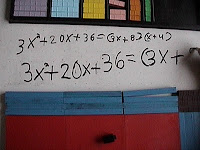
base ten blocks


Remember the child is seven, his writing skills are not well developed, first he wrote it too small then he wrote it too big for purposes of the picture but I think he did just fine...it was taking him quite a while to write it and I wanted to move on to the next problem...

The mind wants to work very rapidly, counting out individual units from the various manipulative sets takes too long. Sometimes even counting out tens or x's takes too long. So while sets that have base ten blocks with tens and individual units are quite useful they become tedious if you want to use them to demonstrate many problems in a row or even just a few larger problems. By larger I simply mean problems that will have a lot of pieces to get out. Showing 60% of 80 for example or even a simple problem like (x+6)(x+7) will require getting out 42 units...you already have to get out 13x, counting out 42 units takes a lot of time, and the student can often get lost (and bored) because of it; however, if all you have to do is get out an x-square, 6 sevens (or 7 sixes) and you can grab 7x and 6x, the problem can be built very rapidly.
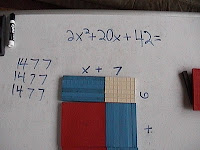
base 10 manipulativesIn this case he had the rectangle

2x2 + 20x + 42

And he had to find the sides. Later, when he knows his multiplication better, he will see that the factors of 42 will be a big help in solving this problem quickly, but for now he takes the 20x and makes a rectangle out of that...it took some trial and error to get 6x on top and 14x (two sets of 7x) so that they would fit...that was a lot of counting and adding. Then he still wasn't sure he had it right because he could not tell if 6 times 7 was 42 because he didn't know it. You can see him doing computation on the side...he has 14 three times and the sevens drawn out...again lots of math going on here to figure out if he has 42 or not. 30 + 4 times 3 or 30 plus 12, and then the long way where he has to add seven plus seven plus seven etc until he gets to 42. If he had to count out individual units this problem would have taken MUCH longer and he may not have finished it at all.

2x2 + 20x + 42 = (x + 7)(2x + 6)

(In the picture the 2x is cut off.) With a few simple pictures, you can actually SEE what it is I'm talking about. You can see that it becomes easy to teach counting and addition, and multiplication and division using algebra because the child has to count out and add up the blocks in order to build the rectangles needed to solve the problems. At this point you begin to see why a picture is worth a thousand words, and if a picture is worth a thousand words having your hands on the blocks and then being able to draw them is worth a thousand explanations. Further, this is the way the subconscious mind works, using pictures NOT symbols and we have come to realize over the last 100 years that most learning takes place in the subconscious mind not in the conscious mind.

Students who benefit from base ten blocks most are the kinesthetic learners, because they literally can get their hands on algebra and work with the problems. They can see and touch the problems in a very real sense. They can see that x times x is an x square, they can touch it...they see and touch the distributive theory of multiplication because they can see an x+3 is just a number with two parts (a binomial) and if I have 3(x+3) (spoken three times x plus three), I get 3x+9 and they can see it.

Getting this problem out is still easy even if the blocks you have are all individual units, but it's still easier to get out 3 threes...and by the way we can note than 9 is a square number when we build it this way. As soon as you do a problem like 5(x+8) counting out the 40 units is going to slow things down and actually take away from the lesson and the concept that the 5 multiplies the x and the 8. Manipulative sets that use rods to represent numbers are again quite useful but will have serious drawbacks when attempting to demonstrate algebra or square numbers and square roots because most often 3, 3-rods do not make a square. Simple concepts like x + x = 2x are easy for any student who is just learning to count. Base ten manipulatives or base ten blocks can be used for so much more than just counting or to teach addition. When used properly very young students can lean to count and add WHILE they learn algebra and vis-versa, and counting, adding and subtracting lead to multiplication and division.


"We used to think that if we knew one, we knew two, because one and one are two. We are finding that we must learn a great deal more about 'and'." ~Arthur Stanley Eddington, as quoted in A Dictionary of Scientific Quotations" (1991) by Alan L. Mackay, p. 79


Lastly for fun he got to build whatever he wanted. Lots of multiplication went on here as I made him count by nines and fives and tens.
Fun Math Activities

The tens are two fives so we counted pretty high by fives, and we counted all those nines (the teal colored one that make up the roof). Using the "trick" "one less and what does it need?" 6 nines is 54, which means 5 is one less than six and six needs four to be ten...for 14 nines it's two less and what does it need? 14 minus 2 is 12 and 4 needs 6 to be ten so (14)(9) = 126 We also counted by adding nines...

BTW you can check me out on FACE BOOK now...and get up dates etc...and of course get more at Crewton Ramone's House of Math