Here is a quick testimonial.
Going from F to A...in an hour a week.
Started in the 30's and worked our way up yo "C" the only way to do that is with a lot of "A's." This story is quite common at the house of math because once you understand the concepts all they can do is change the numbers. This student is studying algebra, specifically quadratics. Turns out it's not hard.
I always enjoy working with students who show marked improvement. Gives me a good reputation for math tutoring. I have to stress the student has to put in the time and effort, all I do it point the way. No one can do your push ups for you as they say. Especially in math.
I also enjoy the math enrichment students...the ones who come who already have good grades but just want to learn more or as the case may be they have an A but they are just going through the motions--they don't actually understand what the are doing. You'd be surprised how much this goes on. Lots of students sport an A but have no idea what they are doing or how it applies and memorize whatever it is just long enough to pass the test and then forget it again.
Here are some more testimonials if you are interested. The point is this system works. Mortensen Math is effective. If you are a teacher it will make you a better teacher because you get better tools to get the job done. If you are a home schooler you can learn math right along side your kids, the question often comes up how do I teach algebra if I never "got" algebra. Well, now you can.
Between my blog and website the excuses have been removed. Used to be people would by a kit and then not know what to do because they needed training and we didn't have enough on video. This caused me to do 3 years of traveling...while there is nothing like face time and personal training in groups with all the stuff I have for free on the net and all the stuff you can get for 5 bucks with a password the days of inaction and excuses about not knowing what to do or where to start are over.
Get yourself a kit and get going...or dust off your old one and get crackin'.
Showing posts with label Factoring Trinomials. Show all posts
Showing posts with label Factoring Trinomials. Show all posts
Friday, May 4, 2012


Monday, December 19, 2011
Crewton Ramone Doing Distribution With A Nine Year Old.
This positive factoring of polynomials is easy and fun for all ages. At the house of math we also do negatives, higher powers and more. If you would like to see problems like this factored then you need a password and there is an abundance of material on the advanced algebra page.

We did problems like to to help work on integers, this nine year ld has little problem with basic operations, and is having fun with fractions already, we will be covering more on this because right now he understands fractions from the point of view of the rules instead of the concepts. In other words he knows how to invert and multiply but he doesn't know why, he knows how to add fractions but he doesn't understand that he is making them "same" so he can add them...and the concept of multiplying by one is lost. But that's another post, this one is about factoring polynomials and it's many and varied uses for teaching math concepts beyond "just" distributive theory.
With young students you use if for cross teaching addends, addition, and multiplication as well as or in addition to factoring and how the distributive theory works. Once we get into negative factors we can use it to teach integers while we are learning about the distributive theory of multiplication.
This was just the warm up, we got into factoring the problems above and more. You can find them on the advanced algebra page, scroll down near the bottom. You will also find hours of other fun algebra there...but as you will see you need a password.
Find us on FaceBook.

We did problems like to to help work on integers, this nine year ld has little problem with basic operations, and is having fun with fractions already, we will be covering more on this because right now he understands fractions from the point of view of the rules instead of the concepts. In other words he knows how to invert and multiply but he doesn't know why, he knows how to add fractions but he doesn't understand that he is making them "same" so he can add them...and the concept of multiplying by one is lost. But that's another post, this one is about factoring polynomials and it's many and varied uses for teaching math concepts beyond "just" distributive theory.
With young students you use if for cross teaching addends, addition, and multiplication as well as or in addition to factoring and how the distributive theory works. Once we get into negative factors we can use it to teach integers while we are learning about the distributive theory of multiplication.
This was just the warm up, we got into factoring the problems above and more. You can find them on the advanced algebra page, scroll down near the bottom. You will also find hours of other fun algebra there...but as you will see you need a password.
Find us on FaceBook.
Tuesday, December 6, 2011
Fun Kindergarten Math Activities: Dboyz Play With Bigger Polynomials
Here are some fun problems:

We cover all of these in the longer 20 minute video. Here is the short version, but you can get to the longer vid from here if you like:
In order to get here we played with basic concepts for months. With a password you can have access to hours and hours of video, sample lessons, PDF's and more and you can see step by step how a 6 year old got here. People are quite amazed at just how much you can get for 3 bucks or 12 bucks for an annual pass. Those who buy annual passes before the end of the year are in for some pleasant surprises next year, along with those of you who have already bought a annual pass to show your support...prices will be going up and there are more products being worked on as we speak that will be available at good discounts for those who have already gotten an annual pass. Also there are going to be separate passwords for various topics but right now one password does it all. For those who just want to take a peak 3 bucks gets you a good 60 days worth...but don't expect any special treatment.
[Update: prices have indeed gone up. Look at the side bar for details.]
For a more complete blog post on with these very same videos go to Math Genius Making.
Of course be sure to find us on FaceBook, and go to the House Of Math for much more on the best use of base ten blocks and manipulatives for math enrichment so your child or students can be doing math like this with no problem.
Stay tuned like I say on my website, "I'm just getting started."
Tuesday, May 24, 2011
Factoring Fun With The Wee Ones
Little boys doing math, you can see their progress, and how they enjoy being mischievous as they are doing their lessons. Several inside jokes regarding counting can be observed. I especially enjoy teaching the 4 year old because he tests MY abilities every time.

You don't help them by doing it for them. Let them do it for themselves. Remove the no from the lesson...let them discover for themselves, teach them that failing is part of learning, and they they aren't wrong just getting more information. Tell them what they have not what they don't have...the basic concepts, I constantly remind myself of these things as I go along.
As a parent or teacher of course you want to show them how or help them when they are struggling to get the answer, but if you love them, let them do it themselves. You couldn't possibly do their walking for them, you could catch them when they fall (or kiss and make it better afterwards) and show them how to walk but the child has to get up and walk. It's the same with the math or any learning you can't just give it to them and expect them to know it, they have to discover for themselves. And when the light bulb goes off the satisfaction brings a smile every single time. Learning is fun.

Balance this by putting them in a situation where they cannot fail. Nothing is more cruel than a trick question or a question where they don't have enough knowledge to answer...it is frustrating and exactly not fun. Some teachers confuse this with "a challenge." Keeping it challenging is important and those challenges should come AFTER the child/student has attained a level mastery, occasionally on the way to attaining mastery but remember this ladder and the concept of degree of difficulty.
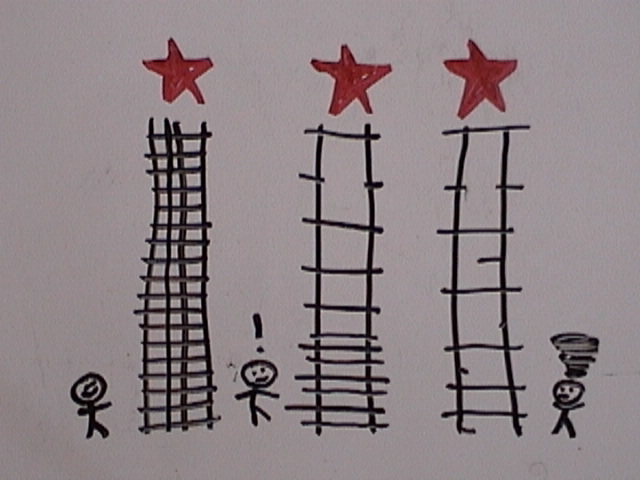
Which ladder you you rather climb?
In the half hour video which is on the sample lesson page the 4 year old exhibits some of the exact same thinking that many adults across the country did during my travels. He counts more than just the sides, he counts by fours instead of ones he is unable to move the pieces easily to form rectangles at first...but all of these things will be easy for him within the year...he's only 4. What is obvious to adults is not always obvious to children, your job is to make it obvious and let them discover it. Unlike the adults he doesn't have any judgment of himself when he gets it wrong or when he isn't getting it right, and he learns quickly from his mistakes and uses the knowledge instantly to help him solve other problems.
On the other hand, his brother who has more experience can see the answers easily and watching his brother really cements the knowledge in for him as he is dying to tell him the answers when the 4 year old doesn't get them right away. It was also fun to see the younger brother insist on making his different from his brother, different but still correct.
There is a lot more going on with this factoring lesson for me than just teaching them addends and multiplication.
He is still having fun learning and playing. Imagine where he will be with his understanding by the time he is 7 THREE years from now, 158 weeks away...300 or 400 lessons away...of course multiplication will be mastered by then, and all 45 addends and fractions and algebra and more. And I will be an even better teacher then than I am now because he will have had a chance to teach me so much more too.
The half hour lesson is available now with a password at the House of math. Factoring polynomials really is child's play, it's a shame more children don't get to play math this way and are relegated to addition and counting at this age.
Come play with us on Facebook.

You don't help them by doing it for them. Let them do it for themselves. Remove the no from the lesson...let them discover for themselves, teach them that failing is part of learning, and they they aren't wrong just getting more information. Tell them what they have not what they don't have...the basic concepts, I constantly remind myself of these things as I go along.
As a parent or teacher of course you want to show them how or help them when they are struggling to get the answer, but if you love them, let them do it themselves. You couldn't possibly do their walking for them, you could catch them when they fall (or kiss and make it better afterwards) and show them how to walk but the child has to get up and walk. It's the same with the math or any learning you can't just give it to them and expect them to know it, they have to discover for themselves. And when the light bulb goes off the satisfaction brings a smile every single time. Learning is fun.

Balance this by putting them in a situation where they cannot fail. Nothing is more cruel than a trick question or a question where they don't have enough knowledge to answer...it is frustrating and exactly not fun. Some teachers confuse this with "a challenge." Keeping it challenging is important and those challenges should come AFTER the child/student has attained a level mastery, occasionally on the way to attaining mastery but remember this ladder and the concept of degree of difficulty.
In the half hour video which is on the sample lesson page the 4 year old exhibits some of the exact same thinking that many adults across the country did during my travels. He counts more than just the sides, he counts by fours instead of ones he is unable to move the pieces easily to form rectangles at first...but all of these things will be easy for him within the year...he's only 4. What is obvious to adults is not always obvious to children, your job is to make it obvious and let them discover it. Unlike the adults he doesn't have any judgment of himself when he gets it wrong or when he isn't getting it right, and he learns quickly from his mistakes and uses the knowledge instantly to help him solve other problems.
On the other hand, his brother who has more experience can see the answers easily and watching his brother really cements the knowledge in for him as he is dying to tell him the answers when the 4 year old doesn't get them right away. It was also fun to see the younger brother insist on making his different from his brother, different but still correct.
There is a lot more going on with this factoring lesson for me than just teaching them addends and multiplication.
He is still having fun learning and playing. Imagine where he will be with his understanding by the time he is 7 THREE years from now, 158 weeks away...300 or 400 lessons away...of course multiplication will be mastered by then, and all 45 addends and fractions and algebra and more. And I will be an even better teacher then than I am now because he will have had a chance to teach me so much more too.
The half hour lesson is available now with a password at the House of math. Factoring polynomials really is child's play, it's a shame more children don't get to play math this way and are relegated to addition and counting at this age.
Come play with us on Facebook.
Sunday, December 12, 2010
Introduction to Pythagorean Theorem
I Introduced a 4 and a 5 year old to Pythagorean Theorem. Really it's that easy.
In the first part of the video you see him factor a problem he's never seen before:
x2 + 8x + 12
The day and week before, he has already done x2 + 8x + 16 a couple of ways once as a problem for completing the square:
x2 + 8x + ?? ?? = What completes the square?
and once as a problem for factoring where he got all the info:
x2 + 8x + 16 and we talked about (x+4)2.
To make it a bit of a challenge I changed it to x2 + 8x + 12. But he's almost at the point where they are all EASY.
Note how his brother builds squares and the quietly arranges them according to size while I am focused on his brother...he received a lot of praise off camera when we reviewed this video together.
Then we played with the concept of squaring the sides of a triangle.
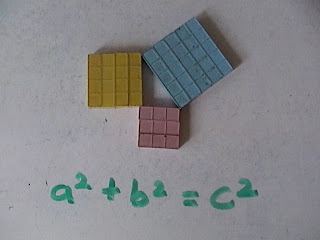
If you build the lesson correctly where your students have to play with the triangles and tell YOU about the relationships (instead of the other way around) you will find 90% of your students will come back with
a2 + b2 = C2!!!
We can also see that later when they see
a2 = c2 - b2 or
b2 = c2 - a2
it will make total sense to them.
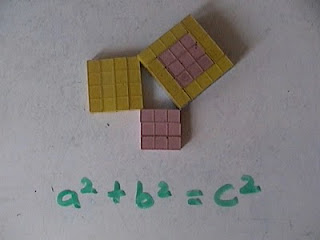
This was just the first time they saw this and they will see it many times again before they reach the ripe old age of 7...note how in the video I didn't even write out the equation. We just played with the blocks and got an experience of the concepts. Next time when we do write the symbols that go along with the blocks they will understand what it means instead of just memorizing a formula.
They will also see that a + b > c ALWAYS, although they may make the joke 3 + 4 = 5 they will know it's a joke and that 32 + 42 = 52 is true but 3 + 4 = 5 isn't.
Also note how much faster and easier this lesson is now that they each can skip count by 3's 4's and 5's...and this lesson gave then another chance to practice skip counting.
Stay tuned for an additional video that is a more formal lesson for YOU on Pythagorean Theorem sans little children where we can see how to make "Pythagorean Triples" and understand more about the theorem before we ever have to get out our square rooting skills for numbers that aren't perfect squares.
I talked to a few teachers who never saw a proof of this...they just got the formula and memorized it. I talk to teachers all the time that are amazed by this little demonstration...INCLUDE it in your lessons with little kids.
The House of Math on FaceBook.
The House of Math
Learn algebra for a buck.
Pythagorean Theorem at the House of Math.
“It isn't enough just to learn -- one must learn how to learn, how to learn without classrooms, without teachers, without textbooks. Learn, in short, how to think and analyze and decide and discover and create." -- Michael Bassis
In the first part of the video you see him factor a problem he's never seen before:
x2 + 8x + 12
The day and week before, he has already done x2 + 8x + 16 a couple of ways once as a problem for completing the square:
x2 + 8x + ?? ?? = What completes the square?
and once as a problem for factoring where he got all the info:
x2 + 8x + 16 and we talked about (x+4)2.
To make it a bit of a challenge I changed it to x2 + 8x + 12. But he's almost at the point where they are all EASY.
Note how his brother builds squares and the quietly arranges them according to size while I am focused on his brother...he received a lot of praise off camera when we reviewed this video together.
Then we played with the concept of squaring the sides of a triangle.
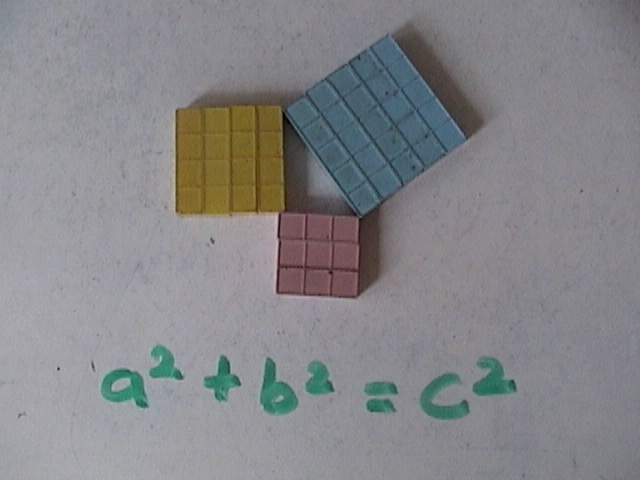
If you build the lesson correctly where your students have to play with the triangles and tell YOU about the relationships (instead of the other way around) you will find 90% of your students will come back with
a2 + b2 = C2!!!
We can also see that later when they see
a2 = c2 - b2 or
b2 = c2 - a2
it will make total sense to them.

This was just the first time they saw this and they will see it many times again before they reach the ripe old age of 7...note how in the video I didn't even write out the equation. We just played with the blocks and got an experience of the concepts. Next time when we do write the symbols that go along with the blocks they will understand what it means instead of just memorizing a formula.
They will also see that a + b > c ALWAYS, although they may make the joke 3 + 4 = 5 they will know it's a joke and that 32 + 42 = 52 is true but 3 + 4 = 5 isn't.
Also note how much faster and easier this lesson is now that they each can skip count by 3's 4's and 5's...and this lesson gave then another chance to practice skip counting.
Stay tuned for an additional video that is a more formal lesson for YOU on Pythagorean Theorem sans little children where we can see how to make "Pythagorean Triples" and understand more about the theorem before we ever have to get out our square rooting skills for numbers that aren't perfect squares.
I talked to a few teachers who never saw a proof of this...they just got the formula and memorized it. I talk to teachers all the time that are amazed by this little demonstration...INCLUDE it in your lessons with little kids.
The House of Math on FaceBook.
The House of Math
Learn algebra for a buck.
Pythagorean Theorem at the House of Math.
“It isn't enough just to learn -- one must learn how to learn, how to learn without classrooms, without teachers, without textbooks. Learn, in short, how to think and analyze and decide and discover and create." -- Michael Bassis
Monday, December 6, 2010
4 Year Old Math Enrichment
A bright 4 year old has a fun time playing math. Before we knew it an hour had gone by. I remembered to take the camera out after about 20 minutes...we had already done some counting, added random numbers together and then started adding pairs, starting easy 1+1 and working our way up to 9+9. All 45 addends will be mastered using base ten blocks. I enlarged the photos in this post a little for those who use Pinterest.


Then we did some multiplication and division. He likes division because he only has to count one side. We count by eights, then we count the sides, then we count the rectangle and each side. He can see 24 ÷ 8 = 3. The three eights are visually obvious too.
 Then we have fun counting and building 20 sixes.
 And even more fun knocking them down.
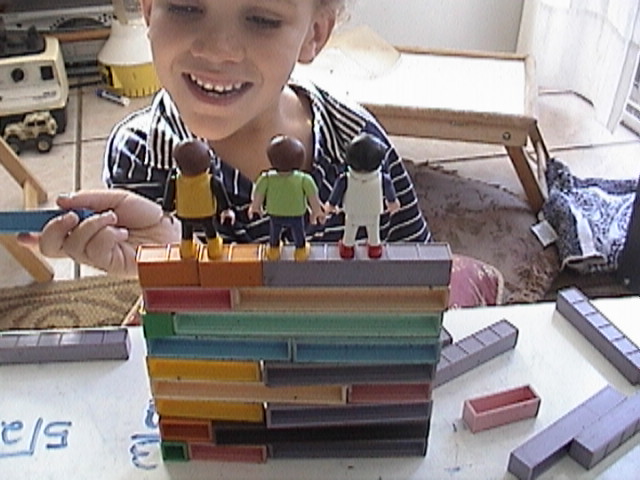
 A free time wall. He had no rules to follow when he built this wall he just built it. The addends for 10 and some smaller numbers are being learned here people think this is all that base ten blocks are good for, making tens and some place value but you can do so much more. Again knocking the thing over is the most fun...
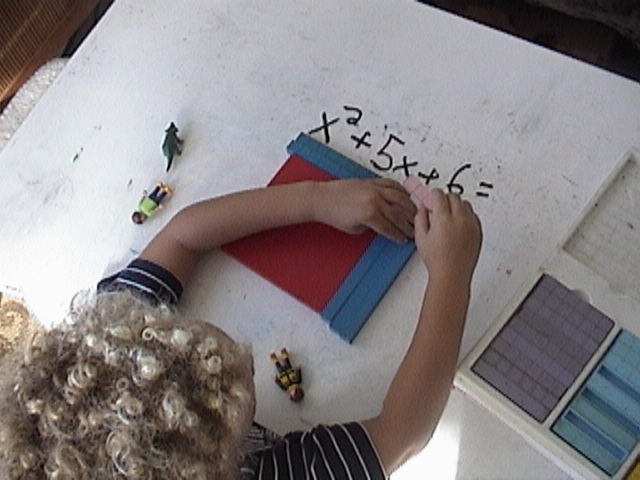
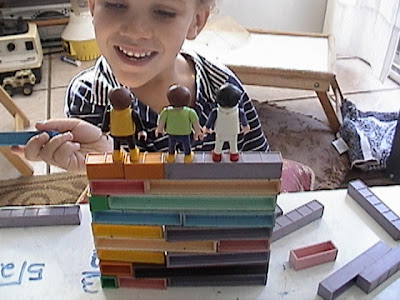 On to some algebra puzzles. I tell him the pieces and he has to turn them into a rectangle. Base ten blocks are great for teaching algebra and addends and a whole lot more.
 The men help him count the sides.
 This one problem teaches him about counting, addends, factoring, multiplication and algebra all in one lesson. This took about 15 minutes from start to finish...15 is a lot to handle when you are four. Note if he had to get out 15 individual units this problem would be nearly impossible and would take a lot longer.
 He took a while figuring out which blocks to make his 15 with, he has some experience factoring so he knows a 10 and a 5 aren't going to cut it.
 At last he has decided on 5's. He uses them to shape the rest of his rectangle. I tell my high school students what this child already knows: the way to factor it lies in the factors of the constant.
 Now that he has three fives all he has to do is make those pesky x's form a rectangle.

A little more work and he has it.
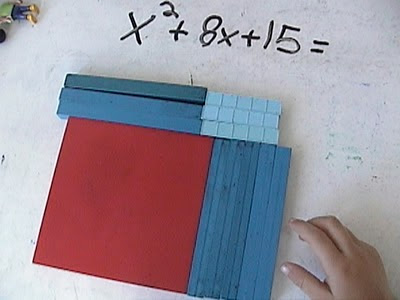 Now his pals can help him count the sides.
 Just for the fun of it he wrote the factors himself to the best of his ability.
 "It almost looks like a 5"
 He was quite proud of his 3. Using base ten blocks to teach concepts and understanding of math is a very powerful thing. Just because they can't write doesn't mean they can't learn math; writing isn't a perquisite for math anymore than writing is a prerequisite for learning English. You will find that students who learn math this way will be able to do a lot more math in their heads than students taught using the current completely ineffectual way we use now.
 x2 + 8x + 15 = (x + 5)(x + 3) is easy and fun to do and completely understood. One means the rectangle the other means the sides. Later we will deepen understanding and add more concepts on top of these basics. Can you see math will always be easy for this child? No fear of new stuff in the future because he has math experience now. Using base ten blocks makes understanding math easy and fun...child's play.
He helps me do the same screen cast:
If you enjoyed this post you will also enjoy this popular post and screencast showing much less structured play with clay for learning math concepts. Math enrichment and a math rich environment go hand in hand.
Find us on FaceBook
Go to the House of Math.
Learn more Algebra for a just a few bucks.
Trig for 8 year olds. Just what it says, click the link and find out more.
This post remains popular going on two years later...he was just 4 and 1/4 when we made this...now algebra is no big deal and fractions and multiplication are fun...he is the go to guy in his kindergarten class when kids want to know what to do when they have math.
And now he is the go to guy in 1st grade. Please take a moment and watch the vid on the concepts page under the heading "Early Exposure to Math Concepts Helps Ensure Success." It's only 3 and a half minutes long and should help dispel the myth that you don't want to start math too early. There is no "too early."
Give your young child the advantage in math with my cool counters compendium.
“I care not what subject is taught if only it be taught well.” ~Thomas Henry Huxley
Tweet

Get this book if you have children 7 and under...find out more about it, and a look inside here. You can get it without a password for just $4.99 People's comments about the base ten block book here.




He helps me do the same screen cast:
If you enjoyed this post you will also enjoy this popular post and screencast showing much less structured play with clay for learning math concepts. Math enrichment and a math rich environment go hand in hand.
Find us on FaceBook
Go to the House of Math.
Learn more Algebra for a just a few bucks.
Trig for 8 year olds. Just what it says, click the link and find out more.
This post remains popular going on two years later...he was just 4 and 1/4 when we made this...now algebra is no big deal and fractions and multiplication are fun...he is the go to guy in his kindergarten class when kids want to know what to do when they have math.
And now he is the go to guy in 1st grade. Please take a moment and watch the vid on the concepts page under the heading "Early Exposure to Math Concepts Helps Ensure Success." It's only 3 and a half minutes long and should help dispel the myth that you don't want to start math too early. There is no "too early."
Give your young child the advantage in math with my cool counters compendium.
“I care not what subject is taught if only it be taught well.” ~Thomas Henry Huxley
Tweet
Get this book if you have children 7 and under...find out more about it, and a look inside here. You can get it without a password for just $4.99 People's comments about the base ten block book here.
"Great book for teaching how to use the blocks! Colorful, clear pictures and cute rhymes make the book fun to read and play around with. We printed the book out, and my 5yo loves how many of the block pictures are big enough to put his blocks directly on top of the pictures. The text plays fast and loose with niceties like punctuation, but is engaging when read aloud.
Most of the book focuses on playing with addition facts up to 10, which gives a solid foundation. But it also delves briefly into such topics as square roots, place value, addition of multi-digit numbers, and a glimpse at multiplication. And in true Crewton Ramone fashion, problem solving with 'x' (basic algebra) is sprinkled throughout. A great intro to playing with math." ~CS, GA.
Most of the book focuses on playing with addition facts up to 10, which gives a solid foundation. But it also delves briefly into such topics as square roots, place value, addition of multi-digit numbers, and a glimpse at multiplication. And in true Crewton Ramone fashion, problem solving with 'x' (basic algebra) is sprinkled throughout. A great intro to playing with math." ~CS, GA.
Wednesday, October 27, 2010
Base Ten Blocks for Algebraic Factoring & Division

Here are a couple of videos showing how to factor and divide positive trinomial expressions.
The first video shows how to factor bigger expressions.
Starting with (3x)(2x) = 6x2
And then moving through these:
2x2 + 13x + 15
3x2 + 14x + 15
3x2 + 15x + 12
3x2 + 11x + 10
6x2 + 7x + 1
6x2 + 8x + 2
6x2 + 12x + 6
Note that the idea or concept is to get used to using the constant and the coefficient of x2 to figure out how to factor the problem. Most lessons from video tutors and how to vdeos on TeacherTube and YouTube tell the students to guess at it or just try all the factor combinations. If they get familiar with these problems they can begin to work out their own algorithms and rules for how to factor the bigger ones, because there is a method to it beyond just trying sets of factors.
And here we see how multiplication and addends are SO important and need to be mastered in order make algebra easy. Which is why you see me stress the 45 addends and multiplication over and over again with the younger students. For the older students who are often having a hard time, going back to the basics of multiplication and addends makes huge improvements in algebra FAST.
The second video shows how to take factoring problems and turn them into division problems. Soon you will be able to get an eCourse that shows you step by step how to do it. Right now if you want to see how to do negative expressions using the blocks you'll need a password to get into this page.
Once you get familiar with these you'll see that the following set of problems are related and are actually pairs of problems.
x2 + 7x + 12.......... x2 - x - 12
x2 + 9x + 18.......... x2 + 3x - 18
x2 + 10x + 24.......... x2 + 2x - 24
These are out of sequence as it were because we did a load of (negative) problems before we got to these:
2x2 + 8x + 6 I forgot to mention it in the video screencast but you might want to take a moment and turn this into a division problem too...you know the factors. See if you can.
This expression cannot be factored which is why we have the quadratic equation:
2x2 - 3x - 27 but this one can
2x2 + 3x - 27 BTW they told me this I didn't tell them how to make it "factorable."
And again this one cannot be factored 2x2 + x - 8 but
2x2 + x - 10 can.
And this one is SUPER EASY
3x2 - 15x + 12
in fact you see it in all positive form in the first video. If you want to see it done with the blocks and a even a drawing you will need a password as I mentioned earlier. If you go there right now you will find an hour's worth of videos you can't get anywhere else. I'll be adding even more video and things like pdfs and links to further explanations but there should be plenty there to keep you occupied there NOW. The hour's worth of video is worth a buck.
Check out the Parents/Teachers Tab it now has MUCH more stuff including links to websites that offer lots of USEFUL FREE stuff, like lesson plans, grant information, discounted school supplies and more. I also took the trouble to get you discount codes for 10% to 20% more off...cuz I'm cool like that.
PDF files are also coming, more products from Mortensen Math more free video and more pasword protected pages...and like I said eCourses are coming too...

Watch the video on the Preview and Purchase page that gives you a page by page over view of the PDF so you can "try before you buy", see exactly what you are getting and be confident it will be money well spent.
http://www.facebook.com/Crewton.Ramone
http://www.crewtonramoneshouseofmath.com
Base Ten Blocks for Algebraic Factoring & Division
Here are a couple of videos showing how to factor and divide positive trinomial expressions.
The first video shows how to factor bigger expressions.
Starting with (3x)(2x) = 6x2
And then moving through these:
2x2 + 13x + 15
3x2 + 14x + 15
3x2 + 15x + 12
3x2 + 11x + 10
6x2 + 7x + 1
6x2 + 8x + 2
6x2 + 12x + 6
Note that the idea or concept is to get used to using the constant and the coefficient of x2 to figure out how to factor the problem. Most lessons from video tutors and how to vdeos on TeacherTube and YouTube tell the students to guess at it or just try all the factor combinations. If they get familiar with these problems they can begin to work out their own algorithms and rules for how to factor the bigger ones, because there is a method to it beyond just trying sets of factors.
And here we see how multiplication and addends are SO important and need to be mastered in order make algebra easy. Which is why you see me stress the 45 addends and multiplication over and over again with the younger students. For the older students who are often having a hard time, going back to the basics of multiplication and addends makes huge improvements in algebra FAST.
The second video shows how to take factoring problems and turn them into division problems. Soon you will be able to get an eCourse that shows you step by step how to do it. Right now if you want to see how to do negative expressions using the blocks you'll need a password to get into this page.
Once you get familiar with these you'll see that the following set of problems are related and are actually pairs of problems.
x2 + 7x + 12.......... x2 - x - 12
x2 + 9x + 18.......... x2 + 3x - 18
x2 + 10x + 24.......... x2 + 2x - 24
These are out of sequence as it were because we did a load of (negative) problems before we got to these:
2x2 + 8x + 6 I forgot to mention it in the video screencast but you might want to take a moment and turn this into a division problem too...you know the factors. See if you can.
This expression cannot be factored which is why we have the quadratic equation:
2x2 - 3x - 27 but this one can
2x2 + 3x - 27 BTW they told me this I didn't tell them how to make it "factorable."
And again this one cannot be factored 2x2 + x - 8 but
2x2 + x - 10 can.
And this one is SUPER EASY
3x2 - 15x + 12
in fact you see it in all positive form in the first video. If you want to see it done with the blocks and a even a drawing you will need a password as I mentioned earlier. If you go there right now you will find an hour's worth of videos you can't get anywhere else. I'll be adding even more video and things like pdfs and links to further explanations but there should be plenty there to keep you occupied there NOW. The hour's worth of video is worth a buck.
Check out the Parents/Teachers Tab it now has MUCH more stuff including links to websites that offer lots of USEFUL FREE stuff, like lesson plans, grant information, discounted school supplies and more. I also took the trouble to get you discount codes for 10% to 20% more off...cuz I'm cool like that.
PDF files are also coming, more products from Mortensen Math more free video and more pasword protected pages...and like I said eCourses are coming too...
Divinely Dandy Non Difficult Division
 Get Divinely Dandy Non Difficult Division for just $19.99. This book will show you everything you learned here and MORE laid out step by step with links to videos and pages that give simple concise explanations for how to use the rectangle to organize thought, how to introduce division concepts at a very young age, and how to make fun while you are doing it. I guarantee that video alone will expand your thinking when it comes to division and math.
Watch the video on the Preview and Purchase page that gives you a page by page over view of the PDF so you can "try before you buy", see exactly what you are getting and be confident it will be money well spent.
http://www.facebook.com/Crewton.Ramone
http://www.crewtonramoneshouseofmath.com
The first video shows how to factor bigger expressions.
Starting with (3x)(2x) = 6x2
And then moving through these:
2x2 + 13x + 15
3x2 + 14x + 15
3x2 + 15x + 12
3x2 + 11x + 10
6x2 + 7x + 1
6x2 + 8x + 2
6x2 + 12x + 6
Note that the idea or concept is to get used to using the constant and the coefficient of x2 to figure out how to factor the problem. Most lessons from video tutors and how to vdeos on TeacherTube and YouTube tell the students to guess at it or just try all the factor combinations. If they get familiar with these problems they can begin to work out their own algorithms and rules for how to factor the bigger ones, because there is a method to it beyond just trying sets of factors.
And here we see how multiplication and addends are SO important and need to be mastered in order make algebra easy. Which is why you see me stress the 45 addends and multiplication over and over again with the younger students. For the older students who are often having a hard time, going back to the basics of multiplication and addends makes huge improvements in algebra FAST.
The second video shows how to take factoring problems and turn them into division problems. Soon you will be able to get an eCourse that shows you step by step how to do it. Right now if you want to see how to do negative expressions using the blocks you'll need a password to get into this page.
Once you get familiar with these you'll see that the following set of problems are related and are actually pairs of problems.
x2 + 7x + 12.......... x2 - x - 12
x2 + 9x + 18.......... x2 + 3x - 18
x2 + 10x + 24.......... x2 + 2x - 24
These are out of sequence as it were because we did a load of (negative) problems before we got to these:
2x2 + 8x + 6 I forgot to mention it in the video screencast but you might want to take a moment and turn this into a division problem too...you know the factors. See if you can.
This expression cannot be factored which is why we have the quadratic equation:
2x2 - 3x - 27 but this one can
2x2 + 3x - 27 BTW they told me this I didn't tell them how to make it "factorable."
And again this one cannot be factored 2x2 + x - 8 but
2x2 + x - 10 can.
And this one is SUPER EASY
3x2 - 15x + 12
in fact you see it in all positive form in the first video. If you want to see it done with the blocks and a even a drawing you will need a password as I mentioned earlier. If you go there right now you will find an hour's worth of videos you can't get anywhere else. I'll be adding even more video and things like pdfs and links to further explanations but there should be plenty there to keep you occupied there NOW. The hour's worth of video is worth a buck.
Check out the Parents/Teachers Tab it now has MUCH more stuff including links to websites that offer lots of USEFUL FREE stuff, like lesson plans, grant information, discounted school supplies and more. I also took the trouble to get you discount codes for 10% to 20% more off...cuz I'm cool like that.
PDF files are also coming, more products from Mortensen Math more free video and more pasword protected pages...and like I said eCourses are coming too...
Watch the video on the Preview and Purchase page that gives you a page by page over view of the PDF so you can "try before you buy", see exactly what you are getting and be confident it will be money well spent.
http://www.facebook.com/Crewton.Ramone
http://www.crewtonramoneshouseofmath.com
Thursday, October 8, 2009
Continuing Down The Algebra Path

Again this work was done by a 7 year old. The first two are familiar to him he did them with ease and the third one was new ad he had to do it all be himself. Zero help from me.
Then we went into a lesson about concept number two: the highest number we count to is NINE, we only count SAME kind, and the numbers just tell you how many; the places tell you what kind, in algebra the symbols (x, y, x2 etc.) tell you what kind the numbers tell you how many and again we can only count same kind. This also applies to fractions. Understanding the five concepts and making sure they understand how they relate to each part of the math is crucial.

Now that we understand where we are and where we are going and why, a set of problems arranged by degree of difficulty is given. The point of this lesson is to go from drawing to symbols so that they can eventually go from symbols to drawing with ease. We want them to go back and forth easily. They have the ability to do this because the only skill they really need is the ability to count. Then we can re-inforce addends, simple multiplication, factoring and lastly factoring trinomials.

Right now this child is getting comfortable with trinomials and when we move on to explain the distributive theory of multiplication as it applies to two binomials, it's going to be simple and OBVIOUS. Right now we are "just counting".
Earlier in the lesson we built all the addends to 18, and practiced the patterns for multiplication for 2, 3, 4 and 5 by counting as we built towers using the same blocks.

Again the time flew by and best of all we had FUN.
More Algebra on Crewton Ramone's House of Math website.
Just donate a buck thirty three...
Subscribe to:
Posts (Atom)