Here you will see students as young as 4 and 5 years old doing algebra and "advanced" math, without ever knowing it's supposed to be hard.
You are invited to learn how to use this method...


Showing posts with label Addition. Show all posts

Tuesday, October 20, 2015

House For A Duck.


Playing math often means learning math without really knowing you are learning math....when you are four or five. In this case we learned a lot of math, addends specifically, without worksheets without pencil, pens or paper. We just built a house for a duck and as an added bonus got a few more repetitions for these addends added to the long term memory. It takes many repetitions starting at an early age to get math facts (or any facts) into "the long term memory" and available for instant recall, but as you will see it's easier when they are younger and here is WHY.

Where most of you err particularly with multiplication is you try to cram the number of repetitions into a short time frame usually well after the brain is out of the "download mode". This can be effective but it has been my experience that this can also cause a host of problems particularly when it comes to math anxiety and attitude toward math in general. Instead of a fun and exciting language that underlies ALL of science and explains the universe around them via the physics and chemistry and biology it becomes drudgery and something that requires a lot of mental effort to memorize a host of math facts that don't seem to go together.

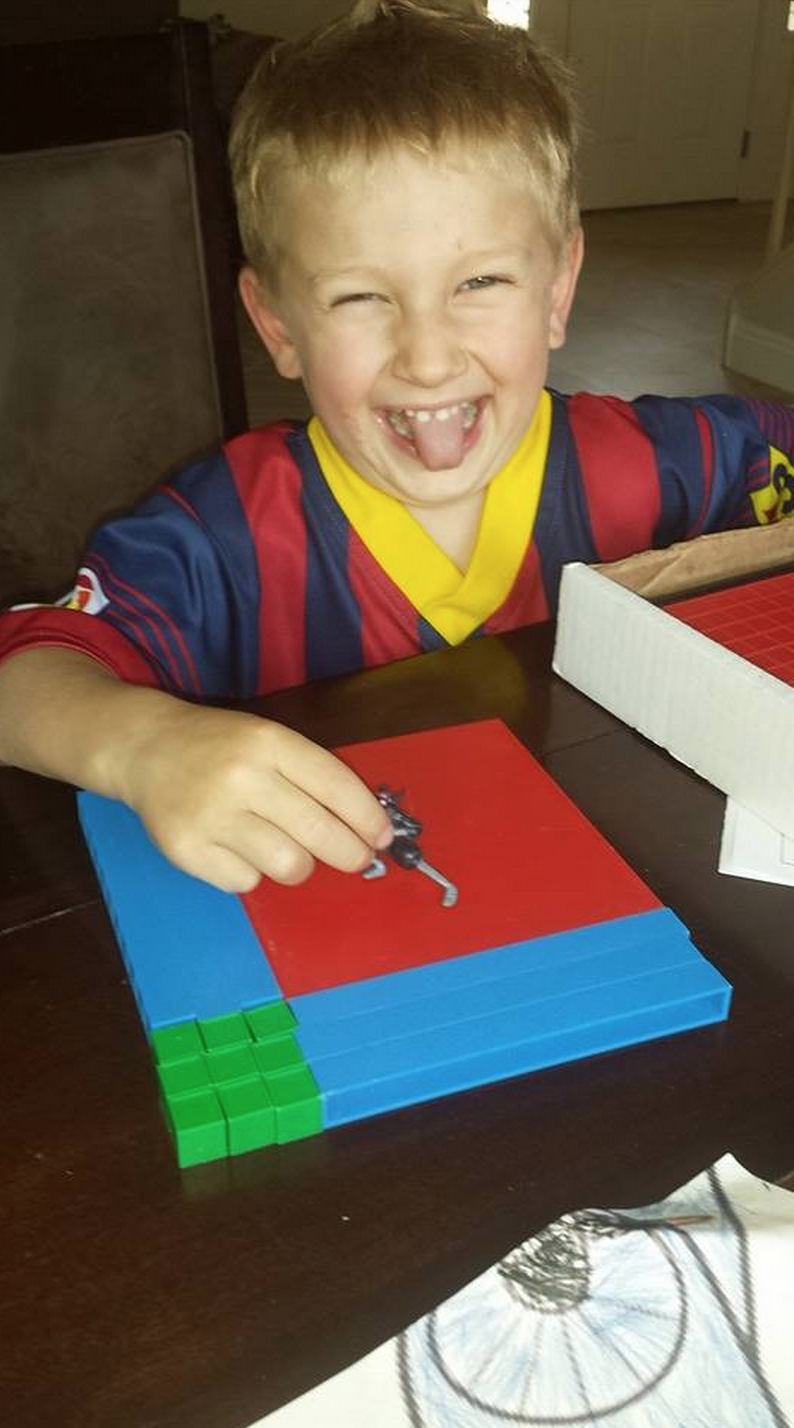
Using base Ten Blocks to Make A House For A Duck, You can also see a math bag in the background because we played what's under the cup too. We had fun while learning basic addends less than 10.


What you want to do is make positive associations with mathematics and avoid having to pound math facts into your children. This is what happens when you wait until they are past the age of 7 or 8 to teach them math. The very basics, 45 addends and 400 multiplication facts are learned easily before the age of 7; it is much harder after this age because the brain state has changed.

If you want to be an effective teacher you need to understand a little about how the brain works and how to put information in it. I will have more on this later but the basic is this:


When the child is naturally in "theta", they are basically in download mode. Learning anything is easier for ANYone while in theta, there is an entire industry dedicated to selling audio technology that puts the brain into these states for "super learning"...being happy and unstressed adds to this ability to learn easily. I cover this in Parent/Teacher training.

Removing "the NO" from the lesson is important because "NO" is a charged word that has all manner of negative associations attached to it even by the age of 5. Just hearing "no" is enough to make some children mad or sad or angry which activates the reptilian brain (cerebellum) which shuts down the prefrontal cortex which activates the fight or flight response where blood is pushed into the limbs NOT into the part of the brain that facilitates learning or higher order thinking.


By age six or seven "downloading" is no longer the default setting as it were and they begin spending more time in alpha and then by age 12 beta (and with training Gamma, a state not shown here and a state associated with "miracles" and the "paranormal" and other psychic abilities not easily explainable by modern science but which can be achieved with "practice.").  Logically the best time to teach a large amount of factual information is in the early years when it is easy down loaded or assimilated. The names of states and their capitols, Presidents, the ABC's and of course math facts like 7x8 and 17 squared are easily learned and stored in the subconscious for easy recall at earlier ages.  And if you make a game of it and make it fun, the learning is easier still.  Play math. Not worksheets.

At Crewton Ramone's House of Math as with Mortensen and Montessori, we emphasize whole brain activities...using both hands for example is VERY important, but can you also see that involving the other sensory cortexes would make learning easier? This is because we use more of the brain. This has been borne out by research at major universities.

This seems obvious to those of us that use manipulatives to teach math but quite a few others are only just now discovering that the more senses you involve the easier learning is.

WHEN you teach is also an important factor...as the child gets older more repetition is required to put information into the sub-conscious mind to be made available for instant recall.   In other words the older the child is the harder it will be to memorize multiplication tables...learn a new language or most any subject.  This does not; however, mean it can't be done. Obviously, it just means it will be harder,  take longer, and often involves a lot of tears and frustration.

Any student properly motivated and who is relaxed and happy can learn math at any age. I have proven this repeatedly for over 25 years with students of all ages including adults. But it is FAR easier if you get them young because by the time they are teens many factors are working against you, brainstate being primary among them but as you know, attitude and motivation may be lacking by the time they reach their teen age years, plus there is the added conditioning of past failures and the thought that math is hard instead of something easy and fun.

Here is theory in action. He sees the math facts. He hears the math facts. He experiences the math facts. He has fun. I should have put the camera on him when he told his parents he was done because you could see the satisfaction and pride in the smile on his face. Such a simple thing building a house for a duck, but terribly important for you to understand that through play we learn math, sans tears or fears and without "robbing them of their childhood", but instead making life far easier for him and others like him down the road.


Once (while) addends are mastered, multiplication which is just repetitive addition also becomes easy and we lessen the chance of losing them to multiplication tables and the stupidity that is the way we currently try to force feed students math at a late age.

Come join me on facebook. Share and like this post.


Sunday, March 22, 2015

Simple Base Ten Blocks Teach Many Math Concepts.


One of the math moms on facebook posted this pic. 

My response:

Nice, now change the game and make it so he can only use one three...then the other ones have to be a two and a one or three ones, you might mention right now they are all three plus zero and it's more fun to make combinations...same with the four, only use one four and the others have to be addends for four and so on also nothing says you only have to use 4 on the corners, you can use 5 or 6 or 7 or more pillars...then you can play "jenga" an see if you can take pillars out without knocking the whole thing down...then when does fall down just build it again and see who can take the most pillars out before it falls...Also, make a video of it and maybe you could win something.

Many math concepts can be learned with just this one simple exercise. You can slide a 2 into the level that he built with three's and the concept that 2 is "smaller than" three is easily seen...in math we could say less than...and we could show the symbols on a white board if we wanted to but at this age playing blocks and verbal reinforcement is enough. You are creating a math rich environment, where several of the senses are used to learn math and basic math concepts like more and less and addition and of course subtraction.

The mind absorbs all this then later (days, weeks, months or even years) this experience can be drawn upon to make sense of these symbols: 2 < 3...

You could put on the skip count CD or multiplication rock vids on youtube in the background and sing along as you skip count the threes he has used. PLAY, make teaching addition fun; little kids love to sing and they don't much care if you can carry a tune or not as long as you are making a joyful noise.

Anyhow make a vid of your kids playing math and you might win some cool stuff. UPDATE: this part is over but you should still check out primal math for some cool apps...Zombie Fish Bits is fun....


If you'd like a FREE manual on showing how to teach even very young children a super easy way to subtract click this link to my Supremely Simple Subtraction manual. A new Games and Activities Manual is in the works but it will be a while so meantime use the old one. (Takes a while to load so give it a minute...)

Another math mom on facebook posted this pic. 

My response:
Excellent...! Now you can talk to him about the 9 in the corner...you could flip the blocks over and count 1 hundred, 6 tens and 9 units...you could talk about square roots and square numbers playfully with the 9 and the 169...and of course the polynomial...x² + 6x + 9...the square root is one side which is x + 3....and of course (x+3)² = (x+3)(x+3) = x² + 6x + 9 and you talk about economy of symbol...that we don't need to write it twice...you could talk about 13² = (13)(13) = 169...you could have him draw a simple picture of it...and talk about these things while he's making his drawing...note I say could you don't have to...you could write some symbols and show him how those symbols describe his creation the same way words can describe a brown cow...and you do it casually, not drilling him not formal instruction just,  "hey...look at these green ones there--they make a square and we can count the sides or one side...hey look at that! You made all those blocks into a square can you count the sides? What's the blue one called?"

If you are on the base ten side he should say, "10...and three units." Or something like that. And you could say, "what's the name for one ten and 3 units...?"

If they are on the smooth side and you are in base x, the blue one's name is x and three units...

A ton of math concepts can be taught off of this one rectangle...you don't need to cover all of them at once...just a few at a time. Check this post out, it talks about all the things you can use this simple rectangle (square) for, when it comes to teaching math concepts.

Now build one that's 14 or x+4 squared...and then 15...or maybe he wants to make a different shape with his 6x...and make it (x+2)(x+3) or some other combination for 6, 5+1, 4+2, 3+3...still 6x but now a different number fits in the corner...just play math, bigger is funner.

Wednesday, December 31, 2014

Bases For Practicing Math

Here is a lesson that uses bases for practicing math.

This is again cross teaching or a compound lesson. I am not interested so much in the student memorizing what one number in base ten is in another base, I am interested in the student being able to grasp some basic concepts like numbers are made out of other numbers, a deeper understanding of place value, a deeper understanding of division concepts...how many times is a number contained in another number--that's basic division.

When we convert from base ten to another base like 2 or 3 IT'S FUN to do. Kids enjoy it if you present it correctly.


This blog post is just to give you some ideas. I'll add more video on this later...I made this video on a lark because a parent was having some trouble explaining division. Play with this a little bit and long division will be a snap. I have lots of other videos on long division and using algebra to teach not only division but the other basic operations as well.   Algebra is just generic math.


This video stops before we get to the repeating decimal. As I was doing this I was thinking too many concepts at a time. Keep it simple...next time we come back to this we can take it a step further and see what happens when we divide by sevens or nines...for not finding out how many time one number is contained in a another number with division should become much easier after converting to bases where you have to think about multiplication and subtraction with different numbers. For example converting 100 into base two...we don't need a 128,  but we do 1-64, 1-32, no 16's, no 8's one 4 and no 2's or 1's...so 1100100. When you are a little kid that's a lot of thinking. But it makes sense and they can see that what they are basically doing is adding 64 to 32 to 4 to get 100...and keeping track with symbols in certain places...that one in the middle of the zeros means one four. Converting it into base three or 4 is also FUN.

I didn't get hung up in the details of notation, but instead focused on focused on the basic concepts.  I assure you when they go do base ten or base x division it will be easier...and again doing division in base x makes "regular" long division easier too.  Repetition is the mother of skill and memory but that doesn't mean you repeat the same thing over and over again. We want them to learn the 45 addends and their multiplication tables....this exercise practices all of that. For the little kids stat out with base two and maybe later do some base three. Do a few easy ones and work your way up.

I often start with base two and then make a table...from x⁰ to x10 across the top (largest on the left to smallest on the right) and then going down the right hand side binary, 3 to 10, 12 and then 16. Just making the table is a great exercise...do as much as you can without a calculator. Then it's fun to punch a calculator and get the answers, unless you are interested in the students practicing the computation. You might want to do it in stages over several lessons so it doesn't get tedious.


Here are the answers...

This gave me an idea for a password protected page called "solutions."


This post is mostly done, check back there may be more...Winter break is proving very challenging for getting things done....lol...

Sunday, November 30, 2014

More Compund Lessons With Base Ten Blocks

Part of what makes this method so effective is the idea of compound lessons. Why learn "one thing at a time"? One thing at a time is great when introducing concepts...but once concepts are understood it's more fun to practice more than one thing at a time, which is why I emphasize compound lessons.  And as you can see using base ten blocks to do it makes math fun.

algebra with base ten blocks, mortensen math, fun math activities
A six year old factors x² + 11x + 30 all by himself and celebrates with his magical math microphone.
People ask me what they should get. Get a combo kit. A set of Multi-Tens and a password or both passwords...and you are good to go. Seriously.  That's it.

In this hour we practiced mostly addition and multiplication but we did activities that were fun to practice them rather than doing worksheets over and over again. Using worksheets to memorize multiplication facts becomes counter productive at some point.
Just building addends over and over again would make math anything but fun. So even with this activity which by itself many kids find fun, we spice it up by racing your brother or mom or who ever happens to be around.  Then we build some pyramids. All kids can benefit from building pyramids, the benefits are manifold. You get fine motor skills, addends which naturally include addition and subtraction skills, and the all important repetition which puts the facts in the memory for instant recall later... 
Here the older boy is feeding his mother and brother combinations for their pyramids. and supervises the construction. They are building 11's, later we could build and find patterns with 11's.
Pretty soon he gets in on the base ten block building action. And his little brother hands over some combinations...sometimes we build all 45 addends at one sitting but today we just did all the ones from 8 to 10 and then 11's and 12's. How many math facts is that?
Children are always quite pleased when they complete one of these...or several of these. Sometimes we build towns or cities or temple complexes or moon bases (or whatever is in their imagination), made entirely out of pyramids built using base ten blocks, but today we played algebra which will give us addends and multiplication too. Started out with problems like x² + 7x +12 and worked our way up. We started there because he already has some experience factoring polynomials and I wanted to start easy...then we went on to x² + 8x + 12, and x² + 8x + 15,  x² + 8x +16...Went thru several with 9x then on to 10x,  those polynomials have lots of combinations.

x² + 9x + 8  you get addends for 9, 1 and 8, and 1 x 8 = 8.
x² + 9x + 14 you get addends for 9, 2 and 7, and 2 x 7 = 14.
x² + 9x + 18 you get addends for 9, 3 and 6, and 3 x 6 = 18.
x² + 9x + 20 you get addends for 9,  4 and 5, and 4 x 5 = 20. 
 
You don't have to do every single one in order...mix it up and have fun.  I did a couple with 10x like x² + 10x + 16 and then x² + 10x + 24...didn't do x² + 10x + 25...which is a good place to start if you want to go down the square numbers and square roots path which are made plain and EASY with base ten blocks.  I had a mom tell me they completed the square with 24 once. I said go back and take a look at that...24 will complete a rectangle but certainly doesn't complete a square. 25 would complete a square...and completing the square is quite a useful skill to have later on when you are graphing polynomials and want to easily convert to vertex form.

Playing with squares and radicals are also fun math activities where you can compound the lessons and learn algebra, addends, multiplication, square roots and more. You decide the emphasis depending on the student. For some older students who are supposedly past addition and multiplication because of their age you can use these techniques for remedial math without them even knowing it.

Instead I gave him x² + 10x + 24 which he got pretty easily but then I gave him x² + 11x + 24, which is a challenge at this age when they are still learning their times tables.  You can see he figured out he needed 8 and 3 to make it work.
Then I gave him a challenge.  x² + 11x + 30...the dilemma after he figured out it was going to be (x+5)(x+6) was finding enough fives or sixes....they were being used in the pyramid...and he found that he could count by 5's but not by sixes as easily...remember this boy is 6 years old, he hasn't mastered his 6 times tables yet but he will....and there won't be tears or frustration. It will be part of fun memories spent playing with his mom instead of being angry at his teacher because of yet another worksheet.
After a little fooling around he decided to make 30 with 6's...which meant he was going to have to bust up his pyramid.
Completing the corner was important to him, later you will find students especially older students who know their times tables skip putting the units in because they already know 5x6...and that 5x6 is the same as 6x5...when they are younger this is still a fun discovery.
Challenge completed! It's time for some celebration which is where we came in. Also some high fives with mom never hurt nothin'.
This lesson took place way back in the beginning of October. Just got around to finishing it here.  In this hour we basically practiced math facts in a very disorderly fashion...we didn't just do a bunch of addition or subtraction for an hour. We did both AND we did multiplication and some division AND we factored polynomials but the algebra was just along for the ride...as you can see it wasn't scary or hard and I used it to teach concepts and facts...most teen-agers I know FAIL algebra right at this point because they don't understand the distributive theory and never saw a polynomial until they were 12 or 13 years old...
Positive memories and positive associations with math are so important i don't have words. Wouldn't you rather have your child's or student's early childhood math experience be like this instead of rife with tears and frustration? They won't all be diamonds but more often than not you will find YOU the parent or teacher can make math fun and teach a whole lot of math all at once in compound lessons like this.

Want to get the materials you see in this blog post? GO HERE.

Want a FREE PDF of the polynomials that cover the 45 addends and the multiplication facts that go with them?  Click here: POLYNOMIAL PDF


Sunday, October 5, 2014

My Two Cents On Common Core.


A little more than two cents on  Common Core

By Crewton Ramone

Let's be clear. I am not a fan.

How I feel listening to mathematicians defending common core.


But let me also be clear the way they are trying to teach addition using addends is a very good way to teach math. It would be visually obvious if they used base ten blocks.

Pictures and articles like this and like this have been making the rounds.


Taken out of context.
My position, with regard to the math at leaste, might be a little more unique than some others because I use manipulatives, so if you are "pro common core" before you dismiss this without even reading it as many who see an opinion counter to theirs are wont to do, take a moment and understand my focus is understanding and learning math, and after 24 years, several hundred videos made, and "too many" web pages and blog posts that detail down to the "nitty-gritty" on HOW TO teach math to every kind of student from the Autistic to the Gifted, I have a pretty good idea of what it is I'm talking about. My results speak for themselves. My students get 100's and can jump through whatever ridiculous hoop the school system puts in front if them because they understand it, they don't just memorize to take a test just to forget it later,  although certainly some do if they never see it again for years and years, myself included. 

Base ten blocks make math easy, and once again if the students understand the concepts all they can do is change the numbers for the test.

Further I am often finding the teachers of mathematics themselves lack understanding because many of them fell into the trap of just memorizing rather than understanding, they don't know why you invert and multiply and confuse dividing by a half and dividing by two. (See the work of Liping Ma,
"Knowing and Teaching Elementary Mathematics" and others for more, go to Amazon, look inside and just read the first few paragraphs of the introduction.) 

Anyway here are a two more articles:

Teach Common Sense not Common Core, April 20, 2014,  By Dr. Ileana Johnson Paugh

“Common Core will be raising good little socialists, who are in tune with their feelings, not so much their critical thinking skills.” – Author unknown


***

Pro-Common Core Deception Falling Apart, April 18, 2014 by Alex Newman

"Facing a growing avalanche of grassroots opposition from teachers, parents, and voters across the political spectrum, pro-Common Core forces — Big Business, Big Media, the Obama administration, and more — are striking back at their critics, oftentimes with outright deception and utterly ridiculous claims."


***
 
"Let's start common core standardized testing earlier...like third grade."


A Little More Than Two Cents On Common Core.
Common Core Will Be Poorly Implemented.


If they start early enough they will avoid many of the problems detailed in "Un-Common, Not Core" by Cynthia Walker. This article was going great until the part about "cognitive development" which almost made me stop reading, but I did read the whole thing. Basically this is another report from the trenches and the reports are not good. Eventually people in this country will figure out government solutions are NOT solutions. The common core is not by accident but by design, and this person touched on, but did not develop the thought that education is being used to keep the classes in their place in Europe, and that common core is going to be used similarly here in the USA. Those wealthy can afford tutors to get their kids through it, the rest of you are screwed. Ha ha. Sorry.

I know Americans love to pretend they are free and live in a classless land of liberty where there is justice for all, while presidents of both stripes renew the NDAA and dare you to say anything at airports, but you do indeed have rulers and they DO intend to rule. Another word for rulers can be masters, and Americans hate that term even more. But your masters understand how to rule and education is a hugely important part of the equation. Well-educated people who understand mathematics are hard to rule. Emphasis on mathematics. The oligarchs had fixed the problem of upward mobility by making sure the very teachers in primary schools in the USA don't understand math but still can get a teaching degree "without taking very much math." They are further fixing the problem with common core.

This not an accident, it is by design.

This is not a mistake, it is by design.


No, really.  I'm not being dramatic.

They know how to use compartmentalization so that even the most altruistic teacher or administrator that does in fact love children and have high ideals about their education can be used to implement a plan that is exactly opposite of the reason they got into education in the first place. Point this out to them and they have been trained to scoff and shout "conspiracy theory." The combination of bullshit and bureaucracy is an exceptionally effective tool for implementing a system that negates and mutes the abilities of good people to use their skills to effect change or do the basic job of educating. At every turn they are hampered because they are limited to "approved" curricula and even when the teachers see it doesn't work or might even be harmful they are stuck with few alternatives. "Rogue educators" are fired. Veterans who were formerly effective quit. Those that would have become rogue teachers or veterans choose not to become teachers in the public schools. Those who understand math rarely go into teaching because they can get paid so much more elsewhere and they don't need the headaches.

Further, say what you will, but TEACHING IS HARD, that doesn't mean it can't be FUN and enjoyable and immensely rewarding but it is HARD even under the most ideal conditions. It is a lot of ridiculously hard, thankless work and the reward for most of them isn't the money, which is why this situation is all the more heartbreaking. I have walked in on teachers who literally had their heads in their hands sobbing, for various reasons...not all of them bad. I won't digress, but the point is that they care. A lot. They tend to get passionate and emotional. This does not stop them from being used by the system, however. When they quit caring, they quit teaching because the money alone isn't worth it.

It angers me to see certain pundits rail against teachers, as if they have it easy with summers off and lots of breaks and they don't really do anything and by the way some of them who do, are well aware of the system for sorting they've put in place; well aware that mathematics is a barrier to entry, and they intend to keep it that way. Others are just clueless.

I assure you teachers are not the problem. But teachers are part of the problem. The same way the government used lawyers to sell their ills and the same way the government allowed big pharma to use doctors to cover for, and sell their ills, is the same way government will use teachers to help implement a social structure that keeps the wealthy wealthy, guts the middle class and keeps the poor in line. Again-- a huge and well educated middle class is NOT in their interest. As an aside what has happened to the professional respect for doctors and lawyers over the years? Has it increased or decreased? The oligarch's social engineers are doing the same to teachers and police. This is also by design not by accident.

The huge increase in secular homeschoolers is a reaction to and symptom of this. The huge amount of social media devoted to the police's abuse of power is also a symptom of this.

The amusing part for me is most people dismiss this idea even as it becomes more pronounced, and can't seem to understand why they would even want this. George Carlin explained it to you several times in no uncertain terms and you all laughed.

It also angers me that most teachers, especially of mathematics, don't seem to see the problem or won't admit it. The primary teachers who on balance can't do math, also seem to be unaware that they have unwittingly become part of the problem when they got involved to become part of the solution. Such is the ability of a good master to cleverly use all assets to their purpose.

In case you've lost track of what the problem is in all these words:
The problem is that our children ain't learnin' no math.

The whole reason I've built and am building the Crewton Ramone "brand" is so that parents can do it themselves without having to pay 50 bucks or more an hour to help their kids with math. If you want it all for free you are completely out of luck, but I try to keep it more than reasonable.  Parent/Teacher training for ridiculously cheap for example. People are telling me it's worth many times the price.

Here is another article I have a slight problem with because this (pushing social agendas) has ALWAYS been done in public "education,"  it is not unique to common core.


http://dailycaller.com/2014/08/08/new-york-common-core-test-quizzes-kids-on-global-warming/

More with my comments:

CR: Don't worry they will figure out how to rig the numbers so it looks like they got C's and D's.

Utah students took their state's new Common Core tests this spring, and they struggled so badly that a majority of the schools could end up graded D or F.
http://www.orlandosentinel.com/features/education/os-testing-florida-utah-worries-20141004-story.html

CR: This article is from USA Today so you need to suspend your disbelief in order to get thru it. Standardized testing is making kids HATE MATH you hear it over and over again but who cares?: it's going well, most likely they have never heard of Liping Ma.


Several states have balked at requiring them and even comedian Louis C.K. last May took to Twitter to complain, "My kids used to love math. Now it makes them cry. Thanks standardized testing and common core!"

But teachers in states where the math and reading standards have been in place longest say that, in spite of the criticisms, Common Core is going well — and that most teachers feel prepared to teach new kinds of lessons.
http://www.usatoday.com/story/news/nation/2014/10/02/teachers-survey-common-core/16601335/


CR: And don't be confused. Common core is not curriculum, they just write curriculum for common core and put it on the text books they sell so teachers will know it's a common core text book...so children can pass a common core standardized test. So why should it matter what method you use if you teach them math and they understand it? Because if they don't do it a certain way it will be marked wrong even if the answer is right.

Common Core standards are not curriculum. The Common Core standards detail what K-12 students should know and be able to do in English/language arts and mathematics at the end of each grade level. The standards are similar to those used by top-performing nations.
http://union-bulletin.com/news/2014/oct/05/column-common-core-ensures-grads-are-prepared-coll/

"The standards are similar to those used by top-performing nations."
CR: Are top performing nations testing their kids to death? Is there money for a certain few corporations in testing?


CR: The answer for the most part is "NO" or you could say as ready as they were to implement "The New Math." Anybody old enough to remember how well that went?

Are teachers really ready for the Common Core?
The controversial standards are about to be tested for the first time, yet questions remain if educators have been adequately trained.
http://www.bostonglobe.com/magazine/2014/10/01/are-teachers-really-ready-for-common-core/bAhagn3zzkQ0bM9w8GgYzN/story.html

If it was easy to train all the teachers we'd have no problem. I've trained trainers (to teach teachers and to train other trainers), and teachers, and students...training teachers requires MANY hours. Training trainers more than that. I know for a fact the teachers in public school didn't get 40 or 50 hours of training and attain mastery. This isn't over. We have a long way to go. Be one of the parents that takes matters into their own hands and gives their kids a solid foundation in math...I have the tools you need and can teach you how to use them if you so desire.

Crewton Ramone is a pissed off math tutor who has been slogging away at math education for more than 20 years now. In that 20 years he has watched the situation steadily deteriorate...


Tuesday, August 19, 2014

Crewton's Math Manipulative Manifesto


Math Manipulatives, base ten blocks, math blocks
Math Manipulatives

Here is an article I wrote about math manipulatives for my website directing people to this blog. Some of the points here will be covered in more detail in the next parent teacher training.


Math Manipulative Manifesto
"Learning is not the product of teaching. Learning is the product of the activity of learners." ~John Holt

This blog is dedicated almost exclusively to showing you how to use manipulativess with your children at your house whether you home-school or not, and also to get you to use them in your classroom if you are a teacher. Note the lack of advertising, adsense, annoying pop up vids etc. The only things I advertise here are blocks, books, and passwords to vids and info.

While meditating it hit me why there is such a disparity of viewpoint between me and most of my "fans" regarding curriculum and organization. Whereas I see it all as just counting, others think of it in subjects, grades or levels or what have you, because the way you were taught was very compartmentalized.

It's been ingrained in you that FIRST you have to learn how to count, next you add next you subtract then you multiply then you divide next you do fractions etc.

What I'm saying and what this method teaches using math manipulatives, is that ALL that is, is counting. All of it. You're just counting. Since we are just counting, we can use division to teach it or we can use fractions to teach counting like addition and multiplication or we can use algebra to teach counting...most people think that in order to do division the student has to have learned how to multiply and subtract...NO. (Look at me! Breaking the rules: you are supposed to remove the no from the lesson.)

Students don't need to have gone through basic operations (addition, subtraction, multiplication, division) before they can do algebra, in fact algebra will teach basic operations. Division is also just counting and we can use division to teach a lot of math concepts as well as how to add, subtract, and multiply and they learn to multiply and subtract while they are learning to count. It's the same with fractions...or algebra.


Ask what is it we are counting?
"Mathematics may be defined as the economy of counting. There is no problem in the whole of mathematics which cannot be solved by direct counting." ~Ernst Mach

All mathematical questions boil down to "what are we counting?" When teaching math you can use division to teach counting or addition to teach counting or algebra to teach counting...you can focus on whatever you like but it doesn't need to be structured such that addition comes first and then subtraction, in fact you will quickly see it's very hard to separate the two and trying to do so may actually be harmful to their understanding.


I have sat in awe in grade schools while lessons on multiplication were taught without any reference to area, or division, or in some cases any reference to repetitive addition...just learn 7 x 8 = 56...and to this day it is amusing that 99.99999999999% of people I meet are wholly unaware that that division "thing" we use is just shorthand for a rectangle. Or what the equals sign means. Or where that percent sign comes from. Or that square numbers are square...but I digress.


The Mathematics is a language and it all goes together and shouldn't be segmented or compartmentalized to the point that the student is unaware that multiplication and division are inverse functions, manipulatives make that visually obvious. They will be able to see and understand this naturally...and then it's easy to point out to them, this is part of "directed discovery" you know what you want them to learn but you let them discover it. You facilitate this by putting them in a math rich environment.


The point is that while we are teaching basic operations we are just counting but don't get confused: basic operations is computation and computation is how we do math but math is much more than just computation. (The fact that I have to write that statement is a clue to the complete failure that is the current state of math education.)


There isn't anything more fun than seeing your own students or children learn something and have fun at the same time, and in knowing you are the one responsible for it. This is why some teachers are addicted to teaching no matter how poor the pay is and no matter how lousy the conditions are.


Math is the language of logic and reasoning combined with critical thinking skills. I have met many students who are great at computation but very,very poor at math. (Some of them go on to get degrees and then, ironically, attempt to teach others the math they don't really understand.

If you put the child in a situation where they CAN NOT FAIL, expect and allow for error, allow for self correction with direction...direct their discovery in a math rich environment: they learn math. They can't help it. AS an added bonus they have fun learning with math manipulatives and/or base ten blocks.

Give the child an algorithm for addition (wanna be a ten) that can be applied to multiplication and suddenly almost effortlessly (much to the amazement of parents and even veteran teachers) the students are adding and multiplying...multiplication is the first milestone because it allows the child to count quickly, once computation is easy the math becomes easy too because computation is how we DO math but again, it's not the math itself.

With computation mastery, math concepts that are understood can be applied to problem solving and answers are fun and easy to see. The combination of computational mastery and conceptual mastery combined with visualization is very powerful. The playful, curious attitude that problems are just games or puzzles removes fear and tears, and learning is seemingly effortless because they are having fun doing it.


Avoid the problems in the first place.
"Intellectuals solve problems, geniuses prevent them." - Albert Einstein
 
There is no greater joy for a parent (or any teacher) than seeing the ah-ha moments and light bulbs go off...it is especially poignant if the child had formally been struggling with math, but I prefer to avoid the problems in the first place.


The question should be "what kind of counting do you want to do today?" Or what kind of counting do you want to teach today? If you are a teacher. 1st graders as an example can learn division and thereby learn a lot about counting, and multiplication and subtraction...as well as addition...they can learn about fractions and thereby learn about addition, multiplication and division as well as concepts like SAME...the way we currently teach it children somehow come to the conclusion that rules have changed when we add fractions. They haven't. We can teach them problem solving, which at first is just recognizing same and "hero zero" and then "no fun get back to one"...all of which is just simple COUNTING even if they are little.


Please click on this link for more on "hero zero" and "no fun get back to one" and removing no from the lesson the other teaching concepts referenced in this manifesto. (Rant. Diatribe).


I've done lessons for 2nd graders on square roots...in order to do square roots we had to count the squares and the sides...so we learned skip counting, used addition skills to count 7 sevens which was more work than counting 4 fours and figured out what the symbol means--just count one side. We also learned about economy of symbol instead of 4 + 4 + 4 + 4 = 16, or even 4 x 4 =16 we could just use 4² =16. I wasn't just teaching square numbers I was teaching lots of counting. NONE of it would be possible without the use of base ten blocks. People are amazed that I go on to do lessons on Pythagorean theorem but they don't understand the part about it's easy when they can see it. I wouldn't even attempt to teach them any of this without math manipulatives.


Further students often never understand the relationship between Pythagorean theorem, distance formula and the first basic trig identity sin² +cos² = 1, it's just a bunch of stuff they memorize long enough to be tested on and then forget--never having made any of the  leaps of understanding or connections. My students avoid this because they've been playing with these concepts for years and baby step their way there instead of it being all new and confusing in all at once in high school.


Shift your paradigm.

What I have to do is get YOU to change YOUR paradigm and understand the way you were taught via compartmentalized, separate subjects, grades and levels might (just maybe, quite possibly) NOT be the best way to teach math, and is part of the reason the teaching of mathematics in general in the USA is an utterly abysmal failure. Most of you recognize that it is an utterly abysmal failure which is why you are here in the first place then the first thing you ask me is, "couldn't you teach and organize your blog and website more like the way we know doesn't work and is an utterly abysmal failure?"


Tuesday, August 5, 2014

Base 10 Block Book for Preschoolers & Kindergarteners.

There aren't a whole lot of base ten block books like this out there. This one is designed for young kids. The idea is you read it to them at bedtime just like any other story book. If you have children that are a little older, 2nd or 3rd grade they could read it to themselves. If you have children older than that check out this blog and website for lots of instruction using base ten blocks to make math EZ! If little kids can do it your highschool kids can too.

Now you can get this content packed base ten block e-book: Crewton Ramones Completely Cool Curious Counters' Kindergarten Compendium for just $19.99. No need to buy a password (if you already have a password this book comes with, just go HERE and click on the picture or the big red "here.") If you don't, get this book and start learning math NOW.

No need to buy a password,  now you can get the book all by itself, I'll send you the file direct to your inbox. Until now this base ten book was only available if you bought a password. now you can get this book by itself.  Put it on your laptop, tablet, or reader or print it out.
As you can see it shows your younger children some crucial math concepts using base 10 blocks to make it easy. It helps you help them master their addition facts, introduces square roots, place value, multiplication and more. Give your child a head start in mathematics. This book makes understanding math concepts fast and easy. Mathematics is the gateway to scholarships, the sciences, and higher paying jobs. Get them started off right.
Read your children this book the way you would any other children's book except with this book they will learn math because base ten blocks make it visually obvious. For ages 9 and under but especially aimed at children ages 3 to 5. That's right PRESCHOOL, (even though it says kindergarten). They can see the math...take a look for yourself...and at this age you can read it to them over and over again. 
Just like any language they aren't going to learn it all the first time you read it to them. They aren't going understand it all the first time but after a very few short weeks the concepts in this book will be understood because it's simply written, it almost rhymes, and it's full of pictures of base ten blocks, the same way any picture book for toddlers is.
Plenty of brightly colored fun pictures explain basic math concepts, that will put your kid well ahead of their peers when they get to kindergarten or preschool. Kids that can do even just a little math at an early age are considered SMART or advanced or even geniuses whether they are or not...but one thing people have noticed over the years is that if you treat kids like they are smart they will act like they are smart. If you put kids in a class known to be advanced they will usually live up to the expectations...the opposite is also true. Put then a class in SPED or the "F Troop" they will often live up (or down) to the lowered expectations.

I have been in plenty of second grade classrooms where many of the students don't know their addends for ten without thinking about it or using their fingers. Some of these kids have to think about it when asked what does five need to be ten?! Base ten blocks help get them off their fingers and into math.

Or how many left if you take three out of nine...? This book will ensure your kid isn't one of them. Basics like this can handicap your children for life. That's no exaggeration. At the other end of the spectrum getting them off on the right foot can give them advantages for the rest of their lives...
So yeah, it's kind of important. And it has been my experience that even if they hit third grade and they don't know their addends teachers don't usually take these kids aside and give them the extra help and time they need to master them. A downward spiral often ensues as these children never learn to add single digit numbers easily, then adding them over and over again (multiplication) becomes difficult and then they try to circumvent this with memorization of multiplication tables via worksheet and flash cards. Then long division is HARD and hated, fractions are poorly understood and mathematics in general becomes PAIN. Sound familiar? Statistically more of you had a poor experience with math than a good one which is usually part of the reason you found your way here.
The homeschool market is growing by leaps and bounds and many of those parents HATE MATH, but are smart enough to understand they need break the cycle...but don't really know how. Plenty of homeschool moms know they suck at math and are concerned they won't be able to teach their children math because they can't do math...well I'm here to show how you can both learn math together. This book is a good start. Lots of teachers are also using this book to help them introduce math to their young students.


This book

Makes math fast, fun and EZ.
Concept based.
Builds a firm foundation in addition facts.
Shows them how to add numbers with ease.
Gives a leg up on Addition/Addends
Introduces Square Roots
Problem Solving
Place Value
Multiplication


base ten block book, headstart with manipulatives, preschool, kindergarten
Here are some responses from parents. If you already have your copy please put some comments in the comments box either for facebook or here on blogger below. 

“My kids love this book.”
“Added to our bedtime stories, now they ask for it!”
“I like it because it makes math easy for them to understand because they can see it.”
“We started out counting and before you know it he was doing some pretty impressive math for a 5 year old.”

More pics and stuff:

Crewton Ramone's Completely Cool Curious Counters' Kindergarten Compendium at the house of math. If you click this link you'll need a password to get it...remember the book is included with a password this page was built for those who just want the book. 


Crewton Ramone's Completely Cool Curious Counters' Kindergarten Compendium here on blogger. Again this page will direct you to a password protected page. If you just want the book order below. Please allow up to 12 hours for delivery...I will email you the actual pdf.  The email you use for paypal is the email I will use unless otherwise specified. No messing with pop ups or download buttons unless you want to. [Haven't built the pop up page yet so...] But you will have to check your email...if you want to me to send it to an email other than the one you used for paypal put in the box.


PDF Prices


Here is a short explanation of the options. Remember if you have a Life Time Pass, the book is INCLUDED, this page was built by request for those that just want the book and only the book...but of course I added extra options to the button just in case you decided to do a little math and figure out getting the book by itself might not be the best option.  Also by now there are people who have gotten an annual password two or more times...and every time they get a new one there's even more stuff than the last time...and their kids are still little. Probably should have gotten a lifetime pass. This button will change soon because the $15.00 price for the PT training is limited to the first 50 paid.

...OF COURSE WITH THE LIFETIME PASS YOU GET BOTH PASSWORDS.


Learn to use your base ten blocks.