Here you will see students as young as 4 and 5 years old doing algebra and "advanced" math, without ever knowing it's supposed to be hard. You are invited to learn how to use this method...
Make learning multiplication fun and easy playing with base ten blocks.
How to get multiplication mastered. You will have practice. There is no way around it. But you can make this practice fun. And you can make it easier by using some basic memory tools. The concept of a peg. And working in a more natural progression that complements the knowledge as it is acquired instead of just a jumble of facts in ordinal order.
Screencast with boys
Starting with Square Numbers and Pairs a lot of the multiplication can be understood. Then it is easy to add another for three's and of course 10's and 5's are easy so then it's easy to add one more or one less. For example fours can be thought of as one less than what ever number you were counting by fives...is of course four so 5 x 6 is thirty and one less six is 30 - 6 = 4 x 6 which is 24. Etc. This needs to be re-cut because the fan messed with the microphone but I STILL haven't had time.
Multiplication
You can use this same thinking with 9's and you can go up AND down with the square numbers...6 x 6 is 36 6 x 5 is 30 one less six and 6 x 7 is 36 + 6 which is 42 and the way you get there easily is with wanna be a ten, six needs 4 to be ten so it takes the 4 out of the six and we get another ten with two left over for 42...4 tens and two. Here is a screencast where I use addends to make multiplication easy for an Autistic student. If it works for her it will probably work for you. Multiplication by nine is EASY btw. So easy FIRST graders can do it. Click that link and watch the second vid. More explanation:
Using squares as a peg
Multiplication is THE milestone in mathematics and should be taught early and mastered so that all the rest of the math becomes easy...
There are books and worksheets that can help but more than anything you want to PLAY and have fun not beat them to death with math facts that make them hate math and turn them off at an early age. Play with blocks, sing songs do a little each day starting when they are very young and by the time they are 6 or seven most of it will be out of the way. Waiting until 4th grade is INSANITY.
Here is a web page of the books Mortensen uses. The facts mastery books are simply more practice and to be used to reinforce the PLAY you do, which should amount to much more time spent than time you spend on the books.
Also do some web searches for "Crewton Ramone Multiplication"...there are tons of pages and videos on this extremely important concept. And of course here is the Multiplication page at the House Of Math.
I strongly recommend you follow a lot of the links on this page. I know it's a lot but I can't stress how important multiplication is for making "the rest" of math easy and understandable because it allows you to see patterns and count very quickly. Then search "Crewton Ramone Multiplication" and see the plethora of pages and vids I've made.
Manipulatives make division easy and even fun. Here is the page at the House of Math on Division. Here are a couple of videos covering division mostly for parents and teachers. The first is much longer and the second is much shorter.
You don't have to teach division last you can teach it first if you want AND you can use it to teach subtraction and multiplication. Conventional wisdom is you have to know how to multiply and subtract to learn the algorithm for division.
Face it. Kids hate long division. They hate it for a lot of reasons. They haven't mastered multiplication; they don't like subtraction because counting backwards can pose challenges they aren't sure where to start counting. Manipulatives and the concept based base ten block methodology erase all of that. Mortensen Math rocks.
As you can see this is edited a little, the whole thing is available HERE. Only about 5 or 6 minutes is missing, the part covering negative polynomial division.
Here is a follow up video:
Between these to videos, the division page at the hous of math and this blogpost
you should be very comfortable presenting division concepts to your young students.
Practice with easy problems that have no remainders FIRST. Get comfortable. SPEND THE TIME, and do a lot of problems. THEN start doing problems with remainders and bigger problems and problems that are hard to model with manipulatives. All the while DO NOT leave out the part where they draw pictures. When we get to the problems that are hard to use blocks to model we can draw pictures and finally we can move to the the symbols ONLY. And the student knows what they are doing and why and although division may never be their favorite thing, it won't be confusing or hard either.
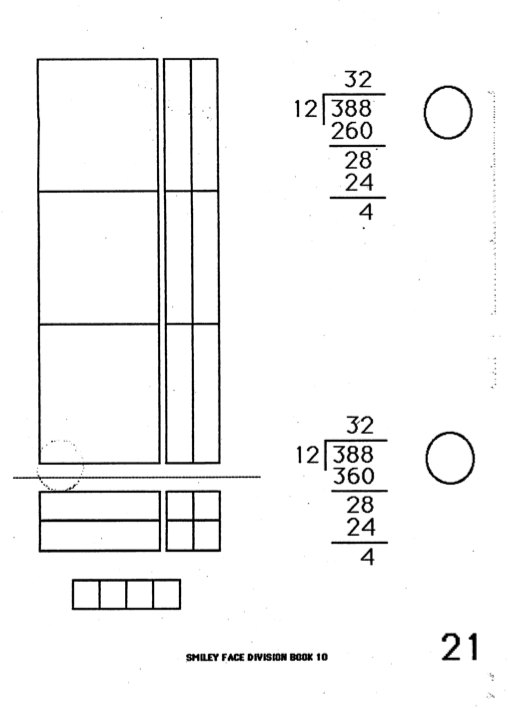
Now we are serious when we say that you can start with smiley face division books if you like because the baby step approach allows you to teach counting as you go. Here a couple of shots from the beginning of the smiley face series.
Keep in mind these books are made for PRE-SCHOOLERS. It should be obvious that older students can benefit from these books too. I suggest that they start at the beginning and "breeze through" until it begin to hit their level rather than skip the first books altogether. Here is book one:
Here is the end of book one. When you are 4 this is a lot of counting! I have seen people fool around with little 2 and three year olds where the child sits in their lap and just points to the right answer. Also because the price has gone up so far using a sheet protector and wet erase marker to get more milage out them is advised. They are no longer priced as consumables although they were originally intended to be.
He is a scan showing book 5. Expanded notation helps with understanding and is used as an intermediate step. I have a personal problem with the placement of the quotients and this was supposed to get fixed but we never got around to it. When Crewton Ramone comes out with a similar series it will be available in pdf form and some of these oversights and compromises will be fixed. It also had to do with the tech of the day 20 years ago but this is no longer an issue.
Remember bigger is funner. Also remember to let them make up a bunch of their own problems that are NOT in the books. As the parent or teacher you should make up some problems too. Practice.
Each booklet is 20 pages long and designed to be non-threatening. So you can see I am showing you page one and then the end of the books. This is the end of book 10. I have seen 5 years olds complete these books. Kindergarten math at a public school is pretty much a snap after that. Tee hee. If you can not afford the books just do lots of problems using the blocks and have them keep track of the problems they did in a journal. YOU may have to do a lot of the drawing and symbols for them because the whole point of these books is that they can learn math without the fine motor skills required to work a pencil.
Hat tip to Elizabeth Stevens for doing all the scans.
Divinely Dandy Non Difficult Division
Get Divinely Dandy Non Difficult Division for just $19.99. This book will show you everything you learned here and MORE laid out step by step with links to videos and pages that give simple concise explanations for how to use the rectangle to organize thought, how to introduce division concepts at a very young age, and how to make fun while you are doing it. I guarantee that video alone will expand your thinking when it comes to division and math.
Watch the video on the Preview and Purchase page that gives you a page by page over view of the PDF so you can "try before you buy", see exactly what you are getting and be confident it will be money well spent.
UPDATE: Here is yet another post on division due to the fact I see people showing how to use base ten blocks that are less effective than they could be. This one includes the #1 video hit for division with base ten blocks.
UPDATE: Divinely Dandy non Difficult Division is DONE! (See below.)
Long Division. Not well loved among students. It's EASY if you understand the concepts. And here we will add a little about square roots too....just for fun. Just because we can. Just because you should cross teach whenever you get the chance so your students can see how it all fits together into one language.
Start simple and work your way up. Remember degree of difficulty...and the other 5 basic concepts. We are fooling around with rectangles and counting. Some call this multiplication and subtraction and others call it division. Bottom line: we are counting. And one more time computation is not mathematics. Computation is how we DO mathematics. Today I found myself with an older student and I told him I don't care about the computation at the moment...I want you to understand the concepts...we'll do the computation later...we trying to find the area of a shaded region with a square and a circle inscribed where the only information was the radius of the circle. But step one was knowing I had to do subtraction. But I digress.
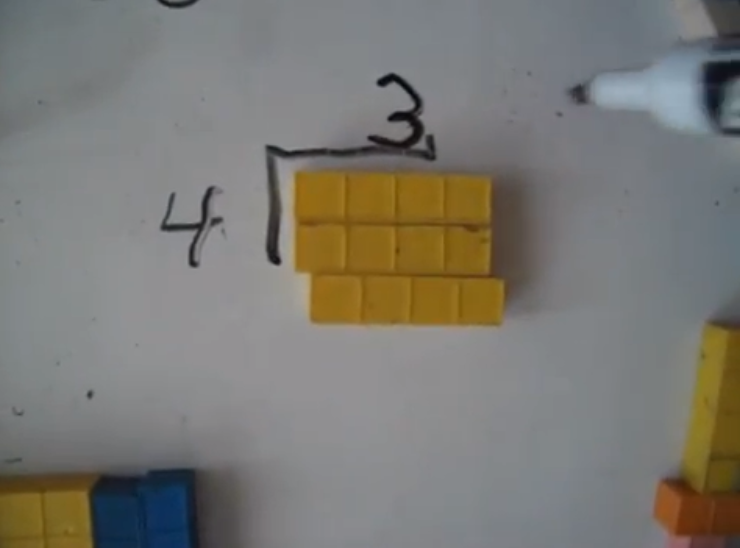
Observe. Here is a very simple rectangle:
The question arises why don't you use this pattern (above) instead of this pattern:
Well, because we want to keep track of subtraction. Long Division With Base Ten Blocks allows us to see what we are doing.
We are counting a rectangle that is 4 across and contains 12. 4 is contained in 12, 3 times. The number inside the rectangle is the dividend the thing being divided, and the number outside (the 4) is the divisor and the 3 is the quotient. We are humans we name everything. "I think I'll call this place Golgatha and move on." Kids have a hard time reading division because of this. This is solved quite simply by saying 4 is contained in 12 how many times? We read left to right so saying 12 divided by 4 is confusing. Besides we denote that this way: 12 ÷ 4 = 3.
Dividend. Divisor. Quotient. Simple no argument. You be surprised at how many people can't figure out the syntax of Multiplier, Multiplicand, Product or think it doesn't matter. To little kids you are right it doesn't matter and you will note you do not hear these math terms in the video below because at the moment this is extraneous information. Later when they are comfortable with the concepts we can start naming names. Meantime we do Long Division With Base Ten Blocks so that it is readily understandable and visually obvious. Once we start getting it down they will be able to do long division in their heads with no blocks and no paper and pencil either. This is called mastery.
Note the lovely blend of symbol and manipulatives. It completely makes sense to he who is but 5.
Now because this is a demo video more or less and because my students are familiar with the blocks we jumped a bunch of steps to a much bigger problem. YOU would NOT do this with your students unless they were quite familiar with the blocks and even then. Do many smaller ones and have them count...you might also do a few where they have to give you parameter just for fun. Many. More than three.
Here we are going to count how many times 12 is contained in 132. The obvious answer is 11. These are easy static problems. I used train teachers all the time and the first thing out of their mouths after their initial excitement subsided was how do do a problem like 7 is contained in 132. Pat answer: "you don't." You do lots of easy ones where it works out perfectly and then a few where we have remainders like 4 is contained in 13 how many times and 12 is contained in 133 how many times BEFORE you even think of moving to dynamic problems. By then they have the concept and they realize paper and pencil is MUCH FASTER than playing with blocks. Besides that's all the algorithms do is make counting fast. But long division is a bitch if you don't understand the basic concepts and you can't multiply. Further let them figure out the algorythim for themselves as you direct their discovery in a math rich environment.
So now lets get even bigger and do one that just happens to be square. AGAIN, YOU would NOT do this until you had done many smaller ones and worked your way up here.
But I am going to illustrate and explain each step. You could do this with 12 is contained in 132 or 13 is contained in 156 etc.
Because Mrs. Irma Hardbottom would accuse your little genius child of cheating if all he they did was write 19 and be done with it, we have to show our work which is again why we pattern with the blocks this way. Across and down.
And you can see other videos on Long Division With Base Ten Blocks where I talk about Hiram the Ant and use little men or animals or dinosaurs to walk along the edges and count. But you should point out that ten 19's are 190 and that one is one 10. Don't get confused with the edges, we are talking about the distance from one side to the other.
Once we take 190 from 361 we had to do a little work to figure out what was left on this problem. After some figuring they counted 171 which with the blocks was 90 and 81 which was 19, 9 times. They were counting the blocks NOT doing subtraction, if they did subtraction it might have been even easier because all they would have to do is take 0 from 1 and get 0, add 1 ten to 6 tens to get 7 tens (see vids on subtraction) leaving us with 2 hundreds because we had to take the 9 tens out of one of the hundreds which is how we end up adding 1 ten to the 6 tens and then taking 1 hundred from 2 hundred is EASY.
It's also easy to see that the square root of 361 is 19 and when it comes to notation this is much easier.
So we did 20 just for fun.
And then we were basically done. Here is all of the above in one fairly concise video:
Anyhow go check out the division page at the House of Math for a little more...long division shouldn't be hard. Look for another post about more advanced problems where the rectangles are more dynamic...these are best drawn or done with symbols AFTER the concepts are mastered.
Here are some more division worksheets (you need a password) and the video on that page teaches you how to use them. YOU could use that vid as a primer and instead of using pencil and paper use the BLOCKS.
Get Divinely Dandy Non Difficult Division for just $19.99. This book will show you everything you learned here and MORE laid out step by step with links to videos and pages that give simple concise explanations for how to use the rectangle to organize thought, how to introduce division concepts at a very young age, and how to make fun while you are doing it. I guarantee that video alone will expand your thinking when it comes to division and math.
Watch the video on the Preview and Purchase page that gives you a page by page over view of the PDF so you can "try before you buy", see exactly what you are getting and be confident it will be money well spent.
"Can you do Division? Divide a loaf by a knife - what's the answer to that?" ~Lewis Carroll, Through the Looking Glass
“We divided ourselves among caste, creed, culture and countries but what is undivided remains most valuable: a mere smile and the love.” ~Santosh Kalwar
The Curious Counter's Compendium.
Get this book if you have children 7 and under...find out more about it, and a look inside here. You can get it without a password for just $2.99
"Great book for teaching how to use the blocks! Colorful, clear pictures and cute rhymes make the book fun to read and play around with. We printed the book out, and my 5yo loves how many of the block pictures are big enough to put his blocks directly on top of the pictures. The text plays fast and loose with niceties like punctuation, but is engaging when read aloud.
Most of the book focuses on playing with addition facts up to 10, which gives a solid foundation. But it also delves briefly into such topics as square roots, place value, addition of multi-digit numbers, and a glimpse at multiplication. And in true Crewton Ramone fashion, problem solving with 'x' (basic algebra) is sprinkled throughout. A great intro to playing with math." ~CS, GA.