You are invited to learn how to use this method...
Showing posts with label Preschool Math Fun. Show all posts
Wednesday, May 27, 2015
Monday, March 17, 2014
Manipulatives Introduce A 4 Year Old To Problem Solving
| |
| Can your 4 year old solve this? Why not? |
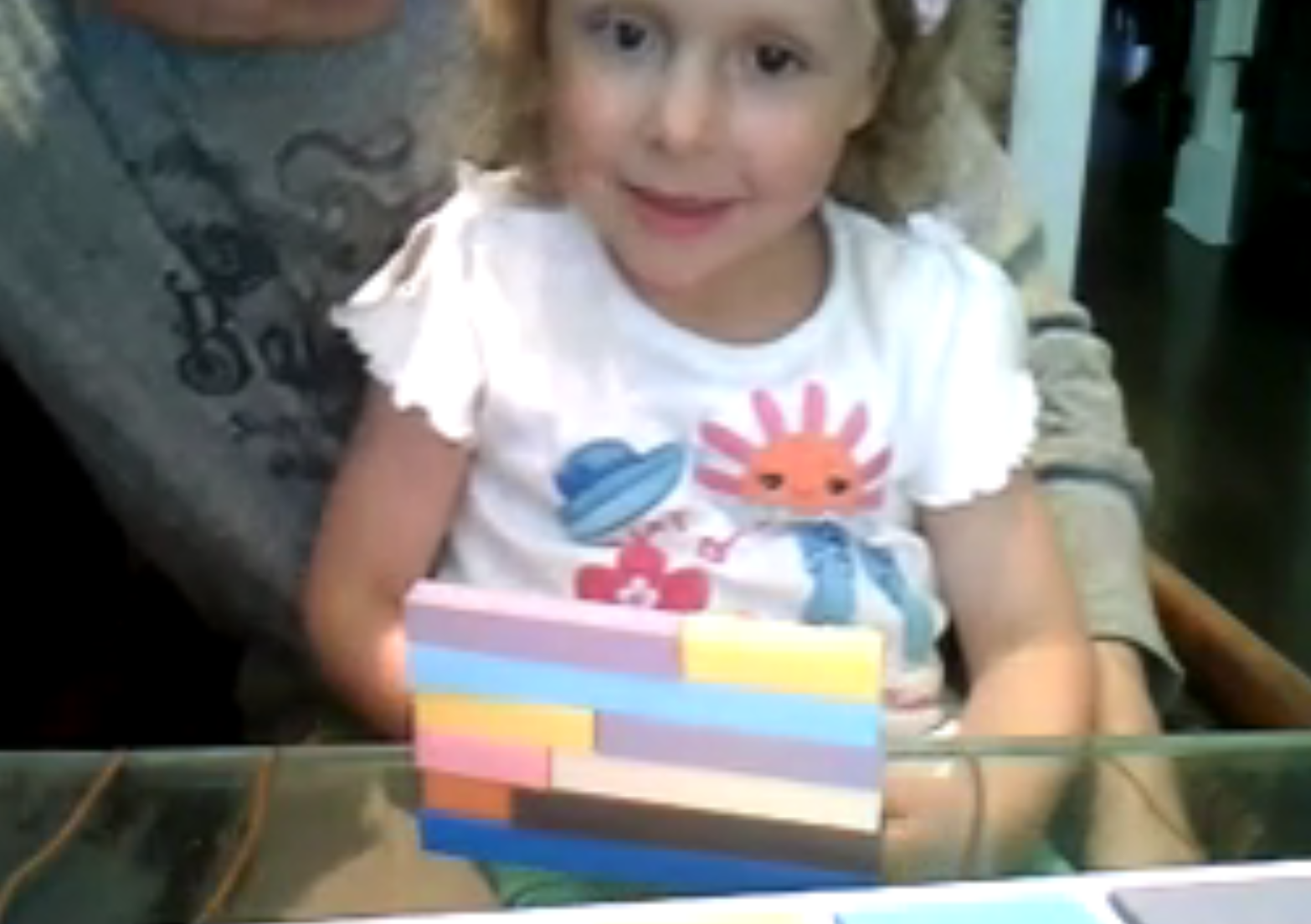
Problem solving is simple when you baby step your way there. So for now we are just figuring out problems like 8 + x = 12. Keep it easy no need to rush. just play.
After this we played what's under the cup for real...and we played for a good 20 more minutes. Even though if you listen you will her ask "Can I go now?" She stayed and they played. She had fun because my youngest was playing with her instead of me and her dad. Kids like to play with other kids which is why group learning can be so effective...it's also why I try to put young students in groups.
I paid my youngest a dollar for helping me tutor this little girl in Chicago...and he is thrilled.
"Wait, you're paying me for this? This is so awesome!"
Just as aside, this child was being taught via vid chat, I wasn't even there in person. I agree that you lose a little when you do it over the internet instead of in person but you don't lose that much. Lots of people could benefit from internet tutoring...again if I can make it this easy for her using the blocks, I can probably make it much easier for older kids too....in fact lots of teens go from "F" to "A" in short order. I prefer YOU teach your own kids but tutoring is what I do. So if you need help be in touch. I also "coach" teachers and parents.
All we did was play what's under the cup. I didn't get that on vid...because when the camera goes on things change and my first obligation is to the paying customer not making vids for the internet...my boy is an old pro at this game and for him it's super easy but he like to play with this little girl via vid chat, she had fun and our lesson lasted longer than usual because she was fully engaged in playing math. Here he is "back in the day" when he was also four.
We made a problem for her, then she made one for us and she learned addends...and I had an epiphany myself while watching them PLAY. I can't stress enough how important it is to let them play, you provide the framework or game and some direction and they'll do the rest if you let them. I also have to work a little with the father on removing NO from the lesson and letting her fool around to get the right answer. She's never wrong just getting more information. 3 + X = 12 she picks a 7 because she knows 3 needs a 7 to be ten and that's often a right answer when there's a three involved...she sees it's a little short and then sees she needs 2 more so she makes the addend for 9 with a 7 and a 2 AND she gets the answer for 3 + X = 12. In her head she realizes she needs a 9 because she can see it. Harder to do if you just have symbols. Her thought process in no way benefits from her being told "no" when she gets the 7.
We also want to remove the fear of failure. Ever hear of Sara Blakely? Her father actually used to ask her how often she failed. You might go read that article because it is very rare that I link to stuff I haven't written...and even less to Forbes or CNBC. They don't need my help. (I need your help though, you could link to me, like pages pin on pinterest etc, it helps people find my work. Page rank, all that SEO stuff.) But that's a good article and a fun interview. Billion with a B.
Parents might want to apply it as best they can with their own kids. It will be hard because in school kids learn to fear the all-mighty "F". They learn to fear failure instead of looking at it as an important part of learning and a crucial part of success. Whether it's mathematics or life in general. This patterning starts young. Instead of being afraid to try or being hesitant to look stupid or displease mom or dad, they just play and learn. There should also be some words of encouragement to keep trying even if you get it wrong more than once.
What usually ends up happening is children or teenagers fail math (algebra is still the most failed subject) learn to hate math and don't keep trying. I can't blame them, really. They are put into a system where they can't succeed; where the system doesn't change to fit the student's natural learning style instead they expect the student to adapt to the teaching style. Worse, it's EXPECTED that a certain percent will fail. Bummer for you if you're in that crowd. At the house of math one of the axioms is put the child in a situation where they can not fail, although they may fail on the way to right answers with directed discovery they eventually get there maybe even on their own.
We've Gotten To The Point Now Where We Expect Students To Fail Math.
Having said all this about failure, I remember a teacher that came to one of our trainings got excited and really applied the lessons she learned and the use of the blocks to her algebra class. I was the trainer that gave her another 30 hours when she had come back after her first 10 hour training. She was so excited and happy and MAD. Her pre-algebra class got all A's because of this method. No one failed, no one even got a "B." Was the principal thrilled? Hell no. He told her she had some how made the tests too easy and that she needed to make the class harder. Her algebra class where she had similar success, not ALL A's but no F's was met with a similar response. This was not a brand new teacher this was a veteran teacher. Some kids should be failing or she wasn't doing it right. This was a training with about 100 people in it, in Utah. Other people chimed in with similar experiences.
I removed all but one of the expletives from the above paragraph for your reading enjoyment. If a four year old can do this and you can see second graders doing algebra and problem solving perhaps teen-agers can do it too. You might also search Crewton Ramone in the classroom and see what comes back.
Now, get yourself a password and get started. I know you're wondering what you get for a password. So I made a whole blog post just for you. I am told I don't charge enough. I am going to give Raymond his own page, fix the percents page and add a trig page here shortly. Then there will be training pages you can buy...just give it a little time; I remember when there were no videos and passwords were a buck.
Give your child a headstart in math with my counting book.
Monday, May 20, 2013
Never Too Young To Build Tens
People are always amazed that somehow children learn math through play. This is because when they remember math there probably wasn't much play or fun associated with it. In fact a lot of people would rather not remember their math experiences at all because they often were so bad.
How about you break this cycle with your kids and give them fun math experiences instead, and happy memories. Use math manipulatives and play and have some fun learning. The idea is to give them an algorithm to solve problems like 7 + 8, but before we do that we have to understand that numbers are made up of other numbers and in order to do that we need to build them starting usually with 10.
This little girl is building tens we built other numbers and counted pairs of numbers too but we spent a lot of time on ten and nines. I'd say this qualifies as quality time with dad. We didn't attempt to write anything at all. Just built and talked about the numbers. Using base ten blocks makes it visually obvious to the child and later when they do see symbols the symbols make sense. She gets a full sensory experience using BOTH hands, hearing and seeing what we are learning as we go...whether she is a kinesthetic learner, a visual or auditory learner doesn't really matter...we cover all the bases. Further, even if she was dyslexic it wouldn't matter there are no symbols to confuse and the base ten blocks level that playing field too. She can see what she is doing and hear her father and I tell her that nine and one is the same as ten.
People often think that in order for them to learn math they have to write it down or they aren't really learning it. Really? Do you get little babies to write words down when you are teaching them English? Or do you just talk to them and they pick up the language that way and later maybe when they are 4 or 5 put a crayon in their hand and let them start learning to write letters...but just because they have a hard time writing their letters doesn't mean they can't speak English. Apply the same thinking and reasoning to the mathematics which is also a language.
You start with very basic concepts like numbers are made up of other numbers and they all want to be ten. You can build tens up and down or you can build them flat or you can make walls. It doesn't matter. If you build sky scrapers they get a good sense of ordination...that is 2 is 1 more than 1 and 3 is 2 + 1 and so on all the way to ten...here she started with 10 first and worked we our way down. There is no wrong way to play you don't have to start at one. She built NINES and TENS.
She looks pretty happy, doesn't she? She was being bribed with goji berries at the time but who cares? She had fun and she did her "work" with lots of smiles and discoveries that caused some exclamations. "6+4 is 10 and 4+6 is also 10!" Some methodologies say you shouldn't reward them and the learning itself should be the reward. Fine. I've seen kids move mountains of math for a piece of chocolate. make the associations with math pleasant from an early age. I give this dad credit because he understands it's extra important to give his daughter a good head start when it come to math (and other subjects) but especially math. Our culture still perpetuates the myth that math is a guy thing, the same way a few hundred years ago reading was a guy thing...
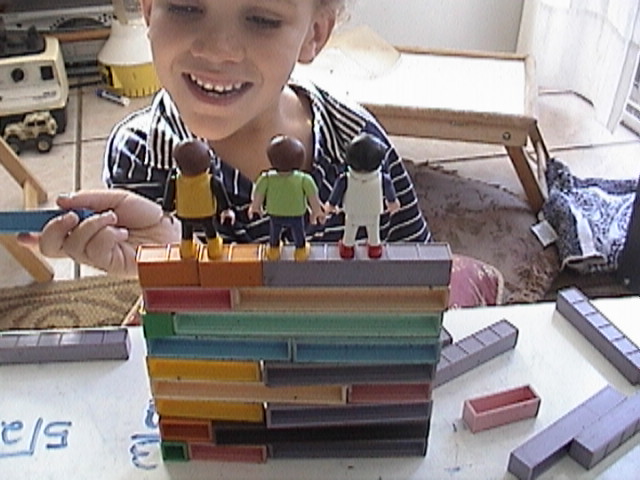
She was having fun building this ten wall on her own. No need to tell her to go in oder starting with nine and one. After a bit we asked her if she could use different combinations but at this point just building the wall that high without knocking it over was a big deal. Fine motor skills being developed...it's more than just math going here.
You can see these shots were taken on two different days about a week apart. In that amount of time at this age it's basically new again. But the repetition isn't lost and neither are the concepts. It's in there. The sub conscious mind stores everything. Later we can bring it out again. To educate. To draw fourth....not to cram in. AND when we draw it fourth it will come with pleasant associations making everything that much easier.
Basically we are working on addends here which will make addition much easier later on. I have pages on addends and addition and more games and activities you can play over at my website Crewton Ramone's House of Math. Join us on FaceBook. And spend some time watching videos on youtube for more info on how to PLAY math.
Tweet
How about you break this cycle with your kids and give them fun math experiences instead, and happy memories. Use math manipulatives and play and have some fun learning. The idea is to give them an algorithm to solve problems like 7 + 8, but before we do that we have to understand that numbers are made up of other numbers and in order to do that we need to build them starting usually with 10.
![]() |
| It's like stairs dad! And the two falling off was all kinds of funny. |
This little girl is building tens we built other numbers and counted pairs of numbers too but we spent a lot of time on ten and nines. I'd say this qualifies as quality time with dad. We didn't attempt to write anything at all. Just built and talked about the numbers. Using base ten blocks makes it visually obvious to the child and later when they do see symbols the symbols make sense. She gets a full sensory experience using BOTH hands, hearing and seeing what we are learning as we go...whether she is a kinesthetic learner, a visual or auditory learner doesn't really matter...we cover all the bases. Further, even if she was dyslexic it wouldn't matter there are no symbols to confuse and the base ten blocks level that playing field too. She can see what she is doing and hear her father and I tell her that nine and one is the same as ten.
People often think that in order for them to learn math they have to write it down or they aren't really learning it. Really? Do you get little babies to write words down when you are teaching them English? Or do you just talk to them and they pick up the language that way and later maybe when they are 4 or 5 put a crayon in their hand and let them start learning to write letters...but just because they have a hard time writing their letters doesn't mean they can't speak English. Apply the same thinking and reasoning to the mathematics which is also a language.
![]() | |
| I can do it... |
![]() |
| Building nines is fun and easy. |
She looks pretty happy, doesn't she? She was being bribed with goji berries at the time but who cares? She had fun and she did her "work" with lots of smiles and discoveries that caused some exclamations. "6+4 is 10 and 4+6 is also 10!" Some methodologies say you shouldn't reward them and the learning itself should be the reward. Fine. I've seen kids move mountains of math for a piece of chocolate. make the associations with math pleasant from an early age. I give this dad credit because he understands it's extra important to give his daughter a good head start when it come to math (and other subjects) but especially math. Our culture still perpetuates the myth that math is a guy thing, the same way a few hundred years ago reading was a guy thing...
![]() |
| You don't have to go in order just play. |
You can see these shots were taken on two different days about a week apart. In that amount of time at this age it's basically new again. But the repetition isn't lost and neither are the concepts. It's in there. The sub conscious mind stores everything. Later we can bring it out again. To educate. To draw fourth....not to cram in. AND when we draw it fourth it will come with pleasant associations making everything that much easier.
Basically we are working on addends here which will make addition much easier later on. I have pages on addends and addition and more games and activities you can play over at my website Crewton Ramone's House of Math. Join us on FaceBook. And spend some time watching videos on youtube for more info on how to PLAY math.
Tweet
Monday, June 11, 2012
Crewton Ramone Takes Two
My favorite part about this vid is the comments: people just don't know what to make of me or it. This is a proof of concept vid...needs more work but I want to make math music vids that are current. Like Weird Al Yankovic except for math...change the lyrics of popular songs to explain math concepts...and then have puppets and good looking kids and base ten blocks dancing around to the beat.
This is just a proto-type if you will. I need a small crew to do camera, song covers and puppets and most of all editing.
Anyhow this one was designed for little kids...three to five. And it was designed to be watched more than once...the concept is multiplication by twos...and getting to know the names of the base 10 blocks.
Unconventional. Odd. Different. People not sure what to think. No pocket protector. No nerd glasses. Multiplication by two's for the little kids.
No. This ain't your grandma's mathematics. It's Crewton Ramone for the wee ones. Just a few math concepts at a time. Math needs to be cool again...currently it is the domain of nerds who do not reproduce...
Find us on FaceBook
Go to Crewton Ramone's House Of Math for more.
This is just a proto-type if you will. I need a small crew to do camera, song covers and puppets and most of all editing.
Anyhow this one was designed for little kids...three to five. And it was designed to be watched more than once...the concept is multiplication by twos...and getting to know the names of the base 10 blocks.
Unconventional. Odd. Different. People not sure what to think. No pocket protector. No nerd glasses. Multiplication by two's for the little kids.
No. This ain't your grandma's mathematics. It's Crewton Ramone for the wee ones. Just a few math concepts at a time. Math needs to be cool again...currently it is the domain of nerds who do not reproduce...
Find us on FaceBook
Go to Crewton Ramone's House Of Math for more.
Saturday, May 21, 2011
Math Concepts, Conceptualization vrs Memorization
Here is a short vid showing the wee ones doing a little math where you don't have to be there you can set it up walk away and come back and check it...then do more, walk away and check it. Math enrichment for them also means understanding what the powerful machines we have built are doing not just pushing buttons...I would be willing to bet that this six year old understands square root and what it means better than a lot of high school kids and even some college kids...
At this age just using a marker is fun in and of itself...the whole thing was a fun activity...took up about an hour of their day, it could have been shorter or longer depending how much fun they were having and how long their interest was held.
What you see here is a short part of it, but enough to give you the idea. I set up trays of blocks for them to count three different times...some days just one set is enough others times more or less...depending on their mood. Make it fun, not work...stress the concepts not the facts, mathematics is NOT computation. Remove the no from the lesson. If they give an incorrect response make them count again; tell them what they DO have not what they don't have, change the thinking from "wrong" to "acquiring more information."
Remember, it takes 18 exposures to get information back out again. We know that with one exposure the information is indeed stored but retrieval is hard, but after 18 exposures we can get more information from short term to mid term memory, and with more exposures we can move it into the long term memory and with yet more exposures we can make that information available for instant recall. Begin exposing your students to mathematical concepts EARLY. You will need to keep exposing them year after year for them to attain mastery and instant recall of things like addition and subtraction facts, multiplication, division and so fourth, but again you haven't taught them mathematics per se, just facts and computation skills which are how we do mathematics.
"Mathematics is a language plus reasoning." ~Richard Feynman
"Reality is consciousness, consciousness is expressed with language. Mathematics expresses reality numerically." ~me, standing on the shoulders of Terrence McKenna and John Paulos. Nanos gigantium humeris insidentes.
They have played with squares and rectangles before counting and building, here we begin introducing some symbols, later we will introduce more concepts and symbols so that we can write simple sentences like (3)(6)=18, 18÷6=3, 3x=18 and the symbols will make sense.
Same with building addends: 6+4=10, 6+x=10 will be simple and obvious and when explanations involving math terms like "additive inverse" are encountered they will also be understood even though they are cumbersome and oblique to most math students under the age of 12. I remember having 4 boys in 6th grade all bewildered, upset and offended by a set of problems like this:
5 + x = 14........x - 7 = 4
3x=24.............6x=24
3x + 5 = 20.......2x - 8 = 12
3x + 3 = 2x + 7 etc
It took about two sessions to clear all that up and get into negative expressions and I earned a couple hundred bucks in the process. (4 x $25 x 2) and people cannot understand why I find it all so ridiculous now...yet the parents and teachers both failed to explain it in a way they could grasp easily...and in the case of the parents some didn't even try, as soon as they see algebra they throw up their hands and say things like "well, I was never good at math so..." or "I get it but I can't explain it..." or "I don't remember any of that stuff even though I passed calculus with a B"....and are shocked when I tell them I failed calculus. FAILED IT. Not even close. Good thing I did. I can feel their pain and understand why it is they don't get it because I have the benefit of having been taught both ways. One way works and the other...uh, not so much.
These same kids play with 3rd power algebra, fractions, percentages and more. The ability to do all of that consists of countng to 9, being able to tell if something is same or different or not and being able to identify a rectangle.
More sample math lessons, tools and information are available at the house of math.
Find us on Facebook.
Tweet
At this age just using a marker is fun in and of itself...the whole thing was a fun activity...took up about an hour of their day, it could have been shorter or longer depending how much fun they were having and how long their interest was held.
What you see here is a short part of it, but enough to give you the idea. I set up trays of blocks for them to count three different times...some days just one set is enough others times more or less...depending on their mood. Make it fun, not work...stress the concepts not the facts, mathematics is NOT computation. Remove the no from the lesson. If they give an incorrect response make them count again; tell them what they DO have not what they don't have, change the thinking from "wrong" to "acquiring more information."
Remember, it takes 18 exposures to get information back out again. We know that with one exposure the information is indeed stored but retrieval is hard, but after 18 exposures we can get more information from short term to mid term memory, and with more exposures we can move it into the long term memory and with yet more exposures we can make that information available for instant recall. Begin exposing your students to mathematical concepts EARLY. You will need to keep exposing them year after year for them to attain mastery and instant recall of things like addition and subtraction facts, multiplication, division and so fourth, but again you haven't taught them mathematics per se, just facts and computation skills which are how we do mathematics.
"Mathematics is a language plus reasoning." ~Richard Feynman
"Reality is consciousness, consciousness is expressed with language. Mathematics expresses reality numerically." ~me, standing on the shoulders of Terrence McKenna and John Paulos. Nanos gigantium humeris insidentes.
They have played with squares and rectangles before counting and building, here we begin introducing some symbols, later we will introduce more concepts and symbols so that we can write simple sentences like (3)(6)=18, 18÷6=3, 3x=18 and the symbols will make sense.
Same with building addends: 6+4=10, 6+x=10 will be simple and obvious and when explanations involving math terms like "additive inverse" are encountered they will also be understood even though they are cumbersome and oblique to most math students under the age of 12. I remember having 4 boys in 6th grade all bewildered, upset and offended by a set of problems like this:
5 + x = 14........x - 7 = 4
3x=24.............6x=24
3x + 5 = 20.......2x - 8 = 12
3x + 3 = 2x + 7 etc
It took about two sessions to clear all that up and get into negative expressions and I earned a couple hundred bucks in the process. (4 x $25 x 2) and people cannot understand why I find it all so ridiculous now...yet the parents and teachers both failed to explain it in a way they could grasp easily...and in the case of the parents some didn't even try, as soon as they see algebra they throw up their hands and say things like "well, I was never good at math so..." or "I get it but I can't explain it..." or "I don't remember any of that stuff even though I passed calculus with a B"....and are shocked when I tell them I failed calculus. FAILED IT. Not even close. Good thing I did. I can feel their pain and understand why it is they don't get it because I have the benefit of having been taught both ways. One way works and the other...uh, not so much.
These same kids play with 3rd power algebra, fractions, percentages and more. The ability to do all of that consists of countng to 9, being able to tell if something is same or different or not and being able to identify a rectangle.
More sample math lessons, tools and information are available at the house of math.
Find us on Facebook.
Tweet
Wednesday, April 20, 2011
Crewton Ramone I just wanna Play Math all day.
Play. Play Math.
I've said it over and over again. Play is important. It's crucial. Note how he talks about problem solvers having to use their hands. Mechanics. Engineers. Kids with blocks. Something happens when you get the tactile sense involved. Kinesthetic learner or not, adding the sense of touch and being able to get your hands on it makes such a big difference mere English words do not adequately convey the importance of it.
2011 and the world of mathematics has still not caught on to how important manipulatives are for increasing comprehension and learning of math concepts. It's still something for special education or minorities. "Real" math teachers don't use manipulatives and certainly not on adults. I note the "real" math teachers are failing miserably as a whole, with a very few bright spots here and there.
Here is yet another TED talk on the subject of play:
"Almost all creativity involves purposeful play." ~Abraham Maslow American psychologist 1908-1970
"Whoever wants to understand much must play much." ~Gottfried Benn German physician 1886-1956
"Play gives children a chance to practice what they are learning." ~Fred Rogers American television personality 1928-2003
"People tend to forget that play is serious." ~David Hockney Contemporary British painter
"Do not…keep children to their studies by compulsion but by play." ~Plato Greek philosopher 427-347 BCE
"Necessity may be the mother of invention, but play is certainly the father." ~Roger von Oech Contemporary American creativity guru
Not to hit you over the head with it, with these math quotes but perhaps maybe, you just might want this to become part of your teaching philosophy. I try to keep these quotes in mind when I play math with my students. Grander men than me have left behind these words so that I might also understand the crucial role of play.
"We didn't do anything dad, we just played with blocks." ~My favorite quote from a little girl who went from "F" to "A".
Here are a few blog posts as a reminder:
http://crewtonramoneshouseofmath.blogspot.com/2010/12/4-year-old-math-enrichment.html
http://crewtonramoneshouseofmath.blogspot.com/2010/09/make-it-fun.html
http://crewtonramoneshouseofmath.blogspot.com/2011/02/math-rich-environment-ii.html
I've said it over and over again. Play is important. It's crucial. Note how he talks about problem solvers having to use their hands. Mechanics. Engineers. Kids with blocks. Something happens when you get the tactile sense involved. Kinesthetic learner or not, adding the sense of touch and being able to get your hands on it makes such a big difference mere English words do not adequately convey the importance of it.
2011 and the world of mathematics has still not caught on to how important manipulatives are for increasing comprehension and learning of math concepts. It's still something for special education or minorities. "Real" math teachers don't use manipulatives and certainly not on adults. I note the "real" math teachers are failing miserably as a whole, with a very few bright spots here and there.
Here is yet another TED talk on the subject of play:
"Almost all creativity involves purposeful play." ~Abraham Maslow American psychologist 1908-1970
"Whoever wants to understand much must play much." ~Gottfried Benn German physician 1886-1956
"Play gives children a chance to practice what they are learning." ~Fred Rogers American television personality 1928-2003
"People tend to forget that play is serious." ~David Hockney Contemporary British painter
"Do not…keep children to their studies by compulsion but by play." ~Plato Greek philosopher 427-347 BCE
"Necessity may be the mother of invention, but play is certainly the father." ~Roger von Oech Contemporary American creativity guru
Not to hit you over the head with it, with these math quotes but perhaps maybe, you just might want this to become part of your teaching philosophy. I try to keep these quotes in mind when I play math with my students. Grander men than me have left behind these words so that I might also understand the crucial role of play.
"We didn't do anything dad, we just played with blocks." ~My favorite quote from a little girl who went from "F" to "A".
Here are a few blog posts as a reminder:
http://crewtonramoneshouseofmath.blogspot.com/2010/12/4-year-old-math-enrichment.html
http://crewtonramoneshouseofmath.blogspot.com/2010/09/make-it-fun.html
http://crewtonramoneshouseofmath.blogspot.com/2011/02/math-rich-environment-ii.html
Labels:
Fun Math Activities,
Math Fun,
Play,
Preschool Math Fun
Tuesday, February 1, 2011
Base Ten Blocks and Playdoh
Math Rich Environment II
Playing IS learning. Play with the stuff they like to play with...in this case playdoh and manipulatives.
This screen cast got over 150 hits in a day, I'm pretty sure people were amazed by their ability to multiply more than the dough...but you never know with the internet.
Share it.
Basically, we played and had fun first and learned math concepts second. This play session lasted around two hours. Note the complete lack of symbols in our play. We just talked about the concepts the symbols will come later.
Here you see us playing with addends and subtraction. A lot is going on here...you see hero zero wearing his five disguise at the top, first it was a ten then we made addends for ten below it then the 4 year old showed me ten take away one in no uncertain terms...
Here we see an addend for seven and a couple of cut outs.
Playing with ten and addends for numbers larger than ten.
Here you can see how the boys lined them up and pressed them in...
Talk about making impressions here we see 6+4 reall is the same as 7+3 and they are the both the same as 10.
So what if they don't line up perfectly they still "get it", at this age the emphasis is on playing and fun. You can't play "wrong."
Cut outs for one I don't talk much about it on the screencast and you don't see it here much either but we did all kinds of math with the cut outs...mostly adding and subtraction and smooshing together...
Then we started playing fractions, under my direction...it's play but it's directed play.
"Why don't we...?" What if we...?" "What would happen if...?" "Can you make a square and cut it up...?"
Looks like an American cheese single...and right there I got about 100 ideas for lessons with a pack of cheese singles...eat your math lessons that will get them subtracting assuming you like eating processed American mucus forming chemically enhanced for optimum flavor cheese. I wonder if I could get Kraft as a sponsor? Anyway, I can see lots of lessons that could be done with cheese singles...
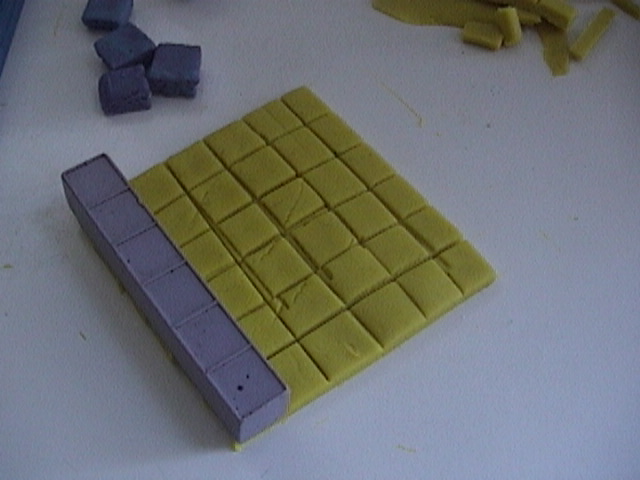
Here we talked about one whole...then because it was yellow we cut it into a 4x4 square using the 4 block as a guide. First we cut it in half, then we cut each half in two to get quarters then we cut the other way and we talked about equivalent fractions...1/4 = 2/8 and they could see it...and then we cut those into halves and you get what you see here.
This gave us a good chance to practice counting by fours and to see 4/16, (also see a relationship of 1 to 3, 1:3, but we did not talk about it at all, I mention it here because it's so blatantly obvious we could show equivalent fractions "the other way." Keep it simple and fun and don't try to stuff too much info in there at a time. Older kids and adults might be ready to make the switches between the two but with the toddlers I made sure it was a coherent lesson with no jumps in perception. It's one square with a strip colored in as opposed to two rectangles, one over the other to show ratio and equivalent fractions of 1/3 that way.) This one square teaches a lot of math as it is.
Bigger is funner. Here we put together a six by six square and talked about fractions as we did it...can you see how fractions and multiplication go hand in hand, and that you can teach multiplication with fractions?
The older boy wants in on the action since he did such a good job of counting by 6s.
However the younger boy would like it known that it was he who did all the work.
Since it was all cut up already I used a six to show one out of six or 1/6th. and that was the same as 6 out of 36. 1/6 = 6/36 again they didn't see any symbols and we didn't do any writing during this session.
Here is 1/36. Just for fun.
Here is 6/36 and again I see a ratio lesson here of 5 to 1, but we didn't do it.
Then we made it smaller and talked about fifths. Each blue block is one of five or 1/5.
Which is the same ans 2/10ths.
It was fun rolling out the skinny lines and making stuff with them. I missed taking pictures of using them on that yellow flat to show other fractions and fractions concepts.
Then after we had played enough with these concepts crunch it all together and start all over again.
"What should we do next? " four year old.
"I dunno," I said. "Let's just PLAY." (And see what happens.)
Here is a screencast where the boys help me tell the story. Caution they may blow your mind with their ability to count.
Outages on Youtube and Screencast0Matic have been common lately. I put screencasts here for all my teacher friends who have YouTube blocked at skool. If you can't watch on one hopefully you can watch the other.
The screencast is titled "Crewton Ramone Play W/Clay Learn Math" on both YouTube and Screencastomatc. Last I checked it had 159 hits on screencastomatic alone and it's only been up since yesterday...please hit the like buttons and rate and share it where ever you watch it. People email and ask if they can use my vids and screencasts for various thing. The answer is YES, BY ALL MEANS GO AHEAD. Just don't try and sell them and try and put a link back to this blog or my website.
Vid won't play? Try this link: https://screencast-o-matic.com/watch/cXVwcalGn
Here are a couple of posts where they play and learn math:
Math Rich Environment
Four year old math enrichment.
And just so you don't forget, you teach toddlers algebra right along with fractions and multiplication.
Find us on FaceBook...
Crewton Ramone's House Of Math.
More fun math activities.
Playing IS learning. Play with the stuff they like to play with...in this case playdoh and manipulatives.
This screen cast got over 150 hits in a day, I'm pretty sure people were amazed by their ability to multiply more than the dough...but you never know with the internet.
Share it.
Basically, we played and had fun first and learned math concepts second. This play session lasted around two hours. Note the complete lack of symbols in our play. We just talked about the concepts the symbols will come later.
Here you see us playing with addends and subtraction. A lot is going on here...you see hero zero wearing his five disguise at the top, first it was a ten then we made addends for ten below it then the 4 year old showed me ten take away one in no uncertain terms...
Here we see an addend for seven and a couple of cut outs.
Playing with ten and addends for numbers larger than ten.
Here you can see how the boys lined them up and pressed them in...
Talk about making impressions here we see 6+4 reall is the same as 7+3 and they are the both the same as 10.
So what if they don't line up perfectly they still "get it", at this age the emphasis is on playing and fun. You can't play "wrong."
Cut outs for one I don't talk much about it on the screencast and you don't see it here much either but we did all kinds of math with the cut outs...mostly adding and subtraction and smooshing together...
Then we started playing fractions, under my direction...it's play but it's directed play.
"Why don't we...?" What if we...?" "What would happen if...?" "Can you make a square and cut it up...?"
Looks like an American cheese single...and right there I got about 100 ideas for lessons with a pack of cheese singles...eat your math lessons that will get them subtracting assuming you like eating processed American mucus forming chemically enhanced for optimum flavor cheese. I wonder if I could get Kraft as a sponsor? Anyway, I can see lots of lessons that could be done with cheese singles...
Here we talked about one whole...then because it was yellow we cut it into a 4x4 square using the 4 block as a guide. First we cut it in half, then we cut each half in two to get quarters then we cut the other way and we talked about equivalent fractions...1/4 = 2/8 and they could see it...and then we cut those into halves and you get what you see here.
This gave us a good chance to practice counting by fours and to see 4/16, (also see a relationship of 1 to 3, 1:3, but we did not talk about it at all, I mention it here because it's so blatantly obvious we could show equivalent fractions "the other way." Keep it simple and fun and don't try to stuff too much info in there at a time. Older kids and adults might be ready to make the switches between the two but with the toddlers I made sure it was a coherent lesson with no jumps in perception. It's one square with a strip colored in as opposed to two rectangles, one over the other to show ratio and equivalent fractions of 1/3 that way.) This one square teaches a lot of math as it is.
Bigger is funner. Here we put together a six by six square and talked about fractions as we did it...can you see how fractions and multiplication go hand in hand, and that you can teach multiplication with fractions?
The older boy wants in on the action since he did such a good job of counting by 6s.
However the younger boy would like it known that it was he who did all the work.
Since it was all cut up already I used a six to show one out of six or 1/6th. and that was the same as 6 out of 36. 1/6 = 6/36 again they didn't see any symbols and we didn't do any writing during this session.
Here is 1/36. Just for fun.
Here is 6/36 and again I see a ratio lesson here of 5 to 1, but we didn't do it.
Then we made it smaller and talked about fifths. Each blue block is one of five or 1/5.
Which is the same ans 2/10ths.
It was fun rolling out the skinny lines and making stuff with them. I missed taking pictures of using them on that yellow flat to show other fractions and fractions concepts.
Then after we had played enough with these concepts crunch it all together and start all over again.
"I dunno," I said. "Let's just PLAY." (And see what happens.)
Here is a screencast where the boys help me tell the story. Caution they may blow your mind with their ability to count.
Outages on Youtube and Screencast0Matic have been common lately. I put screencasts here for all my teacher friends who have YouTube blocked at skool. If you can't watch on one hopefully you can watch the other.
The screencast is titled "Crewton Ramone Play W/Clay Learn Math" on both YouTube and Screencastomatc. Last I checked it had 159 hits on screencastomatic alone and it's only been up since yesterday...please hit the like buttons and rate and share it where ever you watch it. People email and ask if they can use my vids and screencasts for various thing. The answer is YES, BY ALL MEANS GO AHEAD. Just don't try and sell them and try and put a link back to this blog or my website.
Vid won't play? Try this link: https://screencast-o-matic.com/watch/cXVwcalGn
Here are a couple of posts where they play and learn math:
Math Rich Environment
Four year old math enrichment.
And just so you don't forget, you teach toddlers algebra right along with fractions and multiplication.
Find us on FaceBook...
Crewton Ramone's House Of Math.
More fun math activities.
Monday, December 6, 2010
4 Year Old Math Enrichment
A bright 4 year old has a fun time playing math. Before we knew it an hour had gone by. I remembered to take the camera out after about 20 minutes...we had already done some counting, added random numbers together and then started adding pairs, starting easy 1+1 and working our way up to 9+9. All 45 addends will be mastered using base ten blocks. I enlarged the photos in this post a little for those who use Pinterest.

Then we did some multiplication and division. He likes division because he only has to count one side. We count by eights, then we count the sides, then we count the rectangle and each side. He can see 24 ÷ 8 = 3. The three eights are visually obvious too.
Then we have fun counting and building 20 sixes.
And even more fun knocking them down.
A free time wall. He had no rules to follow when he built this wall he just built it. The addends for 10 and some smaller numbers are being learned here people think this is all that base ten blocks are good for, making tens and some place value but you can do so much more. Again knocking the thing over is the most fun...
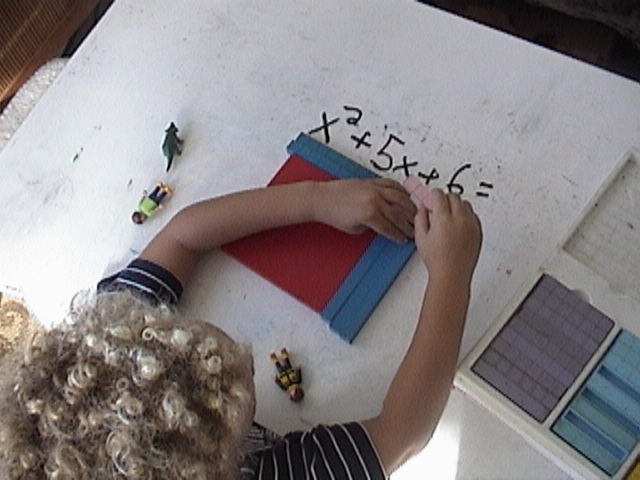
On to some algebra puzzles. I tell him the pieces and he has to turn them into a rectangle. Base ten blocks are great for teaching algebra and addends and a whole lot more.
The men help him count the sides.
This one problem teaches him about counting, addends, factoring, multiplication and algebra all in one lesson. This took about 15 minutes from start to finish...15 is a lot to handle when you are four. Note if he had to get out 15 individual units this problem would be nearly impossible and would take a lot longer.
He took a while figuring out which blocks to make his 15 with, he has some experience factoring so he knows a 10 and a 5 aren't going to cut it.
At last he has decided on 5's. He uses them to shape the rest of his rectangle. I tell my high school students what this child already knows: the way to factor it lies in the factors of the constant.
Now that he has three fives all he has to do is make those pesky x's form a rectangle.

A little more work and he has it.
Now his pals can help him count the sides.
Just for the fun of it he wrote the factors himself to the best of his ability.
"It almost looks like a 5"
He was quite proud of his 3. Using base ten blocks to teach concepts and understanding of math is a very powerful thing. Just because they can't write doesn't mean they can't learn math; writing isn't a perquisite for math anymore than writing is a prerequisite for learning English. You will find that students who learn math this way will be able to do a lot more math in their heads than students taught using the current completely ineffectual way we use now.
x2 + 8x + 15 = (x + 5)(x + 3) is easy and fun to do and completely understood. One means the rectangle the other means the sides. Later we will deepen understanding and add more concepts on top of these basics. Can you see math will always be easy for this child? No fear of new stuff in the future because he has math experience now. Using base ten blocks makes understanding math easy and fun...child's play.
He helps me do the same screen cast:
If you enjoyed this post you will also enjoy this popular post and screencast showing much less structured play with clay for learning math concepts. Math enrichment and a math rich environment go hand in hand.
Find us on FaceBook
Go to the House of Math.
Learn more Algebra for a just a few bucks.
Trig for 8 year olds. Just what it says, click the link and find out more.
This post remains popular going on two years later...he was just 4 and 1/4 when we made this...now algebra is no big deal and fractions and multiplication are fun...he is the go to guy in his kindergarten class when kids want to know what to do when they have math.
And now he is the go to guy in 1st grade. Please take a moment and watch the vid on the concepts page under the heading "Early Exposure to Math Concepts Helps Ensure Success." It's only 3 and a half minutes long and should help dispel the myth that you don't want to start math too early. There is no "too early."
Give your young child the advantage in math with my cool counters compendium.
“I care not what subject is taught if only it be taught well.” ~Thomas Henry Huxley
Tweet
Get this book if you have children 7 and under...find out more about it, and a look inside here. You can get it without a password for just $4.99 People's comments about the base ten block book here.

Then we have fun counting and building 20 sixes.
And even more fun knocking them down.
A free time wall. He had no rules to follow when he built this wall he just built it. The addends for 10 and some smaller numbers are being learned here people think this is all that base ten blocks are good for, making tens and some place value but you can do so much more. Again knocking the thing over is the most fun...
On to some algebra puzzles. I tell him the pieces and he has to turn them into a rectangle. Base ten blocks are great for teaching algebra and addends and a whole lot more.
The men help him count the sides.
This one problem teaches him about counting, addends, factoring, multiplication and algebra all in one lesson. This took about 15 minutes from start to finish...15 is a lot to handle when you are four. Note if he had to get out 15 individual units this problem would be nearly impossible and would take a lot longer.
He took a while figuring out which blocks to make his 15 with, he has some experience factoring so he knows a 10 and a 5 aren't going to cut it.
At last he has decided on 5's. He uses them to shape the rest of his rectangle. I tell my high school students what this child already knows: the way to factor it lies in the factors of the constant.
Now that he has three fives all he has to do is make those pesky x's form a rectangle.

Now his pals can help him count the sides.
Just for the fun of it he wrote the factors himself to the best of his ability.
"It almost looks like a 5"
He was quite proud of his 3. Using base ten blocks to teach concepts and understanding of math is a very powerful thing. Just because they can't write doesn't mean they can't learn math; writing isn't a perquisite for math anymore than writing is a prerequisite for learning English. You will find that students who learn math this way will be able to do a lot more math in their heads than students taught using the current completely ineffectual way we use now.
x2 + 8x + 15 = (x + 5)(x + 3) is easy and fun to do and completely understood. One means the rectangle the other means the sides. Later we will deepen understanding and add more concepts on top of these basics. Can you see math will always be easy for this child? No fear of new stuff in the future because he has math experience now. Using base ten blocks makes understanding math easy and fun...child's play.
He helps me do the same screen cast:
If you enjoyed this post you will also enjoy this popular post and screencast showing much less structured play with clay for learning math concepts. Math enrichment and a math rich environment go hand in hand.
Find us on FaceBook
Go to the House of Math.
Learn more Algebra for a just a few bucks.
Trig for 8 year olds. Just what it says, click the link and find out more.
This post remains popular going on two years later...he was just 4 and 1/4 when we made this...now algebra is no big deal and fractions and multiplication are fun...he is the go to guy in his kindergarten class when kids want to know what to do when they have math.
And now he is the go to guy in 1st grade. Please take a moment and watch the vid on the concepts page under the heading "Early Exposure to Math Concepts Helps Ensure Success." It's only 3 and a half minutes long and should help dispel the myth that you don't want to start math too early. There is no "too early."
Give your young child the advantage in math with my cool counters compendium.
“I care not what subject is taught if only it be taught well.” ~Thomas Henry Huxley
Tweet
Get this book if you have children 7 and under...find out more about it, and a look inside here. You can get it without a password for just $4.99 People's comments about the base ten block book here.
"Great book for teaching how to use the blocks! Colorful, clear pictures and cute rhymes make the book fun to read and play around with. We printed the book out, and my 5yo loves how many of the block pictures are big enough to put his blocks directly on top of the pictures. The text plays fast and loose with niceties like punctuation, but is engaging when read aloud.
Most of the book focuses on playing with addition facts up to 10, which gives a solid foundation. But it also delves briefly into such topics as square roots, place value, addition of multi-digit numbers, and a glimpse at multiplication. And in true Crewton Ramone fashion, problem solving with 'x' (basic algebra) is sprinkled throughout. A great intro to playing with math." ~CS, GA.
Subscribe to:
Posts (Atom)