You are invited to learn how to use this method...
Showing posts with label Square Numbers. Show all posts
Sunday, March 22, 2015
Simple Base Ten Blocks Teach Many Math Concepts.
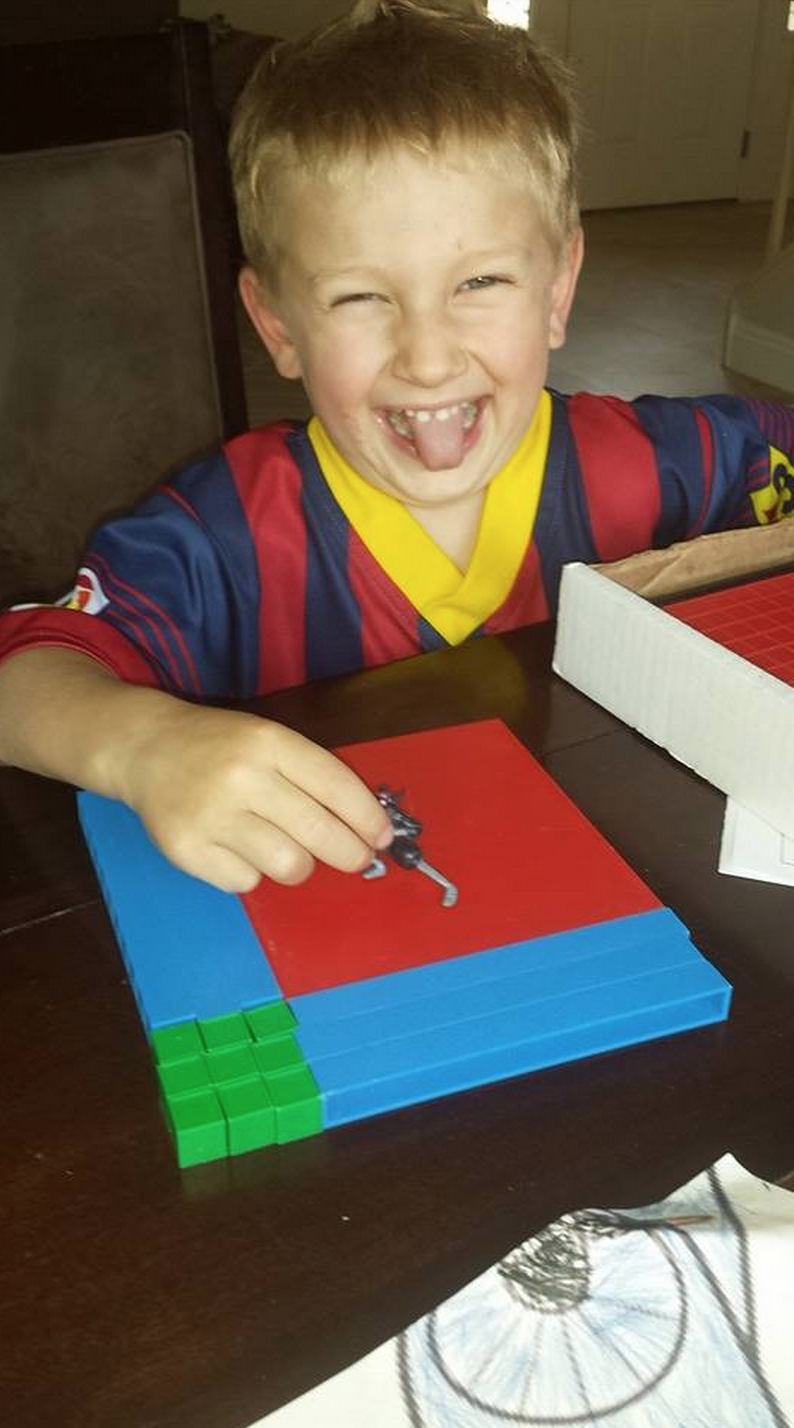
One of the math moms on facebook posted this pic.
My response:
Nice, now change the game and make it so he can only use one three...then the other ones have to be a two and a one or three ones, you might mention right now they are all three plus zero and it's more fun to make combinations...same with the four, only use one four and the others have to be addends for four and so on also nothing says you only have to use 4 on the corners, you can use 5 or 6 or 7 or more pillars...then you can play "jenga" an see if you can take pillars out without knocking the whole thing down...then when does fall down just build it again and see who can take the most pillars out before it falls...Also, make a video of it and maybe you could win something.
Many math concepts can be learned with just this one simple exercise. You can slide a 2 into the level that he built with three's and the concept that 2 is "smaller than" three is easily seen...in math we could say less than...and we could show the symbols on a white board if we wanted to but at this age playing blocks and verbal reinforcement is enough. You are creating a math rich environment, where several of the senses are used to learn math and basic math concepts like more and less and addition and of course subtraction.
The mind absorbs all this then later (days, weeks, months or even years) this experience can be drawn upon to make sense of these symbols: 2 < 3...
You could put on the skip count CD or multiplication rock vids on youtube in the background and sing along as you skip count the threes he has used. PLAY, make teaching addition fun; little kids love to sing and they don't much care if you can carry a tune or not as long as you are making a joyful noise.
Anyhow make a vid of your kids playing math and you might win some cool stuff. UPDATE: this part is over but you should still check out primal math for some cool apps...Zombie Fish Bits is fun....
If you'd like a FREE manual on showing how to teach even very young children a super easy way to subtract click this link to my Supremely Simple Subtraction manual. A new Games and Activities Manual is in the works but it will be a while so meantime use the old one. (Takes a while to load so give it a minute...)
Another math mom on facebook posted this pic.
My response:
Excellent...! Now you can talk to him about the 9 in the corner...you could flip the blocks over and count 1 hundred, 6 tens and 9 units...you could talk about square roots and square numbers playfully with the 9 and the 169...and of course the polynomial...x² + 6x + 9...the square root is one side which is x + 3....and of course (x+3)² = (x+3)(x+3) = x² + 6x + 9 and you talk about economy of symbol...that we don't need to write it twice...you could talk about 13² = (13)(13) = 169...you could have him draw a simple picture of it...and talk about these things while he's making his drawing...note I say could you don't have to...you could write some symbols and show him how those symbols describe his creation the same way words can describe a brown cow...and you do it casually, not drilling him not formal instruction just, "hey...look at these green ones there--they make a square and we can count the sides or one side...hey look at that! You made all those blocks into a square can you count the sides? What's the blue one called?"
If you are on the base ten side he should say, "10...and three units." Or something like that. And you could say, "what's the name for one ten and 3 units...?"
If they are on the smooth side and you are in base x, the blue one's name is x and three units...
A ton of math concepts can be taught off of this one rectangle...you don't need to cover all of them at once...just a few at a time. Check this post out, it talks about all the things you can use this simple rectangle (square) for, when it comes to teaching math concepts.
Now build one that's 14 or x+4 squared...and then 15...or maybe he wants to make a different shape with his 6x...and make it (x+2)(x+3) or some other combination for 6, 5+1, 4+2, 3+3...still 6x but now a different number fits in the corner...just play math, bigger is funner.
Monday, May 5, 2014
Base Ten Block Compound Lesson.
One of the best things about base ten blocks is they impart so much math so quickly if you know how to best use them. They make math concepts visually obvious. They take the overwhelm out of the equation. Even if the child does get all of it in the first exposure they don't turn off, they usually get curious and find out more. Base ten blocks aren't scary.
Here is the student with his younger brother and mom playing around during a game of what's under the cup.
When I talk about collapsing time frames this is one of the reasons why. We can teach so much at once AND make it EASY to understand. They can SEE how it all goes together. When they see it here they will be used to seeing how it works so when they get other lesson they will be used to making those associations and connections on their own. THE EXACT OPPOSITE of teaching it in fragmented lessons that stress memorizing just long enough to take the test. Segmented lessons that focus on rules and process, axiom and postulate DO NOT give the student an over all understanding of the mathematics and may in fact harm their grasp of how the language of math works..
Here is a feisty six year old who although you can't see him was having a fun time playing math with me over the internet. He was shocked when it was time to quit. Base ten blocks and compound lessons. Try a few with your kids. You won't confuse them by exposing them to math concepts early. This vid starts out a tad rough but give it a minute or two.
The video starts out with us building square numbers a really important concept to introduce to little kids. (Do a search, crewton ramone square numbers...see what comes back) This is often overlooked in public schools. And as you can see we cover some basic concepts with regard to squares, WHILE we learning to count and add and multiply.
At this point we have been playing for about half an hour...started out building tens and playing what's under the cup. Introduced some simple concepts like want to be a ten and count the big ones first...and then spent time playing with squares and then took a side trip into multiplication (15 x 15, 16 x 14 etc see vid for more, eventually we will get the 20x20 matrix memorized) where the addends for the tens added up to ten, so ten, tens made a second hundred which made the whole thing EASY. This whole lesson is just teaching more counting while remembering bigger is funner.
Here is a blog post on just plain ol' multiplication. And here is a video on why you WANT to do compound lessons so they get more understanding and not just memorization. I am doing teacher/parent training and this vid is a part of that:
“I don’t want to ruin your spring break…but I’m going to ruin your spring break.” ~Engineering professor while assigning homework
“If all else fails, you can always use the tried and true, ‘The answer is trivial and is left as an exercise to the reader.’” ~Calculus professor
“I made a mistake somewhere… In some sense you’re also responsible for my mistakes, if I make them and you don’t tell me then you’re my accomplices.” ~Mathematical physics professor
“I appreciate that some of you might not be able to see this, but you should be able to work it out anyway.” ~Partial differential equations professor
Here is the student with his younger brother and mom playing around during a game of what's under the cup.
When I talk about collapsing time frames this is one of the reasons why. We can teach so much at once AND make it EASY to understand. They can SEE how it all goes together. When they see it here they will be used to seeing how it works so when they get other lesson they will be used to making those associations and connections on their own. THE EXACT OPPOSITE of teaching it in fragmented lessons that stress memorizing just long enough to take the test. Segmented lessons that focus on rules and process, axiom and postulate DO NOT give the student an over all understanding of the mathematics and may in fact harm their grasp of how the language of math works..
Here is a feisty six year old who although you can't see him was having a fun time playing math with me over the internet. He was shocked when it was time to quit. Base ten blocks and compound lessons. Try a few with your kids. You won't confuse them by exposing them to math concepts early. This vid starts out a tad rough but give it a minute or two.
The video starts out with us building square numbers a really important concept to introduce to little kids. (Do a search, crewton ramone square numbers...see what comes back) This is often overlooked in public schools. And as you can see we cover some basic concepts with regard to squares, WHILE we learning to count and add and multiply.
At this point we have been playing for about half an hour...started out building tens and playing what's under the cup. Introduced some simple concepts like want to be a ten and count the big ones first...and then spent time playing with squares and then took a side trip into multiplication (15 x 15, 16 x 14 etc see vid for more, eventually we will get the 20x20 matrix memorized) where the addends for the tens added up to ten, so ten, tens made a second hundred which made the whole thing EASY. This whole lesson is just teaching more counting while remembering bigger is funner.
Here is a blog post on just plain ol' multiplication. And here is a video on why you WANT to do compound lessons so they get more understanding and not just memorization. I am doing teacher/parent training and this vid is a part of that:
“I don’t want to ruin your spring break…but I’m going to ruin your spring break.” ~Engineering professor while assigning homework
“If all else fails, you can always use the tried and true, ‘The answer is trivial and is left as an exercise to the reader.’” ~Calculus professor
“I made a mistake somewhere… In some sense you’re also responsible for my mistakes, if I make them and you don’t tell me then you’re my accomplices.” ~Mathematical physics professor
“I appreciate that some of you might not be able to see this, but you should be able to work it out anyway.” ~Partial differential equations professor
Tuesday, April 16, 2013
Crewton Ramone In The Classroom.
Here are a few vids I've made while playing around at Haiku School with 1st and 2nd graders using base ten blocks.
We do math that is supposedly advanced for their age. Most of the time the kids don't seem to notice. We fool around with problem solving and algebra, Pythagorean Theorem and addition, multiplication and division. All it is is counting. No concept is beyond the child if presented at the child's level.
Teachers and teachers aides are always amazed at what I take for granted. Several teachers aides commented that they were doing the same thing at the local community college while they attempted to get their teaching degrees. Many of them are being held up because of the math. "Why don't they teach it this way?" is a common question.
I'll get into that some other time. I am building a six hour Audio Course that will cover that (briefly) and a whole lot more. Should be done this summer. To start off here is a rant. Fed up with teachers who tell me kids can't do simple algebra. Teachers can't do simple algebra, not the kids.
Then here is a CLASSIC lesson with first graders. We learn addends for 10 and nine and the nines multiplication table to boot.
Here is another lesson with is a lesson with 1st graders factoring polynomials but what we are really doing is learning addends and multiplication:
As one teacher put it when they get back to the stuff they are doing for "grade level" they ace it. Also In the 1st grade class I go to for an hour a week they blew away their piers on the standardized tests. Especially in "algebraic thinking" but also in general computation. These scores are confidential or I'd share them. Here is more:
I've been fooling with this for 23 years now. I have heard every excuse in the book from teachers as to why they can't do this their classrooms. This post is about removing excuses. ANYBODY can do this. I can train you. You can train yourself. I am working on courses that you can buy for a few bucks to help you implement this in classrooms or in your home or homeschool.
Meantime get a password for 24 bucks and start watching some vids and reading pages that interest you in your spare time. (That's a bit of a joke, my mom was a classroom teacher I know you don't have a lot of spare time.) Once you figure out how AWESOME this is you'll find the time.
Here are second graders doing slightly more advanced play. They are making square polynomials and you can hear the excitement in the room. It's fun. They know they are doing stuff that's supposed to be "hard." In kid culture algebra is hard, but they often ask for it by name.
Here is a lesson on square numbers:
We are getting ready for Pythagoras. Before you dive into more complex concepts it's good to get them used to the elements they will be faced with before hand...like squares and square root. Very important to know what the symbols mean.
And just for fun I took a trip down the radical path. Why. Because you can.
The we played with Pythagoras. The thing to remember is all we are doing is using our counting skills.
The classes with the first graders are about an hour long and 90 minutes with the second graders. I don't expect you to watch all these vids in one sitting but here they all are in one place. You can share them with teachers you know and they can get to them as time permits. Any young ambitions teacher that would like to turn these into lesson plans are welcome to do it...
It is hard to film and teach all at the same time, plus I am hampered by rules about filming children and etc. So I don't make many vids. Hopefully there will e another post like this before summer with a bunch more fun vids for you to watch.
95% of the time we have a great time. Once in a great while things can get rough. I had a Monday morning class with a substitute teacher where the second graders were having a hard time due to lack of sleep
Tweet
We do math that is supposedly advanced for their age. Most of the time the kids don't seem to notice. We fool around with problem solving and algebra, Pythagorean Theorem and addition, multiplication and division. All it is is counting. No concept is beyond the child if presented at the child's level.
Teachers and teachers aides are always amazed at what I take for granted. Several teachers aides commented that they were doing the same thing at the local community college while they attempted to get their teaching degrees. Many of them are being held up because of the math. "Why don't they teach it this way?" is a common question.
I'll get into that some other time. I am building a six hour Audio Course that will cover that (briefly) and a whole lot more. Should be done this summer. To start off here is a rant. Fed up with teachers who tell me kids can't do simple algebra. Teachers can't do simple algebra, not the kids.
Then here is a CLASSIC lesson with first graders. We learn addends for 10 and nine and the nines multiplication table to boot.
Here is another lesson with is a lesson with 1st graders factoring polynomials but what we are really doing is learning addends and multiplication:
As one teacher put it when they get back to the stuff they are doing for "grade level" they ace it. Also In the 1st grade class I go to for an hour a week they blew away their piers on the standardized tests. Especially in "algebraic thinking" but also in general computation. These scores are confidential or I'd share them. Here is more:
I've been fooling with this for 23 years now. I have heard every excuse in the book from teachers as to why they can't do this their classrooms. This post is about removing excuses. ANYBODY can do this. I can train you. You can train yourself. I am working on courses that you can buy for a few bucks to help you implement this in classrooms or in your home or homeschool.
Meantime get a password for 24 bucks and start watching some vids and reading pages that interest you in your spare time. (That's a bit of a joke, my mom was a classroom teacher I know you don't have a lot of spare time.) Once you figure out how AWESOME this is you'll find the time.
Here are second graders doing slightly more advanced play. They are making square polynomials and you can hear the excitement in the room. It's fun. They know they are doing stuff that's supposed to be "hard." In kid culture algebra is hard, but they often ask for it by name.
Here is a lesson on square numbers:
We are getting ready for Pythagoras. Before you dive into more complex concepts it's good to get them used to the elements they will be faced with before hand...like squares and square root. Very important to know what the symbols mean.
And just for fun I took a trip down the radical path. Why. Because you can.
The we played with Pythagoras. The thing to remember is all we are doing is using our counting skills.
The classes with the first graders are about an hour long and 90 minutes with the second graders. I don't expect you to watch all these vids in one sitting but here they all are in one place. You can share them with teachers you know and they can get to them as time permits. Any young ambitions teacher that would like to turn these into lesson plans are welcome to do it...
It is hard to film and teach all at the same time, plus I am hampered by rules about filming children and etc. So I don't make many vids. Hopefully there will e another post like this before summer with a bunch more fun vids for you to watch.
95% of the time we have a great time. Once in a great while things can get rough. I had a Monday morning class with a substitute teacher where the second graders were having a hard time due to lack of sleep
Tweet
Tuesday, June 12, 2012
Playing With Cubes
Getting to know a little about CUBES is important. Children need to have experience with numbers. Square numbers are good to be familiar with too and so are cubes. The problem with a lot of base 10 blocks is they represent cubes as...well, cubes. Which makes sense except that then the manipulatives are limited to the third power then. How do you show powers past 3? Simple you don't.

Here are the first 12 written out. But certainly DON'T just write them out as a drill until AFTER you have built them and talked about them and played with them a bit first. Here is a vid called Crewton Ramone Squares, Cubes and Division because it's about squares cubes and division. I'm creative like that.
Mortensen Math keeps it in two dimensions. Arithmatic not physics. (x)(x²) = x³ or (x²)(x) = x³ instead of (x)(x)(x) = x³ this is a subtle but important distinction which allows me to teach very young students higher powers and so called more advanced mathematics.
Before you get to cubes might be a good idea to play with squares and square numbers. My students will write them out several times during a course of lessons. So they see the numbers and have some experience with them. This will stand them in good stead when they take standardized tests. Many students get through high school without ever knowing their squares and cubes and at Crewton Ramone's house of math we go all the way to 25 with these. (And out to 20x20 on the multiplication tables.) Seriously, your kids know the names of the Pokemons but they don't know the name of 17² or 17³...or maybe it's all the characters in Harry Potter...or they can recite lines from Twilight, but you get the idea.
Squares and cubes should be familiar and easy and part of their instant recall just like 2x2 or 10x10x10...and make sure you eventually go out to 25. You have 12 years to get this accomplished. Here is a short video where Sarah and I are studying for her GED and cubes make their appearance...we only go to 12 here.

Here are the first 12 written out. But certainly DON'T just write them out as a drill until AFTER you have built them and talked about them and played with them a bit first. Here is a vid called Crewton Ramone Squares, Cubes and Division because it's about squares cubes and division. I'm creative like that.
Mortensen Math keeps it in two dimensions. Arithmatic not physics. (x)(x²) = x³ or (x²)(x) = x³ instead of (x)(x)(x) = x³ this is a subtle but important distinction which allows me to teach very young students higher powers and so called more advanced mathematics.
Before you get to cubes might be a good idea to play with squares and square numbers. My students will write them out several times during a course of lessons. So they see the numbers and have some experience with them. This will stand them in good stead when they take standardized tests. Many students get through high school without ever knowing their squares and cubes and at Crewton Ramone's house of math we go all the way to 25 with these. (And out to 20x20 on the multiplication tables.) Seriously, your kids know the names of the Pokemons but they don't know the name of 17² or 17³...or maybe it's all the characters in Harry Potter...or they can recite lines from Twilight, but you get the idea.
Squares and cubes should be familiar and easy and part of their instant recall just like 2x2 or 10x10x10...and make sure you eventually go out to 25. You have 12 years to get this accomplished. Here is a short video where Sarah and I are studying for her GED and cubes make their appearance...we only go to 12 here.
Monday, December 19, 2011
Crewton Ramone And Comander Colby Get Radical
Playing with square numbers can lead a lot of places.
You can end up doing square roots, or distance formula or Pythagorean Theorem...or in this case we ended playing with radicals. You could also start playing with completing the square or finding the difference of two squares...all of these concepts are centered around squares, although some math text books and therefore some math teachers seem to have forgotten this. Really it's about squares.
We have built square numbers before, but this time we ended up expressing numbers in terms of radicals.
We talked a little about why we call them radicals, used our imaginations to make a two into a square and played around with the ideas. I was under the mistaken impression that we had done this before but actually this was his first introduction to them, had I know that we might have used some clay to really conceptualize the fact that we were turning these numbers into squares. I have quite a bit of video and pages and posts devoted to this topic. This should be a clue as to its import.
The sad thing is that it is SO EASY and yet so many kids come to me frustrated and unable to do what their classes require...because they are confused with rules and process. Like factoring polynomials once they see how easy expressing numbers as a radical is they actually get mad. All we are doing is playing around with squares. After a few lessons like this when they see the way it is presented in school and it makes sense...the symbols and lessons are just short hand as it were, for making squares and applying them to mathematics.
The nice thing with this student is he will never know it's supposed to be hard...in fact a lot of times he makes it harder than it is because ever since he got bumped up to Honors Math he tends to over think things...and do whatever it is the hardest way possible.
The second part of this video takes it up a notch replete with some Jazz and blender sounds in the back ground. Eventually this will be on a password protected page...and I really should make a PDF or two...
Find us on FaceBook.
You can end up doing square roots, or distance formula or Pythagorean Theorem...or in this case we ended playing with radicals. You could also start playing with completing the square or finding the difference of two squares...all of these concepts are centered around squares, although some math text books and therefore some math teachers seem to have forgotten this. Really it's about squares.
We have built square numbers before, but this time we ended up expressing numbers in terms of radicals.
We talked a little about why we call them radicals, used our imaginations to make a two into a square and played around with the ideas. I was under the mistaken impression that we had done this before but actually this was his first introduction to them, had I know that we might have used some clay to really conceptualize the fact that we were turning these numbers into squares. I have quite a bit of video and pages and posts devoted to this topic. This should be a clue as to its import.
The sad thing is that it is SO EASY and yet so many kids come to me frustrated and unable to do what their classes require...because they are confused with rules and process. Like factoring polynomials once they see how easy expressing numbers as a radical is they actually get mad. All we are doing is playing around with squares. After a few lessons like this when they see the way it is presented in school and it makes sense...the symbols and lessons are just short hand as it were, for making squares and applying them to mathematics.
The nice thing with this student is he will never know it's supposed to be hard...in fact a lot of times he makes it harder than it is because ever since he got bumped up to Honors Math he tends to over think things...and do whatever it is the hardest way possible.
The second part of this video takes it up a notch replete with some Jazz and blender sounds in the back ground. Eventually this will be on a password protected page...and I really should make a PDF or two...
Find us on FaceBook.
Labels:
Radicals,
Square Numbers,
Square Roots
Wednesday, May 4, 2011
Special Triangles, SOH CAH TOA and laughs...
Here is a short vid covering special triangles, but it's a refresher not a lesson from scratch or an introductory lesson...so it kind of starts in the middle and assumes the student has some familiarity with the subject.
The camera work is, as usual not awesome, but you get the info. You can also start to see how it all goes together, with square numbers and expressing numbers using radicals. We also again have the five basic concepts clearly on display we are just counting we never count past nine only count stuff that is same, concept of same, using rectangles to make it easy to count in this case squares, and of course the concept of ONE: No Fun Get Back To One, in both making one side of the triagle one but also by dividing out the sin cos or tan of an angle to get one x or y which is the length of a side or hypotenuse. This is where we begin to develop critical thinking skills and reasoning the computation is relatively easy...as expressed in the teenager terms, "OMG that's all there is to it?"
You can build triangles using the blocks as sides and learn a lot about the relationships that way. Here is a screencast on Pythagoras' Theorem:
Note that one you understand this, the special triangles make all kinds of sense and you are just playing with making one of the sides ONE, then you can use algebra to make generalizations about them. This math stuff is easy...as long as you can see the pictures and the pictures make sense. The last building block is of course square numbers because the worksheet wanted the sides expressed as radicals:
Here is a little more on that:
Yet more on radicals:
And how to introduce these concepts to little kids:
Find us on Face Book and be sure to go to the house of math for more on other topics. Hit the trig tab once you get there for more FREE lessons....but if you want to see all the videos and the lesson that got Garret an "A" and not just an "A" 100% you will need to buy a password. You can get a lifetime pass for just $250.00 or get a "subscription" for as little as six bucks a month.
The camera work is, as usual not awesome, but you get the info. You can also start to see how it all goes together, with square numbers and expressing numbers using radicals. We also again have the five basic concepts clearly on display we are just counting we never count past nine only count stuff that is same, concept of same, using rectangles to make it easy to count in this case squares, and of course the concept of ONE: No Fun Get Back To One, in both making one side of the triagle one but also by dividing out the sin cos or tan of an angle to get one x or y which is the length of a side or hypotenuse. This is where we begin to develop critical thinking skills and reasoning the computation is relatively easy...as expressed in the teenager terms, "OMG that's all there is to it?"
You can build triangles using the blocks as sides and learn a lot about the relationships that way. Here is a screencast on Pythagoras' Theorem:
Note that one you understand this, the special triangles make all kinds of sense and you are just playing with making one of the sides ONE, then you can use algebra to make generalizations about them. This math stuff is easy...as long as you can see the pictures and the pictures make sense. The last building block is of course square numbers because the worksheet wanted the sides expressed as radicals:
Here is a little more on that:
Yet more on radicals:
And how to introduce these concepts to little kids:
Find us on Face Book and be sure to go to the house of math for more on other topics. Hit the trig tab once you get there for more FREE lessons....but if you want to see all the videos and the lesson that got Garret an "A" and not just an "A" 100% you will need to buy a password. You can get a lifetime pass for just $250.00 or get a "subscription" for as little as six bucks a month.
Labels:
Mortensen Math,
SOH CAH TOA,
Special Triangles,
Square Numbers
Wednesday, April 20, 2011
Crewton Ramone Playing with Radicals.
First off apologies to public school teachers who can't watch YouTube a school the screencasting software is buggin' out and won't let me copy it to a screencast without it being herky jerky video or bad audio...so for now all I have is this youtube video.
It shows me doing a few problems with radicals. Adding and subtracting (combining) them and doing other operations is actually pretty easy when you keep the 5 basic concepts in mind and can see what you are doing.
You might want to look at the square numbers page at the house of math, too.
You might also note there is a new tab on the navigation bar there for percentages. It's password protected though. Progress is being made. Albeit slowly. All it has is two Youtube vids showing how to do percentages with base ten blocks on it at the moment but there's more to come.
Meantime the completing the square page which certainly is related is growing too.
Square numbers are fun and easy.
Find us on FaceBook.
Labels:
Radicals,
Square Numbers,
Square Roots
Sunday, January 2, 2011
What square root means...
Using playdoh to get a feel for square numbers.
Square root means make a square and count one side...but how do you make a square with a two or a three? Playdoh to the rescue.
Use the blocks to help students use their imagination...they can see what the numbers and symbols mean.
Here is another short vid on square numbers...and here is a whole lot more on square numbers at CRHOM.
Find us on FaceBook
Go to the House of Math. (Home Page.)
“The point is to develop the childlike inclination for play and the childlike desire for recognition and to guide the child over to important fields for society. Such a school demands from the teacher that he be a kind of artist in his province.”
~Albert Einstein
Labels:
Square Numbers,
Square Roots
Tuesday, September 8, 2009
Square Numbers
This is a quick video I did on square numbers.
This was a "one take Eddie" but I think it was good enough to get the point across that when we talk about square numbers and expressing the terms as a radical we are simply counting the sides of squares.
This is the beginning of Crewton Ramone's Supremely Simple Square Roots. I plan on making a simple concise Manual with a DVD available that covers square roots, how to square numbers and etc. It will contain a few "tricks" but mostly show the concepts. It will also contain the cross teaching techniques for multiplication...
This was a "one take Eddie" but I think it was good enough to get the point across that when we talk about square numbers and expressing the terms as a radical we are simply counting the sides of squares.
This is the beginning of Crewton Ramone's Supremely Simple Square Roots. I plan on making a simple concise Manual with a DVD available that covers square roots, how to square numbers and etc. It will contain a few "tricks" but mostly show the concepts. It will also contain the cross teaching techniques for multiplication...
Labels:
Square Numbers,
Square Roots
Subscribe to:
Posts (Atom)


