Here you will see students as young as 4 and 5 years old doing algebra and "advanced" math, without ever knowing it's supposed to be hard.
You are invited to learn how to use this method...


Showing posts with label Math Fun. Show all posts

Saturday, March 28, 2015

When a great man walks among fools, the fools know him not.


This is what my guru looks like.
This has got to be one of my favorite humans currently on the planet.  And I've never met him in person.  I aim to remedy that in April.

Turns out lemons are sour.

Money is not a measure of greatness, heart is...although this guy has made more money in a year than many people reading this will make in their lifetime.  This is a good ol' Montana boy who has done good. If you have a message you want to get out to the world, (mine just so happens to be math), this would be a good guy to pay attention to,  he also has several books and eCourses that you might enjoy whether you think you have a message or not. Currently I'm plowing thru the Motivation Manefesto.

This video is particularly relevant to the last several trainings I've had and quite a few emails where sadly parents admit they pretty much have forgotten to how to have fun, certainly can't believe that MATH can be fun, and that learning SHOULD be fun, and that life in general should also be fun. Although they see that drilling and grilling their little kids on math facts might be counter productive they don't know what else to do because that's they way they were taught and that's the only experience they had with math...mostly negative...and certainly that's the prevailing wisdom in public schools. In fact MORE TESTING seems to be their only solution.

"Don't I need worksheets?" "Shouldn't I get some workbooks?" "What do mean just play with the blocks?"

I mean just play with the blocks. Just play math. Explore. Discover. Together.


For those that attended the last training for 20 bucks (which worked out to 5 bucks an hour) and had fun, do as I say, not as I do...

Friday Trainings
have become "a thing"...and this next Friday I'm going to up the price a little bit to $25.00 but defer payment...instead of paying me directly I invite you to join my Kiva team. AFTER you loan the money out and you get paid back you can pay me the funds or you can loan it out again and we'll call it even or you can pay me and I'll loan it out but I'd rather have more team members and it's more fun if you get to chose the loan and the country. I obviously like farming and Ecuador but maybe you'd rather it go someplace else. You could also just join the Kiva team (or some other Kiva team) if you wanted. Wouldn't hurt nothin'.

Last few trainings have been pretty cool, USA, Romania, Canada, Gambia represented. I would love to see a training with all five continents represented one day...soon. Also look for details of a Saturday training instead of a Friday training soon...several people have said they want to come but because of work or kids or whatever it makes Fridays impossible. It sure ain't the money.

Also Brendan has many more GREAT videos and I would encourage anybody doing anything to make time to watch a few (or all) of them.

Details can be found on my FB page here on this blog and soon on the website since it has become a thing....you might want to attend one of the trainings themselves because be assured what happens there and what gets edited and put on the parent teacher training page are two very different things...people are getting a lot out of the training page however...and for the money you can't beat it.


Tuesday, August 19, 2014

Base Ten Block Battle


Playing with base ten blocks. You can't help but make learning fun. Again building stuff over and over again because they want to shoot it down is more fun than worksheets. It is important to use two hands for optimum whole brain sensory input. When the student uses both hands more learning takes place easier, it's that simple.
Using base ten blocks to get addends mastered make learning math almost effortless. First they learn their addends which helps them add two numbers which is basic addition; which helps them add series of numbers which helps them learn to multiply which makes math easy because it allows the student to count quickly.  Math is a whole lot easier when you can multiply because it allows you to divide and discover patterns and a whole lot more. Problem solving and fractions are much more difficult  when the student can't do simple computation. Addends are the basic building block. Gets the kids off their fingers, makes addition a snap...also builds confidence. He built walls of 10 on down to 5 and made a little fort.
I think you can guess what comes next. Knocking them down is the most fun...why not use a nerf gun? We're just playing and having fun while we learn math. Kids will often build walls or set up addends over and over again so they can shoot them down...I wish I had video. That gun couldn't hit the broad side of a barn. LOL!
Okay, fort destroyed, clean up and on to some algebra where we played what completes the square...
Here he is putting 25 in the corner, to complete x² + 10x + ___, he had started from x² + 2x + __, then x² + 4x + __, x² + 6x + __, x² + 8x + __. Again the algebra is along for the ride, he is getting lessons in addends, square numbers and dividing by two...not memorizing formulas involving b/2a...when the time comes though those formulas will make sense...

***

Now onto his brother. Again we start with addends he got a lot more done faster using the tray.  The other way is "cooler" but usually takes longer. If you are playing at home time is not an issue but when you are paying 50 bucks an hour it can be. The one thing I will say about building the tower is that he gets more practice because the walls fall down and have to be rebuilt as you go...it took him a while to build the second story without knocking down the first story...each of those wall was built and repaired more than once. In the tray he does it once and moves on...
Except when he takes the tens out fo no apparent reason and had to put them back in again. AGAIN note the use of both hands because I made him do it...and reminded him verbally more than once...

He was quite proud of the finished product because it looks cool. Kids also find out that building walls out of addends are cooler to shoot at than walls all built out of the same block over and over again...
Then we factored some quadratics started small and worked our way up. First one we did was x² + 5x + 6. Here he is doing x² + 8x + 15. But what he is really doing is learning an addend for 8 and figuring out that 3 x 5 = 15. Also that 15 can be 5 threes or 3 fives...also some division concepts and as an added bonus factoring a quadratic. He is learning counting skills...just happen to be using algebra to teach them, could just as easily be using fractions. I use algebra because it is known to be HARD in kid culture so it builds confidence and self esteem in students like these who are having problems learning math at school
Now I made him get out two tens and a four and measure it with various blocks...he already tried nines...didn't come out evenly...24 is two nines and some more, three nines is too much...eights fit perfectly and he can see 3 eights is the same as 24...but with sevens 3 isn't enough and 4 is too many...and he counted out 7 x 3 = 21 and 7 x 4 =28...he wasn't wrong to get out sevens he was just getting more information and learning as he went. Soon he had eights, and sixes and fours and threes...and calculated that it would take 12 twos...quite a bit of math from just building a wall of 24...
And now he gets some base ten block battle action too. Here he is setting up 12's. Gets the addends for twelve and counts by twelves...note the use of two hands.
And then shoots the twelves.  But never did hit one with that gun. Got a nerf pistol out and made quite a few hits. Kids will usually make more targets and shoot them down over and over again which requires building them over and over again. Tom Sawyer taught me well. SO much more fun than doing a work sheet adding little numbers together. Plus you get fine motor skills AND a whole brain activity instead of just using the dominant writing hand. Here is an article that provides a clue.

"Mathematics may be defined as the economy of counting. There is no problem in the whole of mathematics which cannot be solved by direct counting." ~Ernst Mach

Find us on FB.

Monday, March 24, 2014

Crewton Ramone Just Play With Base Ten Blocks And Learn Math.


Yes, it's true just playing with base ten blocks can teach kids a lot of math on both the conscious and subconscious level. People are stuck in the mode of thinking playing isn't learning and certainly math isn't fun (because it wasn't fun for you) and "playing math" doesn't even sound right.  Making Math Fun is a huge challenge for a lot of parents gauging from the email I get. (you can find the whole vid on the Sample Lessons page) And then if they have too much fun you start to wonder if they learned anything....

Let me start of by saying it's not like your kids will just hover around the blocks and learn math by osmosis...they need some direction and it is purposeful play we are going for not just messing around and throwing blocks at each other.

A seminar company I used to work with way back in the 90's made it sound like all you had to do was buy a kit and your kids would be math geniuses in no time even if the kit just got stuck under their bed and never saw the light of day. They were excellent salesmen. People believed them. Well, turns out children learn a lot thru play and if you aren't new to my blog and website you have heard this all before. A lot. You've seen lots of quotes, and videos...but you haven't seen this one. I just added it to the first grade math worksheets page.

By now I hope you understand that the worksheets are to be used sparingly. They are NOT a primary teaching tool. The blocks are.

On that page CLICK the links or the worksheets for FREE downloads of them. That's right FREE. There is another short video there I would encourage you to watch, and here is a much longer video by the same guy,  Dr. Doug Clements. Teachers in particular might want to make the time to watch that.

Once you have some experience with manipulatives you will see clearly all the learning taking place, these are second graders after all. If you are new around here spend some time perusing the house of math and this blog. After a while you will be able to see the math concepts they are internalizing and how important they are...AND they get to associate FUN with "math time."


Commenting on blog posts and vids is encouraged. The search engines don't care what you are saying as long as you are talking...so you don't have to be complimentary. Make comments, ask questions point out grammatical errors and typos and spelling whatever. Constructive feedback is good...what would you like to see more of or less of or what would you like to see covered that you can't find or that I haven't gotten around to...? I make vids and posts and am met with silence 99% of the time. Actually if I did the math I bet it's even higher than that...if it wasn't for the spammers there'd be hardly any comments at all...

Meantime you can come play on Face Book.


Thursday, January 16, 2014

More Hundreds. (Perfect Scores.)

Before I met him he was usually less than 50%.

Here is a functionally autistic student who went from "F" to "A" in a rather short period of time. Base ten blocks made all the difference. Symbols alone are rarely sufficient until you have spent a lot of time playing with manipulatives. Check out the vids on this page and note how I always fall back on blocks to remind him of concepts we have already covered and to make answers "visually obvious" as the Montessorians say. .


Note the difference in auditory perception which is so common in these kids, they don't hear or process information the same way we do...but I can assure getting "F's" has the same effect on them as anybody else. And so does getting "A's". He was quite proud of himself.

I only spent a few lessons with this kid before he told his mother I would "kill him" if he came and got the answers wrong after all that work. He took it literally. It was fun while it lasted. His mom says maybe he'll come back one day...

If you would like some tutoring where ever you are, all you need is a set of blocks and an internet connection, I usually use google vid chat, that way the dupes at the NSA can learn some math too.

It's pretty easy. You send me funds via paypal and set up a google acct so we can use their vid chat. I also have ooVoo but nobody uses that, and rarely we use skype...the software is just a little better with google although my last few skype calls have been trouble free. I have done vid tutoring all over the country but also Europe, Indonesia, and of course Canada. If you have a couple of kids (siblings) I charge the same not per kid...several families put their three kids on the other end of the video and we all play math since with these manipulatives we level the playing field... Also a few parents are starting to figure out they can make money tutoring others too. The demand is high. I have also done teacher trainings, tutor trainings etc via vid chat not just tutoring kids. All that is required is that everybody has a set of base ten manipulatives (or at leaste enough to go around) and a decent attitude.

As long as you have a set of blocks I am quite confident video tutoring is just as good as being there in person and I have quite a few people who have been getting tutored off and on for months...

Dig thru this blog and play around at The House Of Math...just click links and watch the vids that interest you...get a password which unlocks hours of vids and screencasts (there is also a password protected screencast page) plus PDF's, my book and more detailed pages of instruction where you get to sit in on actual sample lessons but also get direct instruction on how to present math concepts. Maybe it would be a good idea to to start on the Getting Started Page which basically covers how to use a Curriculum Starter Kit but can also be used as an overview. As one person said, "I just go and wonder around clicking links and watching vids and hours go by..."

People are always amazed at how much they get for a password. One page of sample lessons alone is worth the 24 bucks.

Saturday, October 6, 2012

Pyramid Playing Produces a Preponderance of Productivity.

Playing with blocks makes math easy and fun for little kids...and given the proper tools and games and activities "just playing" with blocks can teach quite a bit of math. In fact this is how the Mortensen Method was born. One of the plethora of fun games and activities in your arsenal should be building pyramids of blocks. Walls and towers are fun too...entire math towns can be built. These towns can teach addends or multiplication or combinations of these topics and MORE.

addends with base ten blocks, addition with base ten blocks, manipulatives,

Playing and having fun with math is foreign to so many parents they are sure it can't be this easy. Actually it is. You have to direct a lot of the learning but over all you will see a lot of it can be self directed.

Here are a few of vids that focus on just this one activity: building pyramids. Starting with this short one where we made nines:


Here is a slightly longer vid where we made 12's:


And here is a longer sample lesson with a child that has a few cognitive challenges, but you can hear him catching on after a very short time. You won't find this vid because it is UNLISTED. You will also find it on the sample lessons page.


In the past I have said I don't want to hit you over the head with it but due to some comments made by well meaning parents and teachers of late I am going to hit you over the head with it:

"Play is our brain's favorite way of learning."~Diane Ackerman
Contemporary American author


"Almost all creativity involves purposeful play."~Abraham Maslow
American psychologist 1908–1970

This is not a new concept:

"Do not…keep children to their studies by compulsion but by play."~Plato
Greek philosopher, 427–347 BC

"Man is most nearly himself when he achieves the seriousness of a child at play." ~Heraclitus, Greek philosopher 535–475 BC

"Whoever wants to understand much must play much." ~Gottfried Benn
German physician 1886–1956

"Play is the only way the highest intelligence of humankind can unfold." ~Joseph Chilton Pearce, Contemporary American scholar

"Play gives children a chance to practice what they are learning." ~Fred Rogers
American television personality, 1928–2003

"Children need the freedom and time to play. Play is not a luxury. Play is a necessity." ~Kay Redfield Jamison, Contemporary American professor of psychiatry


"Deep meaning lies often in childish play." ~Johann Friedrich von Schiller
German poet 1759–1805

"Children learn as they play. Most importantly, in play children learn how to learn."
~O. Fred Donaldson, Contemporary American martial arts master


Now if you so are so foolish as to think that you are wiser and smarter than that partial list of people who understand how important play is, I am sorry for you. Play is not just for recess and math can indeed be taught through play. Further, children who learn this way are not confused when it comes time to take tests, because they actually understand the math the questions on these tests are easy and they usually score not just well but in the top percentile of their peers.

With the manipulatives they can actually SEE what they are doing. It's not like this is another way to do math it is a decoding of the symbols in such fashion that both the conscious and sub-conscious mind can understand and better yet it is presented through play.


Saturday, September 8, 2012

Yet More Manipulative Multiplication.

sqaure numbers, base ten blocks, manipulatives,
Make learning multiplication fun and easy playing with base ten blocks.

How to get multiplication mastered. You will have practice. There is no way around it. But you can make this practice fun. And you can make it easier by using some basic memory tools. The concept of a peg. And working in a more natural progression that complements the knowledge as it is acquired instead of just a jumble of facts in ordinal order.

Screencast with boys


Starting with Square Numbers and Pairs a lot of the multiplication can be understood. Then it is easy to add another for three's and of course 10's and 5's are easy so then it's easy to add one more or one less. For example fours can be thought of as one less than what ever number you were counting by fives...is of course four so 5 x 6 is thirty and one less six is 30 - 6 = 4 x 6 which is 24. Etc. This needs to be re-cut because the fan messed with the microphone but I STILL haven't had time.

Multiplication


You can use this same thinking with 9's and you can go up AND down with the square numbers...6 x 6 is 36 6 x 5 is 30 one less six and 6 x 7 is 36 + 6 which is 42 and the way you get there easily is with wanna be a ten, six needs 4 to be ten so it takes the 4 out of the six and we get another ten with two left over for 42...4 tens and two. Here is a screencast where I use addends to make multiplication easy for an Autistic student. If it works for her it will probably work for you.  Multiplication by nine is EASY btw. So easy FIRST graders can do it. Click that link and watch the second vid. More explanation:

Using squares as a peg


Multiplication is THE milestone in mathematics and should be taught early and mastered so that all the rest of the math becomes easy...

1st grade multiplication, base ten blocks, manipulative math fun

There are books and worksheets that can help but more than anything you want to PLAY and have fun not beat them to death with math facts that make them hate math and turn them off at an early age. Play with blocks, sing songs do a little each day starting when they are very young and by the time they are 6 or seven most of it will be out of the way. Waiting until 4th grade is INSANITY.

Here is a web page of the books Mortensen uses. The facts mastery books are simply more practice and to be used to reinforce the PLAY you do, which should amount to much more time spent than time you spend on the books.

Also do some web searches for "Crewton Ramone Multiplication"...there are tons of pages and videos on this extremely important concept.  And of course here is the Multiplication page at the House Of Math.

I strongly recommend you follow a lot of the links on this page. I know it's a lot but I can't stress how important multiplication is for making "the rest" of math easy and understandable because it allows you to see patterns and count very quickly. Then search "Crewton Ramone Multiplication" and see the plethora of pages and vids I've made.

Thursday, May 24, 2012

Using Math Materials To Best Effect

I would Like to introduce you to this woman who has started making vids on Vimeo.

Seriously. Could these kids be any cuter?
And it's even more important to teach girls early because they need every advantage. Our culture puts females at a disadvantage when it comes to math starting very early on.


Here is her channel, Education Unboxed. She has opted to use Cuisenaire Rods, I am hugely biased toward Mortensen Math base 10 Blocks/Manipulatives but she is correct that they are pricey and many parents already have Cuisenaire Rods because they are cheaper. (They are cheaper for a reason IMO.) With just a little work, a few "mods" as geeks and nerds like to say, they can be quite serviceable for teaching math beyond just addition and place value. Her point is to make vids that parents/teacers/homeschoolers can use to put the materials they may already have to better use. I highly recommend her channel and vids and hope she one day makes a blog and website too.

If you can't afford Mortensen math materials, perhaps you can afford a set of the Cuisenaire Rods...and you can get started teaching your kids math and learning math right along side them...with all the FREE suport you get from The House Of Math and this blog and now her vids too you can't afford not to get started and have very few excuses left.


She says she is "just a mom" who wants the best for her kids and wants to help others help their kids too. Even more I want to promote her because so many make excuses that they can't do it because they aren't good at math or don't have a degree or what have you...to which I reply: "just get started." You won't fail and you won't hurt or damage your kids. Errors can be corrected if you make them and can be turned into teachable moments.

My comments and critiques are for her improvement NOT to put her down or denigrate what she is doing. Her point and so is mine that if she (we) can do it SO CAN YOU.

CR:
Another great vid!

OMG: your kids are so cute it brings tears to my eyes.

Fine job removing no from the lesson and telling them what they have. Play a game with yourself how to I remove the negative completely. Instead of it's not 11, show me it's 11 or Hmmm, what's this side called again? (Answer is x, and then plus one.)

Improve your x² by putting a stip of paper over the sides because her observation that it is 10x is correct in this case you can clearly see it. I made a video about this...and it is a common question. Is 10x = x²? And the answer is a little complex involving 10, -10 and multiples of 10; they are after all base 10 blocks. That lesson would be best saved for another day...

Just telling them it's x when they can see it is 10 is usually not sufficient. Solve that problem with a strip of paper. I realize you are improvising with the tools you have and you are doing a FINE JOB.

This; however, is pretty important. Math concepts aren't because mom says so. lol

There is a Montessori concept called "visually obvious." It is visually obvious that that one side is ten...it must be visually obvious that that side and all sides is/are x.

A few side notes. At one point the younger child made and x to the second not an x square, which is good: it was one by nine...you could point that out in a later lesson. x² doesn't always have to be square! Especially if you are doing third power algebra...x³ dosen't have t be a cube either...in fact it will make higher power algebra impossible to present if you try and stay in three dimensions. You may casually mention this if she does it again...that way it's a natural discovery and not a "lesson".

Also they are never wrong. They are just getting more information. (You know this I am just reiterating for those reading.) You are a patent and gentle teacher. You may want to direct them a little more and let them figure out some of their mistakes on their own instead of just showing them so they can have their own ah-ha moment. You accomplish this by asking good questions using control of error and putting them in a situation where they can not fail...each one of those is a full dissertation and they are covered lightly on my concepts page.

Good questions:
Does yours look like mine? How could you make your square look like my square? Show me. How are they same, how are they different, what's the name of this. Etc.

You can also avoid and control error with use of the three period lesson.

Lastly you casually mention they are completing the square when they are in fact completing the square. That is great! You could take a second to ask how they do it...the answer you are looking for is by taking the x and splitting into two parts...this seems small but it's huge. Later when they do the quadratic the (b/2)² will make sense...

I would like your permission to your vids on my website or blog once in a while where they will get more exposure and hopefully encourage others to get started teaching their own kids math. I would also like your permission to put links in these comments because I have covered a lot of this in detail in other places.

Third please contact me via email...info is at my website. Just click the contact tab.
I am a master trainer. I was certified by Jerry to train trainers to train other trainers...not just train teachers to teach kids. The difference is understanding the why of things. You could be a mighty teacher if you wanted to be. You never know where teaching ends...somebody could see your vid and be inspired to do more...a kid could stumble across it and have an epiphany...you're making a positive difference.

One more time: FINE JOB.

Education Unboxed:

Yes, I absolutely do need to cover the sides with paper. I'll be doing that soon!

I THINK I understand what you are saying about "x squared" (not sure how to get the little 2 up there!) not having to be a square. Though I just learned last year that "squared" actually means a square! So, now you're saying that it doesn't HAVE TO BE in a square shape, right? Just that 9 is a square number because it COULD be made into a square? And when it's not in a square shape, then we call it "x to the second?"

Yes, please feel free to post my videos anywhere you'd like. The only reason I made them was to help other people (so they wouldn't have to do the hours and hours of research and reading I've done over the years). And, yes, links in the comments are fine.
I will contact you through your website. Thanks!!!

Then as you can see in this next vid she does...


A couple of notes for ALL teachers including myself: REMOVE THE NO FROM THE LESSON. Migrate to good habits early, but don't worry about doing it wrong if you are wrong just correct the mistake. Some students can be migrated to the correct way just by modeling, they see you doing it correctly so they change to make theirs the same as yours. Occasionally you get the child that wants to be different from you just to be different. These minds are to be encouraged but certain rules are not up for debate, we read left to right for example your blocks should mirror this...here are my comments so far:

Many comments to make. This is great.

Remove the no from the lesson.

Need an equals sign instead of a solidus...

We read left to right...the girls need to be (gently) corrected to put the units in the upper right. It doesn't really matter ( 3 + x )( 4 + x ) = ( x + 3 )( x + 4 ) however ( x + 3 )( x + 4 ) is more correct because we count in descending order. (Count the big ones first.) Also (minor details) move toward putting the parenthesis closer together. Again they aren't wrong they are acquiring more information...and you are simply moving them to more correct notation and mathematical syntax.

Also DRAW pictures. This is the bridge in the mind between the concrete and the abstract. A blend of symbol and blocks is great...
Will add more later.

Keep up the GREAT work.

Find us on FaceBook.


Wednesday, May 16, 2012

Online Math Video Tutoring Is Fun Too


Here are a few Screenshots and vids from some of the Online Math Tutoring I do.

I have found that online math tutoring is fun and the parents have found it is effective. All you need is a set of blocks.


Here is a 12 year old doing some high school math where we are exploring the concept of f(x) and what it means to evaluate algebraic expressions for various values of x. Sound complicated but his 8 year old brother gets it too. We do algebra because it teaches and reinforces basic operations, because of the algebra we have to do addition and subtraction multiplication and division. Their basic skills have improved since I've met them but we rarely drill multiplication facts...

This is one of my favorite students. She is a handful but she she is a free spirit, undisciplined and I dare say a bit naughty at times. But she has a creative mind that needs to be nurtured and rewarded, cultivated not punished for thinking differently and finding the structure of math a little boring. My job is to make computation easy and fun so that later she can "do math" which she will find is far more than computation. Computation is how we do math, but math involves problem solving logic and reasoning.


She is having fun learning addends...I had one parent ask me, "why not just cover the blocks why do you have to put a bag on their head?"
"Because it's more fun."

Building a tower is fun whether you are a boy or a girl. Here we are building the addends for 9 thru 6.  This child is eight. A pox on teachers who think math time can't be play time. She often goes through and tells me all the combinations she has made, although she doesn't have to. Her subconscious also develops a memory for the addends and this makes recall instantaneous.  She doen't have to think or compute...6+3 is the same as 9. We've built it many times. I should have taken pictures of the many times the tower fell over and needed rebuilding...which is also fun. Online Math Video Tutoring is pretty cool. We are as far apart as we can be almost...from Hawaii to the east coast. With the net distance doesn't matter.
After you get them built try playing Jenga with them...take out a block or two without knocking it down. Why? Because it's FUN.
I believe this photo captures a thing called pride. "I did this."  Good for self esteem.  Good for making math fun and giving a positive association with math instead of a negative one.

I find algebra much more useful for teaching math, building towers is fun but so is making these rectangles factoring quadratics not a problem...here she is completing the square and factoring x² + 10x + 25...she gets multiplication, addends, division and algebra all in one lesson. With the towers you get addition and subtraction of addends and fine motor skills but that's about it. Algebra is a much more powerful and effective way to teach more math all at once.


It still amazes me traditional teaching separates the inverse functions of addition and subtraction and multiplication and division. You can see the relationships when you play with the blocks. 6+3 = 3+6 and 9 is made up of a 6 and a 3 in this case so if you make a 9 with a 6 you need three and they see that 9 - 6 is 3 and 9 - 3 is 6...all in one shot where on paper it would take a but to list all those facts. Manipulatives make some operations MUCH faster and easier but eventually you will see paper and pencil really is the much faster way to do math. With Online Math Video Tutoring I can teach anywhere on earth, the concept should still boggle the mind. ANY subject can be taught this way including eye surgery as it turns out but, "dammit Jim I'm a mathematician not a doctor..."


Even when google's vid feed is messed up you can still do a lesson...and algebra is easy even being green. You may also note that I'm pretty generous with what constitutes "one hour" if we are having fun and they don't notice one hour can be 105 minutes...lol...sometimes it's a little less sometimes it more sometimes it really 60 minutes. I stress again with your kids math time shouldn't be rigid but more flexible and the lines between math time and play time should blur and merge.

Join us on FaceBook.


Thursday, May 3, 2012

Just Play Math!

Here is a video of a young student playing math. For us this is a pretty formal lesson. I need to get some video of the boys just playing because as I look over the vids I have, they are not exactly representative of play time. Problem is play is fun and spontaneous and getting the camera out changes that. Observing a thing effects a thing.


 I enjoy this vid because you can see him throwing me some attitude. He wanted to play Legos not make a math a vid. He was also sick... Note the ease with which we breeze through lessons from subtraction to negative numbers.

Listen for the word "no"; it is replaced by me with show me or what do you have etc. We always start in the concrete and we skipped from blocks to symbols without drawing pictures then we went onto multiplication with 7's...

And this inspired a story about the numbers being happy. 7's have to go all the way to 10 before they get happy, 5's get happy after just 2...most get happy after just 5...the "hard" ones don't get happy until 10...3's, 7's, and 9's...

Then when we count all the way to 105 with 7's we get momentarily confused...but we keep counting...the point is we are playing math and we go through the basic operations of subtraction, integers and multiplication in one "lesson."  This is the problem with traditional teaching of the mathematics to young children a lesson on math will be ONE lesson. No flow. Just a compartmentalized lesson on subtraction with borrowing and counting backwards, no movement to integers not shifting gears into multiplication...can you see the "subtraction" that goes on in multiplication when were counting 7's? Seven takes the three out of the next seven and and we get fourteen...etc.

Math. One language.

It has been noted that youtube constantly takes down the vids for multiplication rock. So go to youtube directly and search the vids...or better yet go buy the vids off my page.


Tuesday, July 12, 2011

More Problem Solving For Little Kids

Basically, we are playing advanced "what's under the cup?" but the name of this game is "finding stuff that's same on both sides."

It's fun and even easier than "what's under the cup?" if you do it right. Start off easy and all positive and no fractional answers.


The answers to problems like these are visually obvious. Once you remove the stuff that's same on both sides, this is a slightly more advanced problem because it involves hero zero AND no fun get back to one. The boys can see the answers and what to do. It's FUN when you get it right. Some observant people have noted there are 5x worth of manipulatives on the one side instead of 4, don't worry we sort it out in the longer video.


These two had been couped-up in the house for a couple of days with runny noses and fever but were still able to play math a little bit. Along with several hellacious games of Chutes and Ladders...

Here is the short version where all they do is set up this problem, in the full video we solve this one and several more. The boys say they are easy-peezy. I know several high school students who would beg to differ...as well as a few home school moms.


4x + 1 = 2x + 9


Child's play. This problem is easy if you can see it. Many people I know tend to have their eyes glaze over as soon as they see the algebra. Once they see the problem solving page at Crewton Ramone's House Of Math they can't believe it's that easy. Really, most of the math is child's play and you can make games of it if you are willing to get creative. There are math teachers who get quite excited when they see this way of teaching. Parents who thought they couldn't do math also get excited but they lack the knowledge to make up problems easily on their own, this can be remedied with practice. Here are a couple of story problems that can be represented with these symbols:

4x + 1 = 2x + 9


Bob and Jay are out of town. Bob is trying to catch Jay. Bob is on his skate board going 4 miles an hour, Jay is walking along at 2 miles an hour. Bob is one mile out of town and Jay is 9 miles out of town. How long does it take Bob to catch Jay and how far out of town are they when he does?

Or you could make it a little more difficult: Jay is walking at 2 miles an hour and is 9 miles out of town. Bob is only 1 mile out of town but is walking twice as fast. How long does it take Bob to catch Jay and how far out of town are they when he does?

Same Problem different story. Bob and Jay are going to have a snow ball fight. It the middle of summer in Utah and there is still over 8 feet of snow on the ground in places that are usually green with grass growing on the ground. How long before Jay and Bob learn enough math to debunk global warming claims? No wait...let's try that again:

Bob and Jay are going to have a snow ball fight. Bob has 1 snow ball and Jay has 9, which isn't fair. So they each build more snowballs. Jay works for 2 minutes and Bob works for 4 minutes, they build the same amount of snowballs per minute and when they are done they each have the same amount of snow balls. How many snow balls do they have and how many did they make each minute?

Be sure to check out the previous blog post on problem solving for more. And if you want to see the entire video get yourself a password and go here.


Sunday, July 10, 2011

Algebra Is Counting and Not Really That Complex

Algebra is just generic math. We count stuff. That stuff has names. We can use it for lots of things. Problem solving. Honing our critical thinking skills. Learning to count. Simple stuff like that.

This nine year old can already count, so all I'm doing is giving him new stuff to count. That stuff has names, like "x to the third" and "x squared" and "x", you can also teach kids who are just learning the names of numbers these too: it's just more vocabulary. Mostly I find that the teachers themselves are the ones who have a bias against counting "x to the thirds" due to their own ill experiences with math, but really, to little kids it's just counting.


Little kids actually enjoy algebra because it's like learning with puzzles...the teacher can add more or less meaning as needed, depending on age and skill level.

This little snippet may look impressive but if you watch the whole thing which is on the "advanced" algebra page you can see it was easy and fun and it was a natural progression. The child even made up the problem himself.


I watched the long version of the video with a certain pair of students who were four and six and they made me stop the video so they could answer before the child in the video did. You can also do this with your students. I know three bucks is a lot to pay for a home made 22 minute video but you also get pdf's and access to literally 50+ more videos. Go crazy and spend 12 bucks and you get that access for a year and you'll see how much stuff I add weekly is worth a buck a month.

It will be a while before we move into negative expressions and we still have to play around quite a bit before we start setting these equal to zero and solving them and then move on to graphing them. One step at a time.

Also for homework you could take that last problem we did and draw it so that one side is x2 + 2x + 1 and the other is 3x + 2. You'll get the same thing just in a different shaped rectangle. There's often more than one way to factor third and fourth degree problems.

Find us on Twitter and Facebook...

Wednesday, April 20, 2011

Crewton Ramone I just wanna Play Math all day.

Play. Play Math.

I've said it over and over again. Play is important. It's crucial. Note how he talks about problem solvers having to use their hands. Mechanics. Engineers. Kids with blocks. Something happens when you get the tactile sense involved. Kinesthetic learner or not, adding the sense of touch and being able to get your hands on it makes such a big difference mere English words do not adequately convey the importance of it.

2011 and the world of mathematics has still not caught on to how important manipulatives are for increasing comprehension and learning of math concepts. It's still something for special education or minorities. "Real" math teachers don't use manipulatives and certainly not on adults. I note the "real" math teachers are failing miserably as a whole, with a very few bright spots here and there.

Here is yet another TED talk on the subject of play:


"Almost all creativity involves purposeful play." ~Abraham Maslow American psychologist 1908-1970


"Whoever wants to understand much must play much." ~Gottfried Benn German physician 1886-1956


"Play gives children a chance to practice what they are learning." ~Fred Rogers American television personality 1928-2003


"People tend to forget that play is serious." ~David Hockney Contemporary British painter


"Do not…keep children to their studies by compulsion but by play." ~Plato Greek philosopher 427-347 BCE

"Necessity may be the mother of invention, but play is certainly the father." ~Roger von Oech Contemporary American creativity guru

Not to hit you over the head with it, with these math quotes but perhaps maybe, you just might want this to become part of your teaching philosophy. I try to keep these quotes in mind when I play math with my students. Grander men than me have left behind these words so that I might also understand the crucial role of play.

"We didn't do anything dad, we just played with blocks." ~My favorite quote from a little girl who went from "F" to "A".

Here are a few blog posts as a reminder:


http://crewtonramoneshouseofmath.blogspot.com/2010/12/4-year-old-math-enrichment.html


http://crewtonramoneshouseofmath.blogspot.com/2010/09/make-it-fun.html

http://crewtonramoneshouseofmath.blogspot.com/2011/02/math-rich-environment-ii.html

Tuesday, February 1, 2011

Base Ten Blocks and Playdoh

Math Rich Environment II

Playing IS learning. Play with the stuff they like to play with...in this case playdoh and manipulatives.

This screen cast got over 150 hits in a day, I'm pretty sure people were amazed by their ability to multiply more than the dough...but you never know with the internet.

Share it.

Basically, we played and had fun first and learned math concepts second. This play session lasted around two hours. Note the complete lack of symbols in our play. We just talked about the concepts the symbols will come later.

Here you see us playing with addends and subtraction. A lot is going on here...you see hero zero wearing his five disguise at the top, first it was a ten then we made addends for ten below it then the 4 year old showed me ten take away one in no uncertain terms...

playdoh, base ten blocks
Here we see an addend for seven and a couple of cut outs.
clay and manipulatives
Playing with ten and addends for numbers larger than ten.
base ten blocks and playdoh
Here you can see how the boys lined them up and pressed them in...
math rich enviornment, blocks playdoh,
Talk about making impressions here we see 6+4 reall is the same as 7+3 and they are the both the same as 10.
playdoh for math fun, base ten blocks
So what if they don't line up perfectly they still "get it", at this age the emphasis is on playing and fun. You can't play "wrong."
preschool math fun, playdoh, base ten blocks
Cut outs for one I don't talk much about it on the screencast and you don't see it here much either but we did all kinds of math with the cut outs...mostly adding and subtraction and smooshing together...
make manipulatives with playdoh, base ten blocks
Then we started playing fractions, under my direction...it's play but it's directed play.
"Why don't we...?" What if we...?"  "What would happen if...?" "Can you make a square and cut it up...?"
playdoh for math, preschool math fun
Looks like an American cheese single...and right there I got about 100 ideas for lessons with a pack of cheese singles...eat your math lessons that will get them subtracting assuming you like eating processed American mucus forming chemically enhanced for optimum flavor cheese. I wonder if I could get Kraft as a sponsor?  Anyway, I can see lots of lessons that could be done with cheese singles...
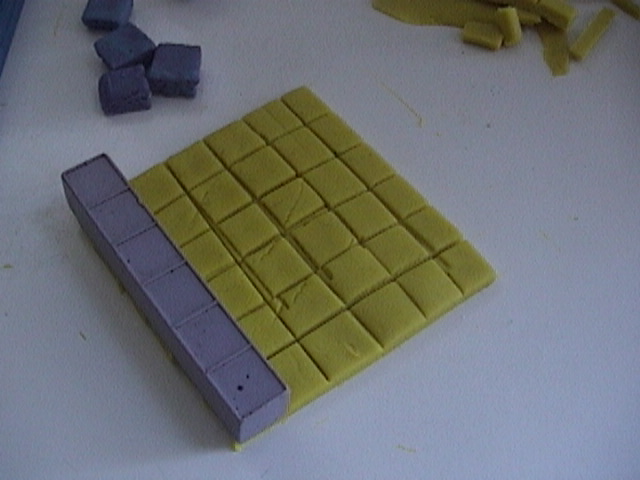
Here we talked about one whole...then because it was yellow we cut it into a 4x4 square using the 4 block as a guide. First we cut it in half, then we cut each half in two to get quarters then we cut the other way and we talked about equivalent fractions...1/4 = 2/8 and they could see it...and then we cut those into halves and you get what you see here.
playdoh math, play doh math, playdoh math manipulatives
This gave us a good chance to practice counting by fours and to see 4/16,  (also see a relationship of 1 to 3, 1:3, but we did not talk about it at all, I mention it here because it's so blatantly obvious we could show equivalent fractions "the other way."  Keep it simple and fun and don't try to stuff too much info in there at a time. Older kids and adults might be ready to make the switches between the two but with the toddlers I made sure it was a coherent lesson with no jumps in perception. It's one square with a strip colored in as opposed to two rectangles, one over the other to show ratio and equivalent fractions of 1/3 that way.) This one square teaches a lot of math as it is.
play doh math, fun math activities, preschool
Bigger is funner.  Here we put together a six by six square and talked about fractions as we did it...can you see how fractions and multiplication go hand in hand, and that you can teach multiplication with fractions?
The older boy wants in on the action since he did such a good job of counting by 6s.
kindergarten math fun, playdoh math
However the younger boy would like it known that it was he who did all the work.
Since it was all cut up already I used a six to show one out of six or 1/6th. and that was the same as 6 out of 36. 1/6 = 6/36 again they didn't see any symbols and we didn't do any writing during this session.
base ten blocks and playdoh
Here is 1/36. Just for fun.
math with playdoh,
Here is 6/36 and again I see a ratio lesson here of 5 to 1, but we didn't do it.
playdoh math, fractions, square numbers
Then we made it smaller and talked about fifths.  Each blue block is one of five or 1/5.
Which is the same ans 2/10ths.
It was fun rolling out the skinny lines and making stuff with them. I missed taking pictures of using them on that yellow flat to show other fractions and fractions concepts.
playdoh math, math fun, fun math activities,
Then after we had played enough with these concepts crunch it all together and start all over again.
"What should we do next? " four year old.
"I dunno," I said. "Let's just PLAY." (And see what happens.)


Here is a screencast where the boys help me tell the story. Caution they may blow your mind with their ability to count.

Outages on Youtube and Screencast0Matic have been common lately.  I put screencasts here for all my teacher friends who have YouTube blocked at skool.  If you can't watch on one hopefully you can watch the other.

The screencast is titled "Crewton Ramone Play W/Clay Learn Math" on both YouTube and Screencastomatc. Last I checked it had 159 hits on screencastomatic alone and it's only been up since yesterday...please hit the like buttons and rate and share it where ever you watch it. People email and ask if they can use my vids and screencasts for various thing. The answer is YES, BY ALL MEANS GO AHEAD. Just don't try and sell them and try and put a link back to this blog or my website.


Vid won't play? Try this link: https://screencast-o-matic.com/watch/cXVwcalGn

Here are a couple of posts where they play and learn math:
Math Rich Environment

Four year old math enrichment.

And just so you don't forget, you teach toddlers algebra right along with fractions and multiplication.

Find us on FaceBook...

 Crewton Ramone's  House Of Math.

More fun math activities.