Here you will see students as young as 4 and 5 years old doing algebra and "advanced" math, without ever knowing it's supposed to be hard.
You are invited to learn how to use this method...


Tuesday, September 30, 2014

Base Ten Blocks and Math Anxiety.

I have seen students whose confidence is so shaken by calculus or algebra that adding small numbers is no longer certain....the reptilian brain kicks in even basic operations become difficult...too much stress or anxiety and you can literally do about two things: fight or flee. This is why in martial arts you fight calmly and better yet with no conscious mind....otherwise the reptile kicks in and you can't remember what to do even if you have practiced for certain situations 1000 times.

I remember a student who was excellent in the dojo...got his belts easily etc. Went to his first competition and got his ass kicked by another guy who was considered less skilled...because he panicked and by his own admission "forgot everything." I have also heard of stories where guys get in street fights and lose with guys who are untrained because of the same reason.

What does this have to do with math and base ten blocks? PLENTY.

It's the EXACT same thing when a student with test anxiety is tested on subject matter with which they would otherwise be completely conversant and familiar...but get an "F" because during the test they can't think.

I remember a student who I worked with coming back with an "F" on material we both knew he knew:

"What was I thinking!" he exclaimed looking at one answer that should have been obvious and to which he wrote a completely wrong answer.
"You weren't thinking."
"Gee, thanks..."
"I'm not criticizing you...you couldn't think..."

And I then went on to explain what happened, and for that hour we did no math but talked about how to handle test anxiety and math anxiety and did some breathing exercises...explaining the flight or flight syndrome so they understand that what's happening is not only normal but HARD WIRED IN for SURVIVAL removes the "I'm stupid" thoughts, allows them to recognize it when it starts to occur and nip in the bud and deal with it instead of letting it run away with their their thought and emotions.

This student went on to pass his class with quite a few 100's something for which I'm famous, (check these vids out) and his parents gave me a hefty tip at the end of the year...he might have gotten an "A" if he hadn't started of with so many scores under 40...lol...and that's another thing too many parents wait till the kid is failing before they "breakdown" and get help. 

This also why the emphasis is on having FUN and playing: so the reptilian brain never gets a chance to kick in and your child's attitude and associations with math are pleasant and positive. As they get older math anxiety is avoided altogether because they understand math and the relationships and how it all goes together...and the symbols are easily decoded and understood.

Base ten blocks make math easy. There are silly people who think base 10 blocks will lead to "block dependency" where the kids can't do math without the blocks. Ludicrous. My blog and website are proof positive that this couldn't be further from the truth. Do any of the kids on that testimonial page get to bring blocks with them to public school when they take the test? Of course not.

Are DBoyz doing algebra and multiplication in their heads without blocks?  Of course they are. Your kids can too...and I can teach you how to do it yourself: check out this parent/teacher training page.

"Soon" (a very relative term at the house of math) there will be an audio course and more on the training page...here is a transcript of the beginning:

Well Hello! and welcome to Crewton Ramone’s 6 Disc -- probably 7 Disc, Audio Program--there is a bonus disc there with a guided Meditation--but what I want to do here over the course of this audio program is get you to understand that anybody can teach math the way I teach math, that YOU CAN use base 10 manipulatives to make math fun and easy, whoever your students are and whatever your mathematical background is; whether you had a good experience or a bad experience, whether you're male or female, you're a homeschoolers, you’re a teacher, a parent that has a kid in public school and you just want to able to help with math or give them “enrichment” this audio program is for you.

Now, specifically the target market that I’m looking for are the people with young children-- if this describes you then you are definitely in the right place. If you are a parent that has young children, definitely children under the age of 12, under the age of 8 better than that under the age 6 even better than that. Well let's say you have a student in--I don’t know if they are in grade school or middle school or high school...wherever they are this audio program is for you and if you have decided that you want to try and help your student or help your child understand mathematics then you are in the right place.

Now in order to do this I want you to be able to use these tools to their best effect, you just need to have some basic understanding, understand some principles and concepts, and you too can teach mathematics, you too can do what I do -- so many would say, "oh you are a genius" or "you are this or that", "oh--you are teacher: you’ve been doing it for 20 years" - "oh you’ve been..." {etc, etc}

Okay, when I was doing this and was two or three years in, people were like, "Wow! I can’t believe you’ve only been doing this for two or three years!", Okay? The idea is Jerry Mortensen had the same problem, everybody was like "Oh! Jerry is special he created the programs...of course", "Maria Montessori she is special because she created the -- Mario Montessori -- whoever it is, right?" -- they all have a crowd following that says, “you can do it but I can’t”...”you are special", "you are different” and what we are trying to do, and Jerry especially, but myself included, is trying to make you understand that you can do it also.


This blog and website is about removing excuses. There was a time when you spent 500 bucks and you got a kit and there were 4 hours of video. TOTAL. That's it. Watch these vids and now you are on your own. Not anymore.

If you wanted more training you could fly to Idaho once or twice a year...IF they were having a training: there hasn't been a training there for years now.

Thursday, September 18, 2014

More PT Training.

26Sept14 10am HST

You were invited. Next one is NEXT Friday, the 26th, 10am HST more teacher training. All you need is the google vid chat plug in installed...a set of blocks, and 20 bucks.


Here is how it works..very simple. Contact me Paypal me 20.00. When you contact me I will send you the paypal info. You need gmail vid chat NOT SKYPE. You might also look into ooVoo, I've done some fun meetings there unrelated to the house of math. But for now gmail vid chat is fast and easy...just install the plug in and you are good to go, then add me to your circles or email me and I'll add you. THEN a little before ten you will get a call or invite.

DON'T try to do it if you don't have high speed internet...shut down everything else...you should have a browser running with one window...shut down all your other programs. Especially word processors and for those with Macs "preview"...have a set of blocks and something to take notes on...a white board is nice but not needed. The blocks are NOT optional. You will hear it over and over again in the vids get your hands on the blocks, math is not a spectator sport, contrary to the way you and I learned it.

2 more hours up on the teacher training page and another hour up on Raymond's page...learn to use your base ten blocks.

I have been told over and over again that just one or two of my password protected pages are are worth the price of an annual password...and the with more than 5 hours of training now on the Parent Teacher Training Page still available for 15 bucks that page is more than worth it. Look forward to a password protected pre-calc page soon.

Tuesday, September 9, 2014

Base Ten Blocks Make AP Calc EZ Too


I was working with an AP calc student. They are just getting started. As usual the student did not see the relationships between what we had done before and the formulas he was getting. When I showed him these side by side with a brief explanation the tell tale "OHHHHHH!" was exclaimed (the light bulb going on / the rush of endorphins when you understand something) and he said, "well, that's easy then."  Base ten blocks give a solid foundation so that when we get to this point many obstacles to understanding have already been mastered and are not issues.  Understanding square numbers and square root for example and trig which is basically the study of how triangles work is made plain using base ten blocks...no one ever explained to me in highs chool that math was a language and how all those formulas were basically saying the same thing and how and when to apply them. It was basically just memorize this, this and this...and I never got the relationships between them until years later.

Desmos.

This student comes once in a blue moon. If he came on a regular basis I wouldn't have to hit him over the head with it as it were and he would see that we are just finding the slope of a line, as well as see Pythagoras not only in distance formula but in the basic trig identity too.  In the last formula we talked about h being more than just h it's the distance  between the a and a+h expressed using economy of symbol.  (The thick black line below the red lines in the last pic below.)

He might also see our old friend from the doughnut factory and playing with ordered pairs rise over run for rate and slope and the "m" in y = mx + b or as he will now see it f(x) = mx + b where m = dy/dx....but all these triangles do go together....and it's pretty easy to see that even the complicated looking formula with a's and h's and stuff isn't so hard after all. The basics are covered on vids and on password protected pages like this. Look for Water tank, doughnut factory constant rate problems.

Then tangent lines and secant lines are no problem either and with a little more explanation of economy of symbol and that y = f(x) and how we just labeled the points with letters, the anxiety subsides rather rapidly and learning can take place. It's hard to learn anything while in flight or fight response.  We have proven this time and time again. It's pretty obvious that the secant and the tangent lines are going to need different formulas. Average slope between those two points is going to be less accurate the further the points are from each other and more accurate the closer those to points are together.  His online textbook actually had some cool gifs and animations that really helped explain things.  That link goes to a page that has an animation on the bottom give it a few seconds to load.

secant line
Now this and the formulas that came with aren't thought of as hard anymore and we can play and fool around with the concepts. If I want to know the distance between those points of course I use distance formula, if I want to know the slope of that line then I need to know dy/dx but now instead of just x and y, I have x and f(x) or in this case the points are labeled [a, f(a)] and [a+h, f(a+h)] but it's really just x and y...and secant and tangent and limits and intervals are all just language to describe what's going on here. But what if I don't want an average? What if I don't want the "as a crow flies" answer but the actual length of that curved line? Well I need more math and this guy named Newton came along and gave us more math, we call it calculus.

We can also find the tangent line to point P or any point along the curve.  Tangent Line = Instantaneous Rate of Change = Derivative.  That line would be "outside" the curve not under it....speaking generally.

Some more explanations and drawing make the general concepts understood. Here we can see the curve being analyzed a little further. See the triangle shaping up in the corner there?

We are going to use symbols to describe that triangle and the part we are interested in is the hypotenuse, but in order to find the hypotenuse which is the average slope of the curve between those two points we need to know the sides which are the changes or distances between  x and y.  

Secant line = Average Rate of Change = Slope. Simple.


 Add more information and it looks more complicated but actually there is MORE understanding taking place, not less...but you don't want to come in at the end...or in the middle which I find is where most text books start, instead of starting at the beginning.  I can also usually find the "holes" in the students mathematics that are making it hard.  Sometimes those holes go all the way back to not understanding division or fractions. Lots of times a review of triangles and Pythagoras is in order.

 Now I've added labels for the axis and put more info in blue the tan line and the secant line and the basic formula for it, the axis of symmetry is the dotted line and we can see that the tan line and secant line are not the same thing so we will need different formulas to describe them.


tan secant


At last it becomes absolutely clear that we are just playing with triangles and those fancy formulas are just talking about the sides of the triangle...and all of this is in very general terms we are just playing with concepts. Next we will add numbers instead of just having the distance between a and a +h we'll have numbers that tell us what (where) a is and how far it is to a + h.  We'll get an quadratic expression  that describes the curve and from that we do lots of math. We can also find the area under that curve between a and a+h and we can be quite exact about it.    But that's a lesson for another day...and the blocks will come in really handy here too. Because how are we going to do that? By making and summing up rectangles...

Meantime we talked about limits and derivatives and how tan and secant lines differ and how to think about things in general and specific terms depending on the symbols.  We  talked about the power rule a lot and the chain rule a little bit and I showed him how the power rule works and what it means.
power rule
Going from f '(x²) = 2x and f '(x³) = 3x² isn't hard but the WHY of it can be. Then a little more discussion of dy/dx and d/dx and time was up...

Base Ten Blocks For A Real Head Start

Base ten blocks really do make math easy and fun. If you spend even just a few minutes looking around my website and this blog, you will find videos of little kids learning big math...and having fun while doing it. Base ten blocks make it visually obvious and fun for students of all ages. The younger the better.

Here is a group of kids playing math. Do they look engaged to you? Which one is the problem child?  Which one is considered the genius child? In this pic you can't tell. These students are all around 10 years old.

Base ten blocks, base 10 blocks, manipulatives

Get them started off right by using base ten blocks. Here are a couple of students that by now I'm sure you recognize. People are of course amazed at their ability to do math in their heads, thus disproving the thinking that base ten blocks somehow lead to block dependency where they won't be able to do math without having the blocks in hand and other ridiculous ideas.  In fact, I got the job teaching the kids you see above because these two were doing multiplication in their heads in a health food store (calculating simple stuff like if it costs $2.73 per pound and I buy 6 pounds of it how much does it cost?) and one thing led to another.


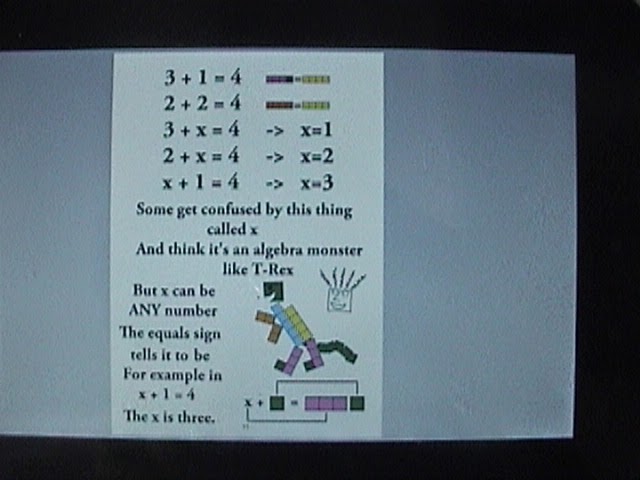
"This is back when I didn't know what anything was..." one of them remarked upon seeing this vid after not seeing it for a long time. Note how when they are young like this, how it looks is important in answering the question, "are they same?" This persists into adulthood and certainly into the teen years...2 + 1 = 3 does NOT look same because of the color of the blocks and on one side there is only one block and on the other two blocks...but in total number it is the same, and this is quickly understood. "The equals sign never lies" is an important math concept. Concept based math teaching with manipulatives speeds and eases the whole process. Very soon (a couple of years) and they are doing math like this.  Everybody is so impressed. They think it's EASY because it is.

Meantime many students have lost track of what the symbol equals even means and somehow come up with the "the answer is" instead of same as...this one understanding has, I have been told directly by older students, made a huge difference in algebra, pre-calc, and trig, and of course calculus. Anyone will tell you x + 5 = 8 doesn't look same, but that statement says it is...IF x = 3. I was also reminded of how much things get lost and confused working with a AP calculus student...because math gets so segmented and compartmentalized they fail to see relationships.

Here is the "whole thing" for those of you interested. This lesson is also on the sample lessons page (I think) along with many hours more video of sample lessons with base ten blocks. These are actual unrehearsed lessons not scripted demonstrations: practice not theory. If you want theory I have about 3 hours of it up now on the parent teacher training page...with more to come. There's some short free stuff there now for you to check out if you want to get a better idea of the theory behind the method. And there are posts like this to help you understand more about the method and posts like this to help you get started using base ten blocks.


So of course now doing algebra like this is no big deal and neither one of them is even 10 yet. I keep telling them as they get older it's less impressive which is why this is funny on a lot of levels. It's kind of an inside joke. You can see him looking at the picture and being very careful to get it right...he looks at the picture YOU see the symbols.


If you have older kids or students, base ten blocks make math visually obvious for them too, the blocks level the playing field because they speak to all learning styles. Whether male or female, visual, kinesthetic, or auditory learners, ALL benefit from the use of base ten blocks. And  younger really is better. So I made this to help get them started off right. Combine with this blog and website and your kids won't have to worry about common core mathematics, because they'll know math not just have some stuff memorized and jumping through the silly hoops on tests showing work or "number sense" won't be hard at all...all they may see the absurdity of it all.


base ten block book, base 10 blocks, preschool, kindergarten
I have a goofy little base ten block book I wrote that people have found useful for the younger crowd. If you have a copy please go leave a comment on this page. There was a spurt of comments when I first built the page but now they have trickled off. Add yours. Good, bad or indifferent.

"I have to tell you that when I first started to watch your videos I cried....after learning it myself in school (haha) then teaching my three daughters algebra using Saxon, Math U See and things from the Teaching Company, I never really had any idea of what I was doing. Watching the videos of you made everything make sense!!! I'm sure that this is a labor of love for you but I just wanted to say thank you! It is much appreciated." ~HS, Ohio, USA.

Having traveled the USA doing seminars I can tell you this was not an uncommon response when people finally understood a math concept and faced their math demons...usually revolving around algebra but sometimes with much simpler things like why invert and multiply--something most teachers have no idea how to explain and end up saying "just memorize it..."  Avoid the problems in the first place it's never too late to break the cycle, start off with my book if you have young children.

Here is what it looks like when you give a young kid a head start with base ten manipulatives. YOU can do this too.

Wednesday, August 27, 2014

Want Fries With That?

Once I was doing some demo teaching for an eighth grade class of whiners. They would often interrupt lessons on algebra and factoring with questions like, "when are we ever going to use this?" or "why do we have to learn this?"...etc. Even though they were easily getting it with their base ten blocks.

My answer is the same everytime, "if you are working in fast food, you are right you will never use it but if you are working in engineering or architecture or the sciences you will use algebra just about every day. So I tell you what. Let's practice something else. Repeat after me, 'Would you like fries with that?'"

Stunned silence. From the back of the class, "This guy's harsh."

Later that same year in that same class they gave me a standing ovation...

Learn to use your base ten blocks.

anonymous said:

I make $15 an hour doing work that actually requires my brain, if they raise the minimum wage and I'm quitting and finding a career flipping burgers lol

demonic-lionfish answered:

Working with your hands does not preclude working with your mind.

Take my job for example. You may call what I do “unskilled” or what a line cook does “just flipping burgers”, but that is because of a classist bias against blue collar work. I am a prep cook. Every day I utilize my knowledge of physics to successfully balance and carry multiple dishes and ingredients in my hands, as well as to lift objects that someone of my size should not be able to lift. I use my logical analysis skills to figure out which recipes need to be made first, and even then to further prioritize on a number of criteria, because it is paramount that certain items are ready before open and that all items are made as soon as possible. I use basic division and multiplication to determine ingredient amounts for recipes depending on how many times we need them made, which has been projected given the day and other criteria like weather that affect our guest volume. I will do this math across multiple measuring systems, converting up and down on two different scales depending on how a recipe is written. I use a knowledge cache of cooking techniques, which require studying and practice, to execute dishes to perfection and I must do it perfectly every time, or else it’s waste.

And the line? Try making 30 burgers at the same time. All of these have side dishes that guests pick from a list of five sides. All 30 entrees came to you at the same time. You’re on grill and hot sides, and you have a coworker on pantry and a coworker on hot box that fulfill other sides and entrees that don’t require the flat top, convection stove, or fryer. All of these have to go out around the same time, but you can only make two or three plates at a time tops. This is pretty complex time management man, especially when you factor in the fact that beef is ordered to different taste and you have to keep track of that too.


Judging by this question, you aren’t qualified to “flip burgers”.


Tuesday, August 26, 2014

Base Ten Blocks Make Algebra Child's Play


Base Ten Blocks Make Advanced Algebra Child's Play. For those of you wondering if the work I do with younger kids makes a difference when they are older...that picture was taken with some very young students (8 and 9 years) who at the time were learning much more about 8 + 8 and 8 x 8, and that 64 is square, than they were about algebra.

This post will eventually be on one of the password protected pages (Advanced Algebra) but you are getting these videos here for FREE. Eventually, this post will get buried on this blog and people will have a hard time finding it. As I have often said these posts get old but they don't get out dated...use the methods you find here on your students. They work.

And again if they work on little kids they will work on high school kids and college students too. The idea is to introduce CONCEPTS in stages and get comfortable with them THEN add more and a little more. It is good to start with something easy and familiar so they get the grasp of it..."it" being the concept or idea rather than deluge them with a huge amount of unfamiliar math all at once. This is what textbooks do. They put too much together at once and it becomes overwhelming and confusing.

Start with completing the square. I have lots of vids and pages devoted to that, making it easy and using it to teach children more than just algebra but also counting and dividing by two and addends and multiplication. But when the time comes they are quite familiar with completing the square and factoring. Being thus grounded, it's easy to add new concepts and more understanding. So lets begin with this:


This video is not listed so please don't share it unless you are sharing this whole post.

Being able to count by square numbers all the way to 25 is also a good skill to have...

Note that I start off with lessons on making squares and square numbers. Imagine that.
Being able to square numbers quickly and easily makes this vastly simpler for understanding because that part is out of the way as it were. So when we want to take half of the x and square it it's no problem (get it?) even if the amount of x is odd...as Forrest would say: "That's good, that's one less thing." [To worry about.]

Being able to square numbers that end in 5 is a good skill to have but rather than memorize some rule I show them where the rule comes from and math is less mysterious.

You may also note that using base ten blocks to make algebra easy has benefits where kids can see the relationship between squaring 35 and getting 1225, and taking half of 7 and squaring that and getting 12.25...a lot of older students just go, "OH! Well then that's easy..." Usually they hate any of the ones that have fractions in them...but that's easy too. I find fractions are almost universally a stumbling block.

After you've watched the first one up there lets go back and really get the concepts down.

So lets back up, keep it easy and start with something REALLY familiar and focus:


And then a little practice.


And a little more:


And now they look like the little geniuses they are and are ready to play with the quadratic:

This video is not listed so please don't share it unless you are sharing this whole post.

I spent another class where instead of dividing by "a" we multiply by "4a" to make it easier but that video is lost. You can see a stale presentation of it here though:


With the DBoyz I some questions and really got into why we complete the square with b²...

And now we are ready to start playing with ones that have more negatives...and instead of real roots imaginary ones and so on...what do you think? By the time they are in high school will this stuff be easy or hard for them?

And it all started with taking x² + 2x + 1, taking the x and putting them on the sides and putting the one in the corner...then moving on to 4x and 6x and 10x...with base 10 blocks they can see what they are doing get their hands on it and then when we move to mostly symbols it makes sense. 

This is one of they key differences we find with kids who learn math using base ten blocks they can see the relations ships and math isn't a confused segmented set of mysterious rules. And then completing the square and vertex form are much more easily understood and relate-able, the students see how it all goes together. I have found that using base ten blocks makes things like distance formula, Pythagorean theorem, and the first trig identity go together in the students heads too...instead of being completely separate things.

Using base ten blocks in a step by step approach can make math child's play for your students too. Manipulatives make math easy and fun, it's just counting. I've tried to give a detailed explanation via the videos here but if I left something out or you have further questions please comment below...

Tuesday, August 19, 2014

Crewton's Math Manipulative Manifesto


Math Manipulatives, base ten blocks, math blocks
Math Manipulatives

Here is an article I wrote about math manipulatives for my website directing people to this blog. Some of the points here will be covered in more detail in the next parent teacher training.


Math Manipulative Manifesto
"Learning is not the product of teaching. Learning is the product of the activity of learners." ~John Holt

This blog is dedicated almost exclusively to showing you how to use manipulativess with your children at your house whether you home-school or not, and also to get you to use them in your classroom if you are a teacher. Note the lack of advertising, adsense, annoying pop up vids etc. The only things I advertise here are blocks, books, and passwords to vids and info.

While meditating it hit me why there is such a disparity of viewpoint between me and most of my "fans" regarding curriculum and organization. Whereas I see it all as just counting, others think of it in subjects, grades or levels or what have you, because the way you were taught was very compartmentalized.

It's been ingrained in you that FIRST you have to learn how to count, next you add next you subtract then you multiply then you divide next you do fractions etc.

What I'm saying and what this method teaches using math manipulatives, is that ALL that is, is counting. All of it. You're just counting. Since we are just counting, we can use division to teach it or we can use fractions to teach counting like addition and multiplication or we can use algebra to teach counting...most people think that in order to do division the student has to have learned how to multiply and subtract...NO. (Look at me! Breaking the rules: you are supposed to remove the no from the lesson.)

Students don't need to have gone through basic operations (addition, subtraction, multiplication, division) before they can do algebra, in fact algebra will teach basic operations. Division is also just counting and we can use division to teach a lot of math concepts as well as how to add, subtract, and multiply and they learn to multiply and subtract while they are learning to count. It's the same with fractions...or algebra.


Ask what is it we are counting?
"Mathematics may be defined as the economy of counting. There is no problem in the whole of mathematics which cannot be solved by direct counting." ~Ernst Mach

All mathematical questions boil down to "what are we counting?" When teaching math you can use division to teach counting or addition to teach counting or algebra to teach counting...you can focus on whatever you like but it doesn't need to be structured such that addition comes first and then subtraction, in fact you will quickly see it's very hard to separate the two and trying to do so may actually be harmful to their understanding.


I have sat in awe in grade schools while lessons on multiplication were taught without any reference to area, or division, or in some cases any reference to repetitive addition...just learn 7 x 8 = 56...and to this day it is amusing that 99.99999999999% of people I meet are wholly unaware that that division "thing" we use is just shorthand for a rectangle. Or what the equals sign means. Or where that percent sign comes from. Or that square numbers are square...but I digress.


The Mathematics is a language and it all goes together and shouldn't be segmented or compartmentalized to the point that the student is unaware that multiplication and division are inverse functions, manipulatives make that visually obvious. They will be able to see and understand this naturally...and then it's easy to point out to them, this is part of "directed discovery" you know what you want them to learn but you let them discover it. You facilitate this by putting them in a math rich environment.


The point is that while we are teaching basic operations we are just counting but don't get confused: basic operations is computation and computation is how we do math but math is much more than just computation. (The fact that I have to write that statement is a clue to the complete failure that is the current state of math education.)


There isn't anything more fun than seeing your own students or children learn something and have fun at the same time, and in knowing you are the one responsible for it. This is why some teachers are addicted to teaching no matter how poor the pay is and no matter how lousy the conditions are.


Math is the language of logic and reasoning combined with critical thinking skills. I have met many students who are great at computation but very,very poor at math. (Some of them go on to get degrees and then, ironically, attempt to teach others the math they don't really understand.

If you put the child in a situation where they CAN NOT FAIL, expect and allow for error, allow for self correction with direction...direct their discovery in a math rich environment: they learn math. They can't help it. AS an added bonus they have fun learning with math manipulatives and/or base ten blocks.

Give the child an algorithm for addition (wanna be a ten) that can be applied to multiplication and suddenly almost effortlessly (much to the amazement of parents and even veteran teachers) the students are adding and multiplying...multiplication is the first milestone because it allows the child to count quickly, once computation is easy the math becomes easy too because computation is how we DO math but again, it's not the math itself.

With computation mastery, math concepts that are understood can be applied to problem solving and answers are fun and easy to see. The combination of computational mastery and conceptual mastery combined with visualization is very powerful. The playful, curious attitude that problems are just games or puzzles removes fear and tears, and learning is seemingly effortless because they are having fun doing it.


Avoid the problems in the first place.
"Intellectuals solve problems, geniuses prevent them." - Albert Einstein
 
There is no greater joy for a parent (or any teacher) than seeing the ah-ha moments and light bulbs go off...it is especially poignant if the child had formally been struggling with math, but I prefer to avoid the problems in the first place.


The question should be "what kind of counting do you want to do today?" Or what kind of counting do you want to teach today? If you are a teacher. 1st graders as an example can learn division and thereby learn a lot about counting, and multiplication and subtraction...as well as addition...they can learn about fractions and thereby learn about addition, multiplication and division as well as concepts like SAME...the way we currently teach it children somehow come to the conclusion that rules have changed when we add fractions. They haven't. We can teach them problem solving, which at first is just recognizing same and "hero zero" and then "no fun get back to one"...all of which is just simple COUNTING even if they are little.


Please click on this link for more on "hero zero" and "no fun get back to one" and removing no from the lesson the other teaching concepts referenced in this manifesto. (Rant. Diatribe).


I've done lessons for 2nd graders on square roots...in order to do square roots we had to count the squares and the sides...so we learned skip counting, used addition skills to count 7 sevens which was more work than counting 4 fours and figured out what the symbol means--just count one side. We also learned about economy of symbol instead of 4 + 4 + 4 + 4 = 16, or even 4 x 4 =16 we could just use 4² =16. I wasn't just teaching square numbers I was teaching lots of counting. NONE of it would be possible without the use of base ten blocks. People are amazed that I go on to do lessons on Pythagorean theorem but they don't understand the part about it's easy when they can see it. I wouldn't even attempt to teach them any of this without math manipulatives.


Further students often never understand the relationship between Pythagorean theorem, distance formula and the first basic trig identity sin² +cos² = 1, it's just a bunch of stuff they memorize long enough to be tested on and then forget--never having made any of the  leaps of understanding or connections. My students avoid this because they've been playing with these concepts for years and baby step their way there instead of it being all new and confusing in all at once in high school.


Shift your paradigm.

What I have to do is get YOU to change YOUR paradigm and understand the way you were taught via compartmentalized, separate subjects, grades and levels might (just maybe, quite possibly) NOT be the best way to teach math, and is part of the reason the teaching of mathematics in general in the USA is an utterly abysmal failure. Most of you recognize that it is an utterly abysmal failure which is why you are here in the first place then the first thing you ask me is, "couldn't you teach and organize your blog and website more like the way we know doesn't work and is an utterly abysmal failure?"


Base Ten Block Battle


Playing with base ten blocks. You can't help but make learning fun. Again building stuff over and over again because they want to shoot it down is more fun than worksheets. It is important to use two hands for optimum whole brain sensory input. When the student uses both hands more learning takes place easier, it's that simple.
Using base ten blocks to get addends mastered make learning math almost effortless. First they learn their addends which helps them add two numbers which is basic addition; which helps them add series of numbers which helps them learn to multiply which makes math easy because it allows the student to count quickly.  Math is a whole lot easier when you can multiply because it allows you to divide and discover patterns and a whole lot more. Problem solving and fractions are much more difficult  when the student can't do simple computation. Addends are the basic building block. Gets the kids off their fingers, makes addition a snap...also builds confidence. He built walls of 10 on down to 5 and made a little fort.
I think you can guess what comes next. Knocking them down is the most fun...why not use a nerf gun? We're just playing and having fun while we learn math. Kids will often build walls or set up addends over and over again so they can shoot them down...I wish I had video. That gun couldn't hit the broad side of a barn. LOL!
Okay, fort destroyed, clean up and on to some algebra where we played what completes the square...
Here he is putting 25 in the corner, to complete x² + 10x + ___, he had started from x² + 2x + __, then x² + 4x + __, x² + 6x + __, x² + 8x + __. Again the algebra is along for the ride, he is getting lessons in addends, square numbers and dividing by two...not memorizing formulas involving b/2a...when the time comes though those formulas will make sense...

***

Now onto his brother. Again we start with addends he got a lot more done faster using the tray.  The other way is "cooler" but usually takes longer. If you are playing at home time is not an issue but when you are paying 50 bucks an hour it can be. The one thing I will say about building the tower is that he gets more practice because the walls fall down and have to be rebuilt as you go...it took him a while to build the second story without knocking down the first story...each of those wall was built and repaired more than once. In the tray he does it once and moves on...
Except when he takes the tens out fo no apparent reason and had to put them back in again. AGAIN note the use of both hands because I made him do it...and reminded him verbally more than once...

He was quite proud of the finished product because it looks cool. Kids also find out that building walls out of addends are cooler to shoot at than walls all built out of the same block over and over again...
Then we factored some quadratics started small and worked our way up. First one we did was x² + 5x + 6. Here he is doing x² + 8x + 15. But what he is really doing is learning an addend for 8 and figuring out that 3 x 5 = 15. Also that 15 can be 5 threes or 3 fives...also some division concepts and as an added bonus factoring a quadratic. He is learning counting skills...just happen to be using algebra to teach them, could just as easily be using fractions. I use algebra because it is known to be HARD in kid culture so it builds confidence and self esteem in students like these who are having problems learning math at school
Now I made him get out two tens and a four and measure it with various blocks...he already tried nines...didn't come out evenly...24 is two nines and some more, three nines is too much...eights fit perfectly and he can see 3 eights is the same as 24...but with sevens 3 isn't enough and 4 is too many...and he counted out 7 x 3 = 21 and 7 x 4 =28...he wasn't wrong to get out sevens he was just getting more information and learning as he went. Soon he had eights, and sixes and fours and threes...and calculated that it would take 12 twos...quite a bit of math from just building a wall of 24...
And now he gets some base ten block battle action too. Here he is setting up 12's. Gets the addends for twelve and counts by twelves...note the use of two hands.
And then shoots the twelves.  But never did hit one with that gun. Got a nerf pistol out and made quite a few hits. Kids will usually make more targets and shoot them down over and over again which requires building them over and over again. Tom Sawyer taught me well. SO much more fun than doing a work sheet adding little numbers together. Plus you get fine motor skills AND a whole brain activity instead of just using the dominant writing hand. Here is an article that provides a clue.

"Mathematics may be defined as the economy of counting. There is no problem in the whole of mathematics which cannot be solved by direct counting." ~Ernst Mach

Find us on FB.

Tuesday, August 5, 2014

Base 10 Block Book for Preschoolers & Kindergarteners.

There aren't a whole lot of base ten block books like this out there. This one is designed for young kids. The idea is you read it to them at bedtime just like any other story book. If you have children that are a little older, 2nd or 3rd grade they could read it to themselves. If you have children older than that check out this blog and website for lots of instruction using base ten blocks to make math EZ! If little kids can do it your highschool kids can too.

Now you can get this content packed base ten block e-book: Crewton Ramones Completely Cool Curious Counters' Kindergarten Compendium for just $19.99. No need to buy a password (if you already have a password this book comes with, just go HERE and click on the picture or the big red "here.") If you don't, get this book and start learning math NOW.

No need to buy a password,  now you can get the book all by itself, I'll send you the file direct to your inbox. Until now this base ten book was only available if you bought a password. now you can get this book by itself.  Put it on your laptop, tablet, or reader or print it out.
As you can see it shows your younger children some crucial math concepts using base 10 blocks to make it easy. It helps you help them master their addition facts, introduces square roots, place value, multiplication and more. Give your child a head start in mathematics. This book makes understanding math concepts fast and easy. Mathematics is the gateway to scholarships, the sciences, and higher paying jobs. Get them started off right.
Read your children this book the way you would any other children's book except with this book they will learn math because base ten blocks make it visually obvious. For ages 9 and under but especially aimed at children ages 3 to 5. That's right PRESCHOOL, (even though it says kindergarten). They can see the math...take a look for yourself...and at this age you can read it to them over and over again. 
Just like any language they aren't going to learn it all the first time you read it to them. They aren't going understand it all the first time but after a very few short weeks the concepts in this book will be understood because it's simply written, it almost rhymes, and it's full of pictures of base ten blocks, the same way any picture book for toddlers is.
Plenty of brightly colored fun pictures explain basic math concepts, that will put your kid well ahead of their peers when they get to kindergarten or preschool. Kids that can do even just a little math at an early age are considered SMART or advanced or even geniuses whether they are or not...but one thing people have noticed over the years is that if you treat kids like they are smart they will act like they are smart. If you put kids in a class known to be advanced they will usually live up to the expectations...the opposite is also true. Put then a class in SPED or the "F Troop" they will often live up (or down) to the lowered expectations.

I have been in plenty of second grade classrooms where many of the students don't know their addends for ten without thinking about it or using their fingers. Some of these kids have to think about it when asked what does five need to be ten?! Base ten blocks help get them off their fingers and into math.

Or how many left if you take three out of nine...? This book will ensure your kid isn't one of them. Basics like this can handicap your children for life. That's no exaggeration. At the other end of the spectrum getting them off on the right foot can give them advantages for the rest of their lives...
So yeah, it's kind of important. And it has been my experience that even if they hit third grade and they don't know their addends teachers don't usually take these kids aside and give them the extra help and time they need to master them. A downward spiral often ensues as these children never learn to add single digit numbers easily, then adding them over and over again (multiplication) becomes difficult and then they try to circumvent this with memorization of multiplication tables via worksheet and flash cards. Then long division is HARD and hated, fractions are poorly understood and mathematics in general becomes PAIN. Sound familiar? Statistically more of you had a poor experience with math than a good one which is usually part of the reason you found your way here.
The homeschool market is growing by leaps and bounds and many of those parents HATE MATH, but are smart enough to understand they need break the cycle...but don't really know how. Plenty of homeschool moms know they suck at math and are concerned they won't be able to teach their children math because they can't do math...well I'm here to show how you can both learn math together. This book is a good start. Lots of teachers are also using this book to help them introduce math to their young students.


This book

Makes math fast, fun and EZ.
Concept based.
Builds a firm foundation in addition facts.
Shows them how to add numbers with ease.
Gives a leg up on Addition/Addends
Introduces Square Roots
Problem Solving
Place Value
Multiplication


base ten block book, headstart with manipulatives, preschool, kindergarten
Here are some responses from parents. If you already have your copy please put some comments in the comments box either for facebook or here on blogger below. 

“My kids love this book.”
“Added to our bedtime stories, now they ask for it!”
“I like it because it makes math easy for them to understand because they can see it.”
“We started out counting and before you know it he was doing some pretty impressive math for a 5 year old.”

More pics and stuff:

Crewton Ramone's Completely Cool Curious Counters' Kindergarten Compendium at the house of math. If you click this link you'll need a password to get it...remember the book is included with a password this page was built for those who just want the book. 


Crewton Ramone's Completely Cool Curious Counters' Kindergarten Compendium here on blogger. Again this page will direct you to a password protected page. If you just want the book order below. Please allow up to 12 hours for delivery...I will email you the actual pdf.  The email you use for paypal is the email I will use unless otherwise specified. No messing with pop ups or download buttons unless you want to. [Haven't built the pop up page yet so...] But you will have to check your email...if you want to me to send it to an email other than the one you used for paypal put in the box.


PDF Prices


Here is a short explanation of the options. Remember if you have a Life Time Pass, the book is INCLUDED, this page was built by request for those that just want the book and only the book...but of course I added extra options to the button just in case you decided to do a little math and figure out getting the book by itself might not be the best option.  Also by now there are people who have gotten an annual password two or more times...and every time they get a new one there's even more stuff than the last time...and their kids are still little. Probably should have gotten a lifetime pass. This button will change soon because the $15.00 price for the PT training is limited to the first 50 paid.

...OF COURSE WITH THE LIFETIME PASS YOU GET BOTH PASSWORDS.


Learn to use your base ten blocks.


Thursday, July 31, 2014

Base Ten Blocks For Fractions Success


Base ten blocks make fractions much easier to understand. The Fractions page on my website is in serious need of an over haul. Eventually I will get to it. Meantime there Are posts like this.

Here we packed more into the hour (but not too much more from the stand point of CONCEPTS), going over the same concepts using fractions tiles and multi-tens, and drawing them with symbols and practicing problems adding up to less than one. Also did a couple subtraction problems. Then ended with a few that were one and some more...next lesson will contain more symbols less blocks and more on improper fractions. All of this and all we learned was adding and subtracting fractions. Multiplication and division of fractions will come another da, and they are just as easy to present and understand using manipulatives.

Please read this from the POV of how you would present it to your students or kids, and note the common stumbling blocks to be avoided. Base ten blocks and manipulatives allow you to avoid the misconceptions in the first place. Starting with the most common misconception, that some how the rules have changed when we get to fractions. They haven't: we can only combine same kind with addition or subtraction.

I have this one kid I would really like to video tape but I don't want to embarrass him, because he consistently shows a basic lack of understanding of CONCEPTS. This is because he has never been exposed to them.

Asked him to add 1/2 +1/3

His answer 1/5. "Because if the tops are the same you just leave them alone and add the bottoms...or is it the other way around?"

fractions tiles, fractions pieces


When I showed it was 5/6 using manipulatives there was a lot of "ohh!" and "OK" and "I get it" so we went over the 5 basic concepts focusing on they have to be SAME before we can add them...and because he is still lacking in multiplication skills, I used fractions manipulatives to help him practice multiplication (and addition).  We could skip count this by 3's or by 4's...put the next over lay on and then we will be counting 5's...etc...you don't have to know your multiplication tables in order to do fractions. Use the fractions to help learn multiplication.


base ten blocks for fractions, fractions tiles, multi-tens, top tray

I also asked him during the course of adding fractions which was bigger 1/4 or 1/3...of course he said 1/4.

fractions tiles, base ten blocks fractions,
Visually Obvious.

Then before I showed him any of the fractions tiles and asked how many to make a whole one if I have 1/3...he said 3 and how many to make a whole one if I have 4ths?...4 so four is more than three. TRUE. But the more pieces you need the smaller each piece is...puzzled look. But as soon as I get the factions pieces out one look and it's VISUALLY OBVIOUS that 1/4 is the smaller one. "OH!" This child is a teenager.

fractions tiles, adding fractions, visual fraction representation
Not stupid, just never been exposed to math concepts and manipulatives just rules, formula and stuff to memorize long enough to take a test and forget. He is a Classic American Math Student. Had he never met me he could probably have a bright career in climate "science."

We talked about 1/5 and 1/5...how many? 2/5. EASY because they are same. Once we make them the same kind we can add them. x + x is easy because they are same kind...you get 2x. One of something plus another one of the same thing gives you two of something.  Easy.  But if they aren't same kind we better make them same kind so we can add them. Then we talked about the numerator and the denominator. He had forgotten the name of "the bottom one"...de nom, de name, da kind of it...but he did remember the numerator which tells you how numerous the kind is...

"What kind of math is this?"

"Adding and subtracting fractions. About fourth grade level in most public schools..."

"But for your kids it's like first grade."

"Right."

We did several more problems until he got the hang of it using manipulatives...THEN I moved to drawings...and we stopped there. Tonight his sub-conscious gets a chance to put some things together and then we will work on going from blocks to drawings to symbols. Because he is a teenager I can go much more rapidly than if he were 6 or 7.

Then we talked about improper fractions and did about three of those just to give him a taste, ending with...5/6 + 4/9...could you think of a common denominator?
base ten blocks for fractions, fractions pictures
Symbols, Drawings and Blocks

"NO."

So he plays with his sliders on his multi-tens blocks and gets the answer. But still couldn't convert it to 1 and 5/18ths on his own...that's a concept for another day for now one and some more is good enough. Like remembering numbers if you try to remember too many at a time some of them are going to get lost so just a few concepts at a time is best.

Right now the concept of SAME and doing the multiplication is enough. Next I'll add more to that...which will further cement the foundational concepts of making them same before we add them. The rules didn't change we have to understand equivalent fractions and common denominators. With young kids first we play with the tiles then we play with the multi-tens, having multiple lessons in both. With this student he got it all in one lesson because he has more experience and is older and can handle it...if he was 5 we would have done less. Just the one concept of making them same and then practicing adding them using tiles; then maybe some drawing and then some symbols. That might take THREE HOURS. Then on a different day a lesson with multi tens...again another hour or two. Five or six separate classes, spaced out over time. 

Using "sliders" is the fun way to do it. Over all kids like using sliders more. If you don't have multi-tens don't worry you can just use base ten blocks out of your combo kit and get them out a pair at a time,  kids like this too and it's especially good for the hands on experience, it takes longer though which isn't a problem if you are homeschooling. Just for fun I uploaded this to blogger so it's a video you won't find anywhere else.


Can you also see how easy it is to talk about equivalent fractions and learn skip counting while we do?

For those with dyslexic students not that the image is reversed because I used my lap top's camera for all of these pics, but I am able to "flip' the photos but not the video. And it doesn't matter...base ten blocks level the playing field.

Want some Fractions Worksheets made for base ten blocks?

Percentages usually come next after fraction. Showing how to do percentages with base ten blocks is EZ.

BTW if you want to learn how to use the blocks to teach your kids I have SEVEN Hours up so far, but you need a special PT password. Go here for Parent Teacher Training. $15 bucks such a deal....


“A man is like a fraction whose numerator is what he is and whose denominator is what he thinks of himself. The larger the denominator, the smaller the fraction.” ~Leo Tolstoy