Here you will see students as young as 4 and 5 years old doing algebra and "advanced" math, without ever knowing it's supposed to be hard.
You are invited to learn how to use this method...


Showing posts with label Polynomial Division. Show all posts

Wednesday, July 6, 2016

Vid From The Vaults

A year later at Sweet 16, but now Sweet 16 is about to turn 21.

This is a fun video covering some basic concepts in geometry. Basically, I demystify distance formula for a giggly girl.  Pythagorean theorem.  I always looked forward to fooling around with math with her because we always ended up laughing our butts off.  (See second video.) And this usually led to sloppy notation on my part. The point is she was understanding the fundamental concepts. There is a point in the video where I write out distance formula and fail to put the 2's in for the squares...very annoying looking back but she fully understood they were squares. Other than that, I hope you see how teaching her the fundamental concept of a² + b² = c² improved her understanding dramatically and therefore her grade.

Then she could see that a was equal to the difference of x's and b was equal to the difference of y's.

a = (x₂ - x₁)  b = (y₂ - y₁)

Look at how many less symbols I need to say it mathematically.

Then we have to square them and then square root them AFTER we add them together.

                                                       _______________
(x₂ - x₁)² + (y₂ - y₁)²  = D²  so  D = √(x₂ - x₁)² + (y₂ - y₁)²         which if you think about it a little is just

a² + b² = c²

a little "gussied up" as my grandma would say.   Anyhow there should be 2's there...but as I said the lesson was understood.


Anyhow I dug this out of the archives. The first video hasn't been seen by anyone but me. The second one as I type this has about 50 hits.


We always just laughed and laughed and laughed. Before me, math made her cry. It was those tears that made her dad break down and call me.


These are typical high school math lessons right out of the textbook. I claim exemption from copyright under the education purposes only clause. This blog is free to view and so is the video. Besides these types of questions and horrid explanations certainly are not unique to this text book manufacturer. Often I barely have time to develop concepts because the book covers so much in just a few pages. And people say I skip around. What a joke.

Take a look at the topics covered in that first video...the way they are presented the kids can't figure out it's all basically the same concept...just variation of applying algebra and Pythagorean theorem to get the job done whether it was distance or mid-points.  Learn how to use base ten blocks.

Thursday, August 9, 2012

More Manipulative Division.

Manipulatives make division easy and even fun. Here is the page at the House of Math on Division. Here are a couple of videos covering division mostly for parents and teachers. The first is much longer and the second is much shorter.

division with base ten blocks, divison with manipulatives, long division

You don't have to teach division last you can teach it first if you want AND you can use it to teach subtraction and multiplication. Conventional wisdom is you have to know how to multiply and subtract to learn the algorithm for division.

Face it. Kids hate long division. They hate it for a lot of reasons. They haven't mastered multiplication; they don't like subtraction because counting backwards can pose challenges they aren't sure where to start counting. Manipulatives and the concept based base ten block methodology erase all of that. Mortensen Math rocks.


As you can see this is edited a little, the whole thing is available HERE. Only about 5 or 6 minutes is missing, the part covering negative polynomial division.

Here is a follow up video:


Between these to videos, the division page at the hous of math and this blogpost

http://crewtonramoneshouseofmath.blogspot.com/2012/06/long-division-with-base-ten-blocks.html


you should be very comfortable presenting division concepts to your young students.

Practice with easy problems that have no remainders FIRST. Get comfortable. SPEND THE TIME, and do a lot of problems. THEN start doing problems with remainders and bigger problems and problems that are hard to model with manipulatives. All the while DO NOT leave out the part where they draw pictures. When we get to the problems that are hard to use blocks to model we can draw pictures and finally we can move to the the symbols ONLY. And the student knows what they are doing and why and although division may never be their favorite thing, it won't be confusing or hard either.

Now we are serious when we say that you can start with smiley face division books if you like because the baby step approach allows you to teach counting as you go. Here a couple of shots from the beginning of the smiley face series.

Keep in mind these books are made for PRE-SCHOOLERS. It should be obvious that older students can benefit from these books too. I suggest that they start at the beginning  and "breeze through" until it begin to hit their level rather than skip the first books altogether. Here is book one:

modeling division, simple division, division pictures
Here is the end of book one. When you are 4 this is a lot of counting! I have seen people fool around with little 2 and three year olds where the child sits in their lap and just points to the right answer. Also because the price has gone up so far using a sheet protector and wet erase marker to get more milage out them is advised. They are no longer priced as consumables although they were originally intended to be.
division concepts, beginer division, division drawings
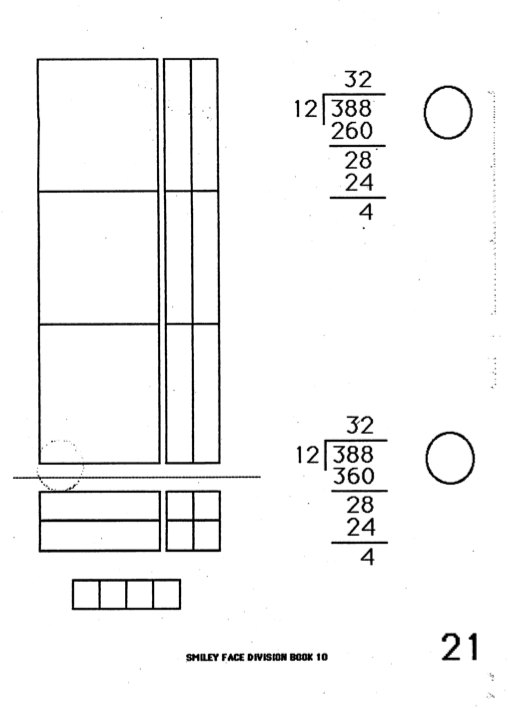
He is a scan showing book 5. Expanded notation helps with understanding and is used as an intermediate step. I have a personal problem with the placement of the quotients and this was supposed to get fixed but we never got around to it. When Crewton Ramone comes out with a similar series it will be available in pdf form and some of these oversights and compromises will be fixed. It also had to do with the tech of the day 20 years ago but this is no longer an issue.
long divison, expanded notation division
Remember bigger is funner. Also remember to let them make up a bunch of their own problems that are NOT in the books. As the parent or teacher you should make up some problems too. Practice.
long division, expanded notation, long division with base ten blocks
Each booklet is 20 pages long and designed to be non-threatening. So you can see I am showing you page one and then the end of the books. This is the end of book 10. I have seen 5 years olds complete these books. Kindergarten math at a public school is pretty much a snap after that. Tee hee.  If you can not afford the books just do lots of problems using the blocks and have them keep track of the problems they did in a journal. YOU may have to do a lot of the drawing and symbols for them because the whole point of these books is that they can learn math without the fine motor skills required to work a pencil.
long division with base ten blocks


More 1st grade math worksheets.

Here is a page about (the smiley face) books at the house of math:

http://www.crewtonramoneshouseofmath.com/Mortensen-Math-Books.html


Hat tip to Elizabeth Stevens for doing all the scans.


Divinely Dandy Non Difficult Division


 Get Divinely Dandy Non Difficult Division for just $19.99.  This book will show you everything you learned here and MORE laid out step by step with links to videos and pages that give simple concise explanations for how to use the rectangle to organize thought,  how to introduce division concepts at a very young age, and how to make fun while you are doing it.  I guarantee that video alone will expand your thinking when it comes to division and math.

Watch the video on the Preview and Purchase page that gives you a page by page over view of the PDF so you can "try before you buy", see exactly what you are getting and be confident it will be money well spent. 


Wednesday, October 27, 2010

Base Ten Blocks for Algebraic Factoring & Division

factoring polynomials, base ten blocks, manipulatives, algebra

Here are a couple of videos showing how to factor and divide positive trinomial expressions.

The first video shows how to factor bigger expressions.

Starting with (3x)(2x) = 6x2

And then moving through these:

2x2 + 13x + 15

3x2 + 14x + 15

3x2 + 15x + 12

3x2 + 11x + 10

6x2 + 7x + 1

6x2 + 8x + 2

6x2 + 12x + 6

Note that the idea or concept is to get used to using the constant and the coefficient of x2 to figure out how to factor the problem. Most lessons from video tutors and how to vdeos on TeacherTube and YouTube tell the students to guess at it or just try all the factor combinations. If they get familiar with these problems they can begin to work out their own algorithms and rules for how to factor the bigger ones, because there is a method to it beyond just trying sets of factors.

And here we see how multiplication and addends are SO important and need to be mastered in order make algebra easy. Which is why you see me stress the 45 addends and multiplication over and over again with the younger students. For the older students who are often having a hard time, going back to the basics of multiplication and addends makes huge improvements in algebra FAST.

The second video shows how to take factoring problems and turn them into division problems. Soon you will be able to get an eCourse that shows you step by step how to do it. Right now if you want to see how to do negative expressions using the blocks you'll need a password to get into this page.

Once you get familiar with these you'll see that the following set of problems are related and are actually pairs of problems.

x2 + 7x + 12.......... x2 - x - 12

x2 + 9x + 18.......... x2 + 3x - 18

x2 + 10x + 24.......... x2 + 2x - 24

These are out of sequence as it were because we did a load of (negative) problems before we got to these:

2x2 + 8x + 6 I forgot to mention it in the video screencast but you might want to take a moment and turn this into a division problem too...you know the factors. See if you can.

This expression cannot be factored which is why we have the quadratic equation:

2x2 - 3x - 27 but this one can

2x2 + 3x - 27 BTW they told me this I didn't tell them how to make it "factorable."

And again this one cannot be factored 2x2 + x - 8 but

2x2 + x - 10 can.

And this one is SUPER EASY

3x2 - 15x + 12

in fact you see it in all positive form in the first video. If you want to see it done with the blocks and a even a drawing you will need a password as I mentioned earlier. If you go there right now you will find an hour's worth of videos you can't get anywhere else. I'll be adding even more video and things like pdfs and links to further explanations but there should be plenty there to keep you occupied there NOW. The hour's worth of video is worth a buck.


Check out the Parents/Teachers Tab it now has MUCH more stuff including links to websites that offer lots of USEFUL FREE stuff, like lesson plans, grant information, discounted school supplies and more. I also took the trouble to get you discount codes for 10% to 20% more off...cuz I'm cool like that.

PDF files are also coming, more products from Mortensen Math more free video and more pasword protected pages...and like I said eCourses are coming too...


Divinely Dandy Non Difficult Division


 Get Divinely Dandy Non Difficult Division for just $19.99.  This book will show you everything you learned here and MORE laid out step by step with links to videos and pages that give simple concise explanations for how to use the rectangle to organize thought,  how to introduce division concepts at a very young age, and how to make fun while you are doing it.  I guarantee that video alone will expand your thinking when it comes to division and math.

Watch the video on the Preview and Purchase page that gives you a page by page over view of the PDF so you can "try before you buy", see exactly what you are getting and be confident it will be money well spent.


http://www.facebook.com/Crewton.Ramone


http://www.crewtonramoneshouseofmath.com

Base Ten Blocks for Algebraic Factoring & Division

Here are a couple of videos showing how to factor and divide positive trinomial expressions.

The first video shows how to factor bigger expressions.

Starting with (3x)(2x) = 6x2

And then moving through these:

2x2 + 13x + 15

3x2 + 14x + 15

3x2 + 15x + 12

3x2 + 11x + 10

6x2 + 7x + 1

6x2 + 8x + 2

6x2 + 12x + 6

Note that the idea or concept is to get used to using the constant and the coefficient of x2 to figure out how to factor the problem. Most lessons from video tutors and how to vdeos on TeacherTube and YouTube tell the students to guess at it or just try all the factor combinations. If they get familiar with these problems they can begin to work out their own algorithms and rules for how to factor the bigger ones, because there is a method to it beyond just trying sets of factors.

And here we see how multiplication and addends are SO important and need to be mastered in order make algebra easy. Which is why you see me stress the 45 addends and multiplication over and over again with the younger students. For the older students who are often having a hard time, going back to the basics of multiplication and addends makes huge improvements in algebra FAST.

The second video shows how to take factoring problems and turn them into division problems. Soon you will be able to get an eCourse that shows you step by step how to do it. Right now if you want to see how to do negative expressions using the blocks you'll need a password to get into this page.

Once you get familiar with these you'll see that the following set of problems are related and are actually pairs of problems.

x2 + 7x + 12.......... x2 - x - 12

x2 + 9x + 18.......... x2 + 3x - 18

x2 + 10x + 24.......... x2 + 2x - 24

These are out of sequence as it were because we did a load of (negative) problems before we got to these:

2x2 + 8x + 6 I forgot to mention it in the video screencast but you might want to take a moment and turn this into a division problem too...you know the factors. See if you can.

This expression cannot be factored which is why we have the quadratic equation:

2x2 - 3x - 27 but this one can

2x2 + 3x - 27 BTW they told me this I didn't tell them how to make it "factorable."

And again this one cannot be factored 2x2 + x - 8 but

2x2 + x - 10 can.

And this one is SUPER EASY

3x2 - 15x + 12

in fact you see it in all positive form in the first video. If you want to see it done with the blocks and a even a drawing you will need a password as I mentioned earlier. If you go there right now you will find an hour's worth of videos you can't get anywhere else. I'll be adding even more video and things like pdfs and links to further explanations but there should be plenty there to keep you occupied there NOW. The hour's worth of video is worth a buck.


Check out the Parents/Teachers Tab it now has MUCH more stuff including links to websites that offer lots of USEFUL FREE stuff, like lesson plans, grant information, discounted school supplies and more. I also took the trouble to get you discount codes for 10% to 20% more off...cuz I'm cool like that.

PDF files are also coming, more products from Mortensen Math more free video and more pasword protected pages...and like I said eCourses are coming too...


Divinely Dandy Non Difficult Division


 Get Divinely Dandy Non Difficult Division for just $19.99.  This book will show you everything you learned here and MORE laid out step by step with links to videos and pages that give simple concise explanations for how to use the rectangle to organize thought,  how to introduce division concepts at a very young age, and how to make fun while you are doing it.  I guarantee that video alone will expand your thinking when it comes to division and math.

Watch the video on the Preview and Purchase page that gives you a page by page over view of the PDF so you can "try before you buy", see exactly what you are getting and be confident it will be money well spent. 


http://www.facebook.com/Crewton.Ramone


http://www.crewtonramoneshouseofmath.com

Wednesday, August 19, 2009

90 Min Flies By...


I know I'm doing it right when there isn't any time for me...

Last few sessions I have had, have flown by in an instant. Have a little seven year old doing problems like 12 x 13, 13 x 15 etc...and having fun doing it...because bigger is funner.

Had a couple young girls doing math and having some fun...we did algebra...than backed up to addends...how is it possible we have created a system where a 14 year old girl doesn't know for sure what 6 needs to be ten? It boggles my mind, and the worst part is the system will start blaming HER.

In the picture above we were doing a compound teaching lesson where I showed her 15 x 13 and (x+5)(x+3)...just introducing them to the patterns and later when we evaluate these expressions for various values of x it will be easy. Then we went from multiplication to division it took a second for them to realize we were doing the same problems...


In my defense I wrote those upside down. After this we backed up and built addends for 10 and 9...they had a little race and I could see they have some sisterly competitiveness...which I can gently exploit to get more done in less time. I started the lesson with the 5 concepts then a quick lesson on rounding for their little sister who was not present, they assured me she had it wired. Then we moved onto a quick lesson on where these symbols (greater than and less than) come from

< >

No more confusion or memory devices. They know what the symbols mean. One more time and it should be "in there" [minds] and easily re-callable.

Then came some two digit by two digit multiplication, mostly as a confidence builder and then the algebra and then addends...and then 90 minutes had gone by. To me it felt like 5 minutes max....so I was shocked when their mother said an hour had gone by and pleaded for more time.

Also if you go here you can see the testimonials are trickling in. There seems to be a common theme: FUN.